

436
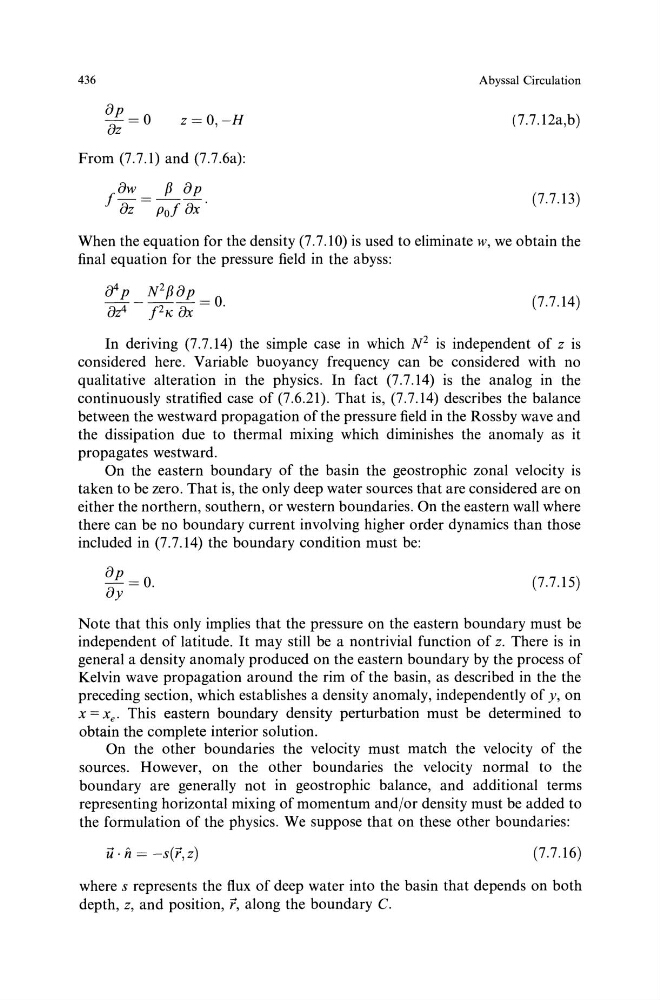
8p =0
az
z=O,-H
From (7.7.1) and (7.7.6a):
1 aw = __!!_ ap.
8z Pof 8x
Abyssal Circulation
(7.7.12a,b)
(7.7.13)
When the equation for the density (7.7.10) is used to eliminate w, we obtain the
final equation for the pressure field in the abyss:
(7. 7.14)
In deriving (7.7.14) the simple case in which N 2 is independent of z is
considered here. Variable buoyancy frequency can be considered with no
qualitative alteration in the physics. In fact (7. 7.14) is the analog in the
continuously stratified case of (7.6.21). That is, (7.7.14) describes the balance
between the westward propagation of the pressure field in the Ross by wave and
the dissipation due to thermal mixing which diminishes the anomaly as it
propagates westward.
On the eastern boundary of the basin the geostrophic zonal velocity is
taken to be zero. That is, the only deep water sources that are considered are on
either the northern, southern, or western boundaries. On the eastern wall where
there can be no boundary current involving higher order dynamics than those
included in (7.7.14) the boundary condition must be:
8p =0
8y
.
(7.7.15)
Note that this only implies that the pressure on the eastern boundary must be
independent of latitude. It may still be a nontrivial function of z. There is in
general a density anomaly produced on the eastern boundary by the process of
Kelvin wave propagation around the rim of the basin, as described in the the
preceding section, which establishes a density anomaly, independently of y, on
x = xe. This eastern boundary density perturbation must be determined to
obtain the complete interior solution.
On the other boundaries the velocity must match the velocity of the
sources. However, on the other boundaries the velocity normal to the
boundary are generally not in geostrophic balance, and additional terms
representing horizontal mixing of momentum and/or density must be added to
the formulation of the physics. We suppose that on these other boundaries:
-
A
( -
)
u·n = -s r,z
(7.7.16)
where s represents the flux of deep water into the basin that depends on both
depth, z, and position, r, along the boundary c.
8p =0
az
z=O,-H
From (7.7.1) and (7.7.6a):
1 aw = __!!_ ap.
8z Pof 8x
Abyssal Circulation
(7.7.12a,b)
(7.7.13)
When the equation for the density (7.7.10) is used to eliminate w, we obtain the
final equation for the pressure field in the abyss:
(7. 7.14)
In deriving (7.7.14) the simple case in which N 2 is independent of z is
considered here. Variable buoyancy frequency can be considered with no
qualitative alteration in the physics. In fact (7. 7.14) is the analog in the
continuously stratified case of (7.6.21). That is, (7.7.14) describes the balance
between the westward propagation of the pressure field in the Ross by wave and
the dissipation due to thermal mixing which diminishes the anomaly as it
propagates westward.
On the eastern boundary of the basin the geostrophic zonal velocity is
taken to be zero. That is, the only deep water sources that are considered are on
either the northern, southern, or western boundaries. On the eastern wall where
there can be no boundary current involving higher order dynamics than those
included in (7.7.14) the boundary condition must be:
8p =0
8y
.
(7.7.15)
Note that this only implies that the pressure on the eastern boundary must be
independent of latitude. It may still be a nontrivial function of z. There is in
general a density anomaly produced on the eastern boundary by the process of
Kelvin wave propagation around the rim of the basin, as described in the the
preceding section, which establishes a density anomaly, independently of y, on
x = xe. This eastern boundary density perturbation must be determined to
obtain the complete interior solution.
On the other boundaries the velocity must match the velocity of the
sources. However, on the other boundaries the velocity normal to the
boundary are generally not in geostrophic balance, and additional terms
representing horizontal mixing of momentum and/or density must be added to
the formulation of the physics. We suppose that on these other boundaries:
-
A
( -
)
u·n = -s r,z
(7.7.16)
where s represents the flux of deep water into the basin that depends on both
depth, z, and position, r, along the boundary c.