

396
Abyssal Circulation
ignored, and, again, Stommel and Arons were clear that they expected the
pronounced bottom topography of the abyssal ocean basins to cause
"deviations" from the simple theory which they presented. In spite of these
reservations the theory still exists today as the fundamental building block of
our understanding of the motion of the deep water.
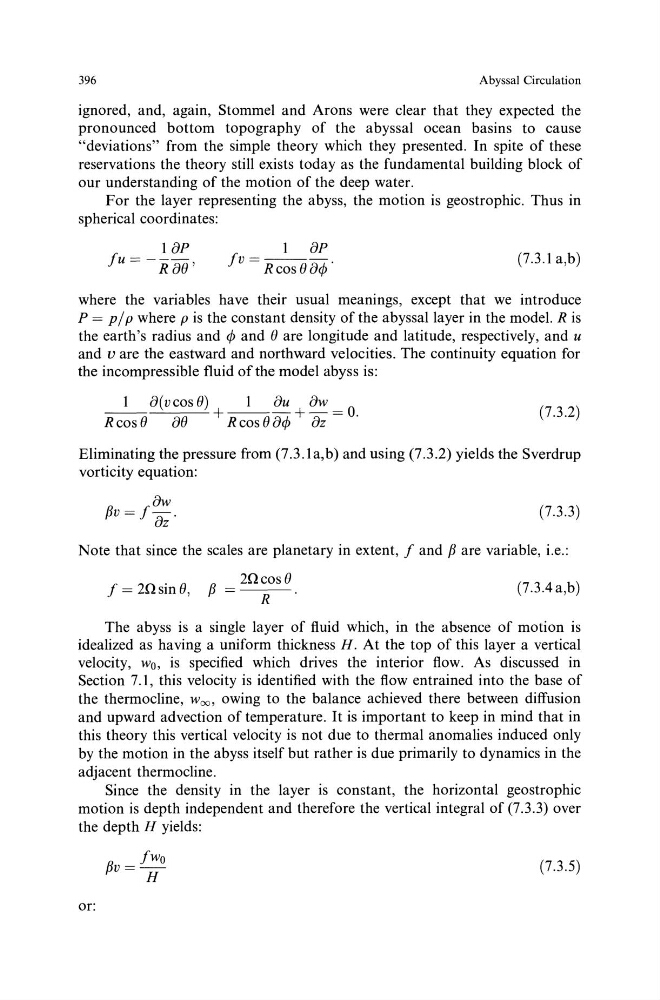
For the layer representing the abyss, the motion is geostrophic. Thus in
spherical coordinates:
1 8P
f v = R cos (} 8 (7.3.1 a,b)
where the variables have their usual meanings, except that we introduce
P = pj p where pis the constant density of the abyssal layer in the model. R is
the earth's radius and and v are the eastward and northward velocities. The continuity equation for
the incompressible fluid of the model abyss is:
8(vcos0) +-1_8u + 8w = O.
R cos (}
8(}
R cos (} 8 (7.3.2)
Eliminating the pressure from (7.3.1a,b) and using (7.3.2) yields the Sverdrup
vorticity equation:
(7.3.3)
Note that since the scales are planetary in extent, f and f3 are variable, i.e.:
f = 2Qsin0, f3 = 2Q cos (} .
R
(7.3.4a,b)
The abyss is a single layer of fluid which, in the absence of motion is
idealized as having a uniform thickness H. At the top of this layer a vertical
velocity, w0, is specified which drives the interior flow. As discussed in
Section 7.1, this velocity is identified with the flow entrained into the base of
the thermocline, w00 , owing to the balance achieved there between diffusion
and upward advection of temperature. It is important to keep in mind that in
this theory this vertical velocity is not due to thermal anomalies induced only
by the motion in the abyss itself but rather is due primarily to dynamics in the
adjacent thermocline.
Since the density in the layer is constant, the horizontal geostrophic
motion is depth independent and therefore the vertical integral of (7.3.3) over
the depth H yields:
or:
f3v = fwo
H
(7.3.5)
Abyssal Circulation
ignored, and, again, Stommel and Arons were clear that they expected the
pronounced bottom topography of the abyssal ocean basins to cause
"deviations" from the simple theory which they presented. In spite of these
reservations the theory still exists today as the fundamental building block of
our understanding of the motion of the deep water.
For the layer representing the abyss, the motion is geostrophic. Thus in
spherical coordinates:
1 8P
f v = R cos (} 8 (7.3.1 a,b)
where the variables have their usual meanings, except that we introduce
P = pj p where pis the constant density of the abyssal layer in the model. R is
the earth's radius and and v are the eastward and northward velocities. The continuity equation for
the incompressible fluid of the model abyss is:
8(vcos0) +-1_8u + 8w = O.
R cos (}
8(}
R cos (} 8 (7.3.2)
Eliminating the pressure from (7.3.1a,b) and using (7.3.2) yields the Sverdrup
vorticity equation:
(7.3.3)
Note that since the scales are planetary in extent, f and f3 are variable, i.e.:
f = 2Qsin0, f3 = 2Q cos (} .
R
(7.3.4a,b)
The abyss is a single layer of fluid which, in the absence of motion is
idealized as having a uniform thickness H. At the top of this layer a vertical
velocity, w0, is specified which drives the interior flow. As discussed in
Section 7.1, this velocity is identified with the flow entrained into the base of
the thermocline, w00 , owing to the balance achieved there between diffusion
and upward advection of temperature. It is important to keep in mind that in
this theory this vertical velocity is not due to thermal anomalies induced only
by the motion in the abyss itself but rather is due primarily to dynamics in the
adjacent thermocline.
Since the density in the layer is constant, the horizontal geostrophic
motion is depth independent and therefore the vertical integral of (7.3.3) over
the depth H yields:
or:
f3v = fwo
H
(7.3.5)