

394
Abyssal Circulation
apex, is turned southward towards the outer rim to complete the circuit of
recirculation. The mass flux of the western boundary current is therefore only
an indirect measure of the source strength. While proportional to S, it depends
on the parameter (2gDo/0.2r'5). In the Stommel, Arons and Faller experiment
this parameter was order one and so the boundary-current transport is
therefore about double the source strength.
If instead, the source of fluid enters at the rim as shown in Fig. 7.2.3b,
So = 0 and St = S. The interior flow is not altered at all, of course. However,
now the western boundary current flows southward, towards the source, with a
strength:
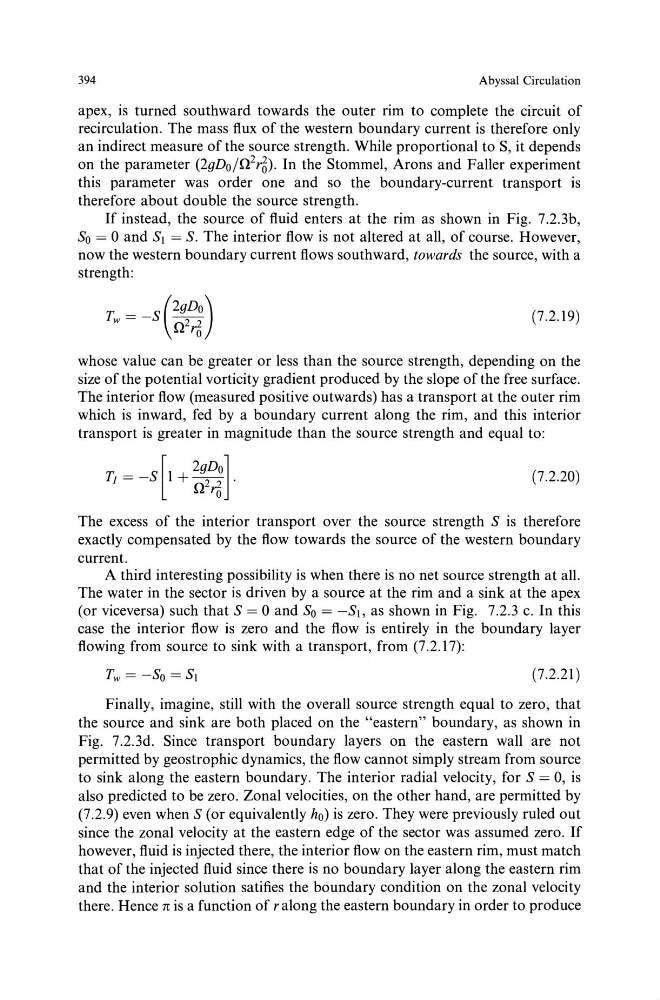
1: = -S (2gDo)
w
g2~
0
(7.2.19)
whose value can be greater or less than the source strength, depending on the
size of the potential vorticity gradient produced by the slope of the free surface.
The interior flow (measured positive outwards) has a transport at the outer rim
which is inward, fed by a boundary current along the rim, and this interior
transport is greater in magnitude than the source strength and equal to:
(7.2.20)
The excess of the interior transport over the source strength S is therefore
exactly compensated by the flow towards the source of the western boundary
current.
A third interesting possibility is when there is no net source strength at all.
The water in the sector is driven by a source at the rim and a sink at the apex
(or viceversa) such that S = 0 and So = -St, as shown in Fig. 7.2.3 c. In this
case the interior flow is zero and the flow is entirely in the boundary layer
flowing from source to sink with a transport, from (7.2.17):
(7.2.21)
Finally, imagine, still with the overall source strength equal to zero, that
the source and sink are both placed on the "eastern" boundary, as shown in
Fig. 7.2.3d. Since transport boundary layers on the eastern wall are not
permitted by geostrophic dynamics, the flow cannot simply stream from source
to sink along the eastern boundary. The interior radial velocity, for S = 0, is
also predicted to be zero. Zonal velocities, on the other hand, are permitted by
(7.2.9) even when S (or equivalently h0) is zero. They were previously ruled out
since the zonal velocity at the eastern edge of the sector was assumed zero. If
however, fluid is injected there, the interior flow on the eastern rim, must match
that of the injected fluid since there is no boundary layer along the eastern rim
and the interior solution satifies the boundary condition on the zonal velocity
there. Hence n is a function of r along the eastern boundary in order to produce
Abyssal Circulation
apex, is turned southward towards the outer rim to complete the circuit of
recirculation. The mass flux of the western boundary current is therefore only
an indirect measure of the source strength. While proportional to S, it depends
on the parameter (2gDo/0.2r'5). In the Stommel, Arons and Faller experiment
this parameter was order one and so the boundary-current transport is
therefore about double the source strength.
If instead, the source of fluid enters at the rim as shown in Fig. 7.2.3b,
So = 0 and St = S. The interior flow is not altered at all, of course. However,
now the western boundary current flows southward, towards the source, with a
strength:
1: = -S (2gDo)
w
g2~
0
(7.2.19)
whose value can be greater or less than the source strength, depending on the
size of the potential vorticity gradient produced by the slope of the free surface.
The interior flow (measured positive outwards) has a transport at the outer rim
which is inward, fed by a boundary current along the rim, and this interior
transport is greater in magnitude than the source strength and equal to:
(7.2.20)
The excess of the interior transport over the source strength S is therefore
exactly compensated by the flow towards the source of the western boundary
current.
A third interesting possibility is when there is no net source strength at all.
The water in the sector is driven by a source at the rim and a sink at the apex
(or viceversa) such that S = 0 and So = -St, as shown in Fig. 7.2.3 c. In this
case the interior flow is zero and the flow is entirely in the boundary layer
flowing from source to sink with a transport, from (7.2.17):
(7.2.21)
Finally, imagine, still with the overall source strength equal to zero, that
the source and sink are both placed on the "eastern" boundary, as shown in
Fig. 7.2.3d. Since transport boundary layers on the eastern wall are not
permitted by geostrophic dynamics, the flow cannot simply stream from source
to sink along the eastern boundary. The interior radial velocity, for S = 0, is
also predicted to be zero. Zonal velocities, on the other hand, are permitted by
(7.2.9) even when S (or equivalently h0) is zero. They were previously ruled out
since the zonal velocity at the eastern edge of the sector was assumed zero. If
however, fluid is injected there, the interior flow on the eastern rim, must match
that of the injected fluid since there is no boundary layer along the eastern rim
and the interior solution satifies the boundary condition on the zonal velocity
there. Hence n is a function of r along the eastern boundary in order to produce