

Introduction
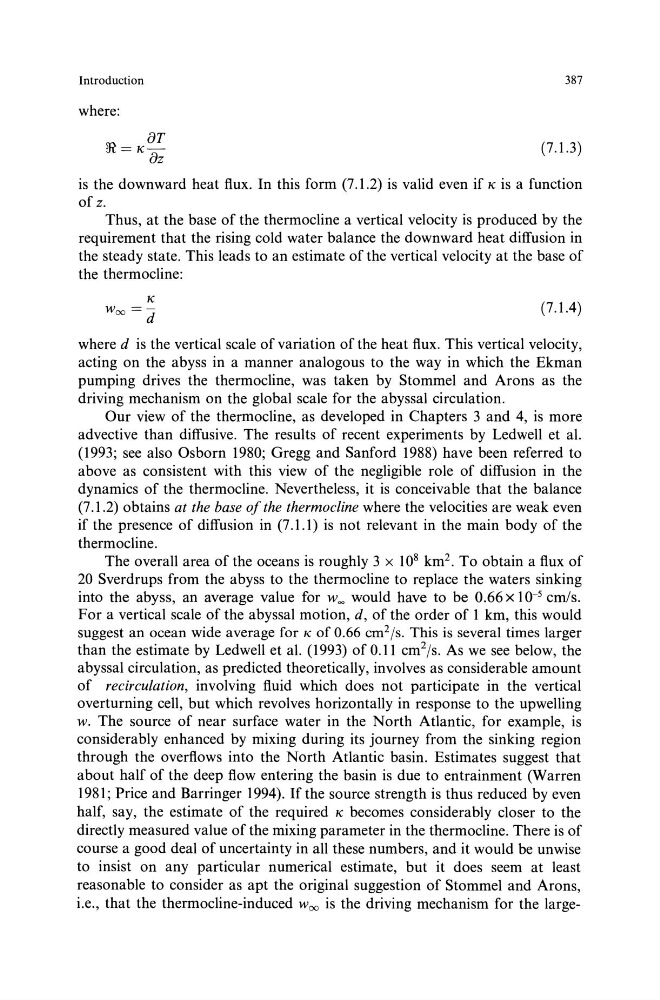
where:
lR = K8T
8z
387
(7.1.3)
is the downward heat flux. In this form (7 .1.2) is valid even if K is a function
ofz.
Thus, at the base of the thermocline a vertical velocity is produced by the
requirement that the rising cold water balance the downward heat diffusion in
the steady state. This leads to an estimate of the vertical velocity at the base of
the thermocline:
K
Woo=d
(7.1.4)
where d is the vertical scale of variation of the heat flux. This vertical velocity,
acting on the abyss in a manner analogous to the way in which the Ekman
pumping drives the thermocline, was taken by Stommel and Arons as the
driving mechanism on the global scale for the abyssal circulation.
Our view of the thermocline, as developed in Chapters 3 and 4, is more
advective than diffusive. The results of recent experiments by Ledwell et al.
(1993; see also Osborn 1980; Gregg and Sanford 1988) have been referred to
above as consistent with this view of the negligible role of diffusion in the
dynamics of the thermocline. Nevertheless, it is conceivable that the balance
(7 .1.2) obtains at the base of the thermocline where the velocities are weak even
if the presence of diffusion in (7 .1.1) is not relevant in the main body of the
thermocline.
The overall area of the oceans is roughly 3 x 10 8 km 2 . To obtain a flux of
20 Sverdrups from the abyss to the thermocline to replace the waters sinking
into the abyss, an average value for w~ would have to be 0.66 x 10-s cm/s.
For a vertical scale of the abyssal motion, d, of the order of 1 km, this would
suggest an ocean wide average for K of 0.66 cm 2 fs. This is several times larger
than the estimate by Ledwell et al. (1993) of 0.11 cm 2 /s. As we see below, the
abyssal circulation, as predicted theoretically, involves as considerable amount
of recirculation, involving fluid which does not participate in the vertical
overturning cell, but which revolves horizontally in response to the upwelling
w. The source of near surface water in the North Atlantic, for example, is
considerably enhanced by mixing during its journey from the sinking region
through the overflows into the North Atlantic basin. Estimates suggest that
about half of the deep flow entering the basin is due to entrainment (Warren
1981; Price and Barringer 1994). If the source strength is thus reduced by even
half, say, the estimate of the required K becomes considerably closer to the
directly measured value of the mixing parameter in the thermocline. There is of
course a good deal of uncertainty in all these numbers, and it would be unwise
to insist on any particular numerical estimate, but it does seem at least
reasonable to consider as apt the original suggestion of Stommel and Arons,
i.e., that the thermocline-induced W 00 is the driving mechanism for the large-
where:
lR = K8T
8z
387
(7.1.3)
is the downward heat flux. In this form (7 .1.2) is valid even if K is a function
ofz.
Thus, at the base of the thermocline a vertical velocity is produced by the
requirement that the rising cold water balance the downward heat diffusion in
the steady state. This leads to an estimate of the vertical velocity at the base of
the thermocline:
K
Woo=d
(7.1.4)
where d is the vertical scale of variation of the heat flux. This vertical velocity,
acting on the abyss in a manner analogous to the way in which the Ekman
pumping drives the thermocline, was taken by Stommel and Arons as the
driving mechanism on the global scale for the abyssal circulation.
Our view of the thermocline, as developed in Chapters 3 and 4, is more
advective than diffusive. The results of recent experiments by Ledwell et al.
(1993; see also Osborn 1980; Gregg and Sanford 1988) have been referred to
above as consistent with this view of the negligible role of diffusion in the
dynamics of the thermocline. Nevertheless, it is conceivable that the balance
(7 .1.2) obtains at the base of the thermocline where the velocities are weak even
if the presence of diffusion in (7 .1.1) is not relevant in the main body of the
thermocline.
The overall area of the oceans is roughly 3 x 10 8 km 2 . To obtain a flux of
20 Sverdrups from the abyss to the thermocline to replace the waters sinking
into the abyss, an average value for w~ would have to be 0.66 x 10-s cm/s.
For a vertical scale of the abyssal motion, d, of the order of 1 km, this would
suggest an ocean wide average for K of 0.66 cm 2 fs. This is several times larger
than the estimate by Ledwell et al. (1993) of 0.11 cm 2 /s. As we see below, the
abyssal circulation, as predicted theoretically, involves as considerable amount
of recirculation, involving fluid which does not participate in the vertical
overturning cell, but which revolves horizontally in response to the upwelling
w. The source of near surface water in the North Atlantic, for example, is
considerably enhanced by mixing during its journey from the sinking region
through the overflows into the North Atlantic basin. Estimates suggest that
about half of the deep flow entering the basin is due to entrainment (Warren
1981; Price and Barringer 1994). If the source strength is thus reduced by even
half, say, the estimate of the required K becomes considerably closer to the
directly measured value of the mixing parameter in the thermocline. There is of
course a good deal of uncertainty in all these numbers, and it would be unwise
to insist on any particular numerical estimate, but it does seem at least
reasonable to consider as apt the original suggestion of Stommel and Arons,
i.e., that the thermocline-induced W 00 is the driving mechanism for the large-