

Introduction
385
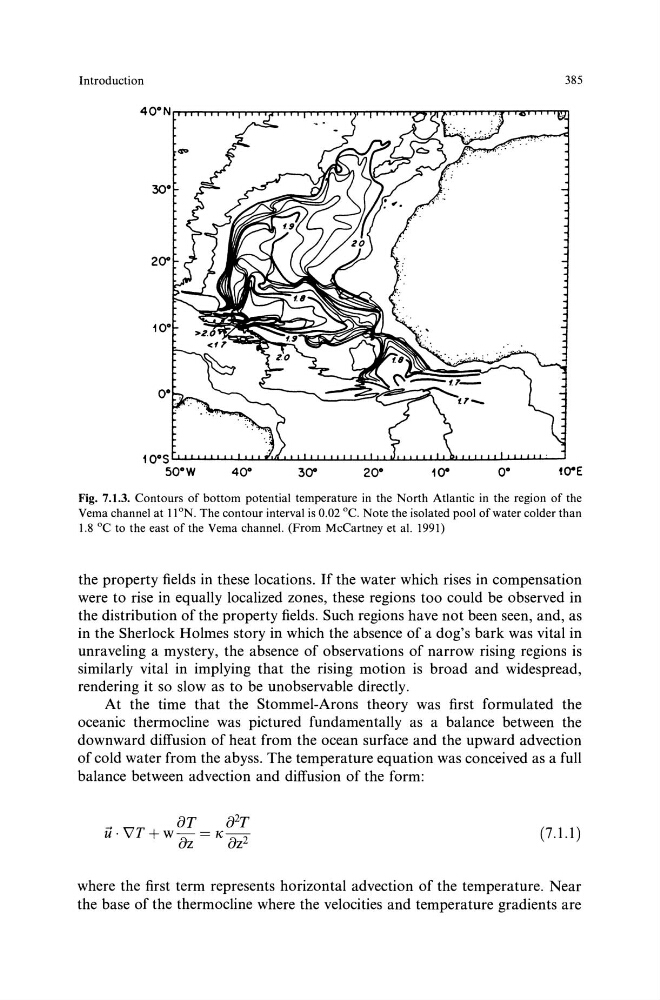
Fig. 7.1.3. Contours of bottom potential temperature in the North Atlantic in the region of the
Vema channel at l1°N. The contour interval is 0.02 °C. Note the isolated pool of water colder than
1.8 °C to the east of the Vema channel. (From McCartney eta!. 1991)
the property fields in these locations. If the water which rises in compensation
were to rise in equally localized zones, these regions too could be observed in
the distribution of the property fields. Such regions have not been seen, and, as
in the Sherlock Holmes story in which the absence of a dog's bark was vital in
unraveling a mystery, the absence of observations of narrow rising regions is
similarly vital in implying that the rising motion is broad and widespread,
rendering it so slow as to be unobservable directly.
At the time that the Stommel-Arons theory was first formulated the
oceanic thermocline was pictured fundamentally as a balance between the
downward diffusion of heat from the ocean surface and the upward advection
of cold water from the abyss. The temperature equation was conceived as a full
balance between advection and diffusion of the form:
_
8T
&T
U· \!T+w-= K -
8z
8z 2
(7.1.1)
where the first term represents horizontal advection of the temperature. Near
the base of the thermocline where the velocities and temperature gradients are
385
Fig. 7.1.3. Contours of bottom potential temperature in the North Atlantic in the region of the
Vema channel at l1°N. The contour interval is 0.02 °C. Note the isolated pool of water colder than
1.8 °C to the east of the Vema channel. (From McCartney eta!. 1991)
the property fields in these locations. If the water which rises in compensation
were to rise in equally localized zones, these regions too could be observed in
the distribution of the property fields. Such regions have not been seen, and, as
in the Sherlock Holmes story in which the absence of a dog's bark was vital in
unraveling a mystery, the absence of observations of narrow rising regions is
similarly vital in implying that the rising motion is broad and widespread,
rendering it so slow as to be unobservable directly.
At the time that the Stommel-Arons theory was first formulated the
oceanic thermocline was pictured fundamentally as a balance between the
downward diffusion of heat from the ocean surface and the upward advection
of cold water from the abyss. The temperature equation was conceived as a full
balance between advection and diffusion of the form:
_
8T
&T
U· \!T+w-= K -
8z
8z 2
(7.1.1)
where the first term represents horizontal advection of the temperature. Near
the base of the thermocline where the velocities and temperature gradients are