

370
Equatorial Dynamics of the Thermocline: The Equatorial Undercurrent
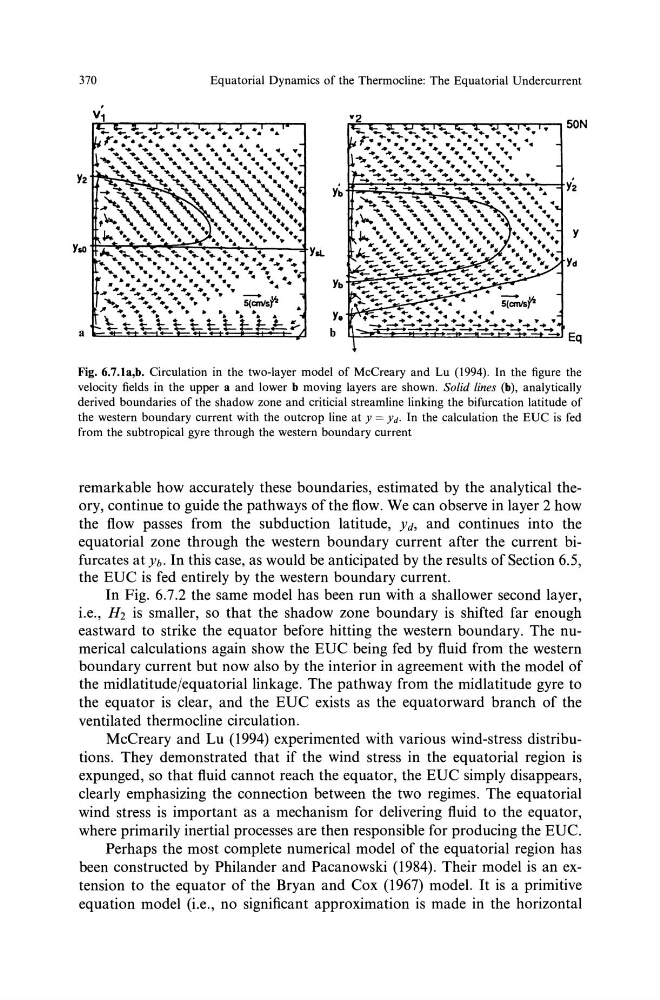
Fig. 6.7.1a,b. Circulation in the two-layer model of McCreary and Lu (1994). In the figure the
velocity fields in the upper a and lower b moving layers are shown. Solid lines (b), analytically
derived boundaries of the shadow zone and criticial streamline linking the bifurcation latitude of
the western boundary current with the outcrop line at y = Yd· In the calculation the EUC is fed
from the subtropical gyre through the western boundary current
remarkable how accurately these boundaries, estimated by the analytical theory, continue to guide the pathways of the flow. We can observe in layer 2 how
the flow passes from the subduction latitude, Yd. and continues into the
equatorial zone through the western boundary current after the current bifurcates at Yb· In this case, as would be anticipated by the results of Section 6.5,
the EUC is fed entirely by the western boundary current.
In Fig. 6.7.2 the same model has been run with a shallower second layer,
i.e., H2 is smaller, so that the shadow zone boundary is shifted far enough
eastward to strike the equator before hitting the western boundary. The numerical calculations again show the EUC being fed by fluid from the western
boundary current but now also by the interior in agreement with the model of
the midlatitudefequatorial linkage. The pathway from the midlatitude gyre to
the equator is clear, and the EUC exists as the equatorward branch of the
ventilated thermocline circulation.
McCreary and Lu (1994) experimented with various wind-stress distributions. They demonstrated that if the wind stress in the equatorial region is
expunged, so that fluid cannot reach the equator, the EUC simply disappears,
clearly emphasizing the connection between the two regimes. The equatorial
wind stress is important as a mechanism for delivering fluid to the equator,
where primarily inertial processes are then responsible for producing the EUC.
Perhaps the most complete numerical model of the equatorial region has
been constructed by Philander and Pacanowski (1984). Their model is an extension to the equator of the Bryan and Cox (1967) model. It is a primitive
equation model (i.e., no significant approximation is made in the horizontal
Equatorial Dynamics of the Thermocline: The Equatorial Undercurrent
Fig. 6.7.1a,b. Circulation in the two-layer model of McCreary and Lu (1994). In the figure the
velocity fields in the upper a and lower b moving layers are shown. Solid lines (b), analytically
derived boundaries of the shadow zone and criticial streamline linking the bifurcation latitude of
the western boundary current with the outcrop line at y = Yd· In the calculation the EUC is fed
from the subtropical gyre through the western boundary current
remarkable how accurately these boundaries, estimated by the analytical theory, continue to guide the pathways of the flow. We can observe in layer 2 how
the flow passes from the subduction latitude, Yd. and continues into the
equatorial zone through the western boundary current after the current bifurcates at Yb· In this case, as would be anticipated by the results of Section 6.5,
the EUC is fed entirely by the western boundary current.
In Fig. 6.7.2 the same model has been run with a shallower second layer,
i.e., H2 is smaller, so that the shadow zone boundary is shifted far enough
eastward to strike the equator before hitting the western boundary. The numerical calculations again show the EUC being fed by fluid from the western
boundary current but now also by the interior in agreement with the model of
the midlatitudefequatorial linkage. The pathway from the midlatitude gyre to
the equator is clear, and the EUC exists as the equatorward branch of the
ventilated thermocline circulation.
McCreary and Lu (1994) experimented with various wind-stress distributions. They demonstrated that if the wind stress in the equatorial region is
expunged, so that fluid cannot reach the equator, the EUC simply disappears,
clearly emphasizing the connection between the two regimes. The equatorial
wind stress is important as a mechanism for delivering fluid to the equator,
where primarily inertial processes are then responsible for producing the EUC.
Perhaps the most complete numerical model of the equatorial region has
been constructed by Philander and Pacanowski (1984). Their model is an extension to the equator of the Bryan and Cox (1967) model. It is a primitive
equation model (i.e., no significant approximation is made in the horizontal