

Effect of Entrainment
363
1.0
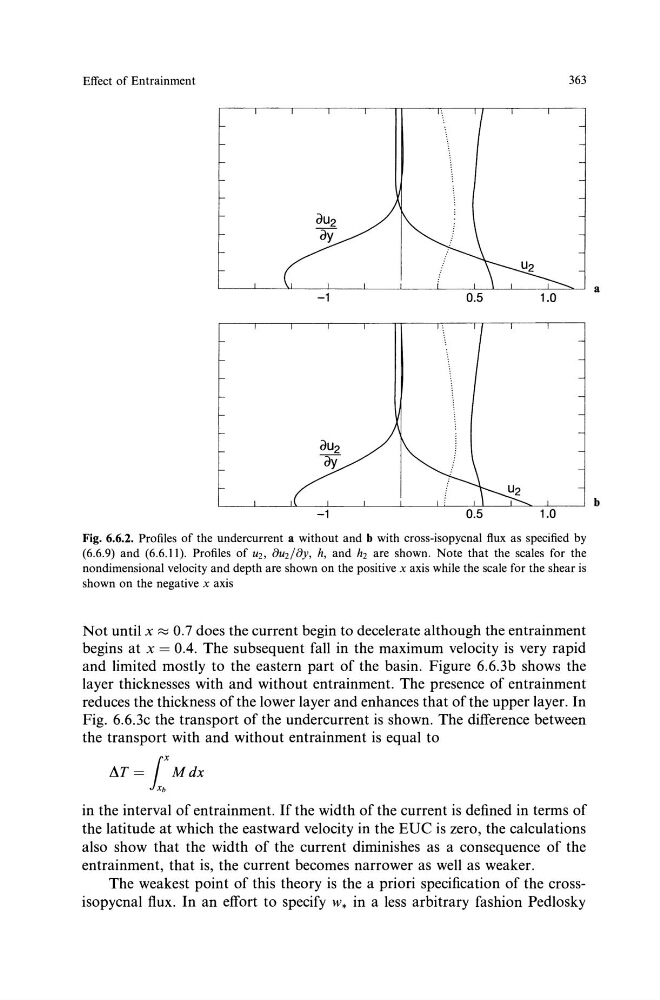
Fig. 6.6.2. Profiles of the undercurrent a without and b with cross-isopycnal flux as specified by
(6.6.9) and (6.6.11). Profiles of u2, 8u2/8y, h, and h2 are shown. Note that the scales for the
nondimensional velocity and depth are shown on the positive x axis while the scale for the shear is
shown on the negative x axis
Not until x ~ 0. 7 does the current begin to decelerate although the entrainment
begins at x = 0.4. The subsequent fall in the maximum velocity is very rapid
and limited mostly to the eastern part of the basin. Figure 6.6.3b shows the
layer thicknesses with and without entrainment. The presence of entrainment
reduces the thickness of the lower layer and enhances that of the upper layer. In
Fig. 6.6.3c the transport of the undercurrent is shown. The difference between
the transport with and without entrainment is equal to
AT= 1x Mdx
Xb
in the interval of entrainment. If the width of the current is defined in terms of
the latitude at which the eastward velocity in the EUC is zero, the calculations
also show that the width of the current diminishes as a consequence of the
entrainment, that is, the current becomes narrower as well as weaker.
The weakest point of this theory is the a priori specification of the crossisopycnal flux. In an effort to specify w. in a less arbitrary fashion Pedlosky
a
b
363
1.0
Fig. 6.6.2. Profiles of the undercurrent a without and b with cross-isopycnal flux as specified by
(6.6.9) and (6.6.11). Profiles of u2, 8u2/8y, h, and h2 are shown. Note that the scales for the
nondimensional velocity and depth are shown on the positive x axis while the scale for the shear is
shown on the negative x axis
Not until x ~ 0. 7 does the current begin to decelerate although the entrainment
begins at x = 0.4. The subsequent fall in the maximum velocity is very rapid
and limited mostly to the eastern part of the basin. Figure 6.6.3b shows the
layer thicknesses with and without entrainment. The presence of entrainment
reduces the thickness of the lower layer and enhances that of the upper layer. In
Fig. 6.6.3c the transport of the undercurrent is shown. The difference between
the transport with and without entrainment is equal to
AT= 1x Mdx
Xb
in the interval of entrainment. If the width of the current is defined in terms of
the latitude at which the eastward velocity in the EUC is zero, the calculations
also show that the width of the current diminishes as a consequence of the
entrainment, that is, the current becomes narrower as well as weaker.
The weakest point of this theory is the a priori specification of the crossisopycnal flux. In an effort to specify w. in a less arbitrary fashion Pedlosky
a
b