

358
Equatorial Dynamics of the Thermocline: The Equatorial Undercurrent
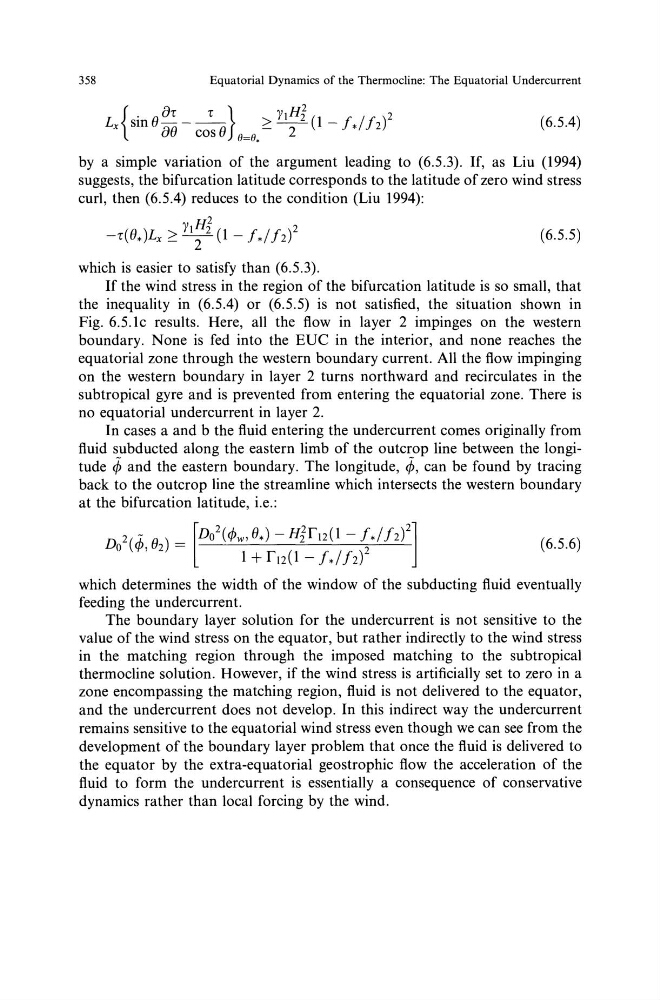
{
0
87:
7: }
YtHi (
I 2
Lx smO-- - -
2::-- 1- f. h)
8() cos () IJ=IJ.
2
(6.5.4)
by a simple variation of the argument leading to (6.5.3). If, as Liu (1994)
suggests, the bifurcation latitude corresponds to the latitude of zero wind stress
curl, then (6.5.4) reduces to the condition (Liu 1994):
-7:(0.)Lx 2:: Yt~I (1- /.//2) 2
(6.5.5)
which is easier to satisfy than (6.5.3).
If the wind stress in the region of the bifurcation latitude is so small, that
the inequality in (6.5.4) or (6.5.5) is not satisfied, the situation shown in
Fig. 6.5.lc results. Here, all the flow in layer 2 impinges on the western
boundary. None is fed into the EUC in the interior, and none reaches the
equatorial zone through the western boundary current. All the flow impinging
on the western boundary in layer 2 turns northward and recirculates in the
subtropical gyre and is prevented from entering the equatorial zone. There is
no equatorial undercurrent in layer 2.
In cases a and b the fluid entering the undercurrent comes originally from
fluid subducted along the eastern limb of the outcrop line between the longitude (fi and the eastern boundary. The longitude, ¢,can be found by tracing
back to the outcrop line the streamline which intersects the western boundary
at the bifurcation latitude, i.e.:
Do2(;fi,e 2 ) = [Do 2 (¢w,O.) -Hi_rl2(1- ~·lhf]
1 + rn(l -f./ h)
(6.5.6)
which determines the width of the window of the subducting fluid eventually
feeding the undercurrent.
The boundary layer solution for the undercurrent is not sensitive to the
value of the wind stress on the equator, but rather indirectly to the wind stress
in the matching region through the imposed matching to the subtropical
thermocline solution. However, if the wind stress is artificially set to zero in a
zone encompassing the matching region, fluid is not delivered to the equator,
and the undercurrent does not develop. In this indirect way the undercurrent
remains sensitive to the equatorial wind stress even though we can see from the
development of the boundary layer problem that once the fluid is delivered to
the equator by the extra-equatorial geostrophic flow the acceleration of the
fluid to form the undercurrent is essentially a consequence of conservative
dynamics rather than local forcing by the wind.
Equatorial Dynamics of the Thermocline: The Equatorial Undercurrent
{
0
87:
7: }
YtHi (
I 2
Lx smO-- - -
2::-- 1- f. h)
8() cos () IJ=IJ.
2
(6.5.4)
by a simple variation of the argument leading to (6.5.3). If, as Liu (1994)
suggests, the bifurcation latitude corresponds to the latitude of zero wind stress
curl, then (6.5.4) reduces to the condition (Liu 1994):
-7:(0.)Lx 2:: Yt~I (1- /.//2) 2
(6.5.5)
which is easier to satisfy than (6.5.3).
If the wind stress in the region of the bifurcation latitude is so small, that
the inequality in (6.5.4) or (6.5.5) is not satisfied, the situation shown in
Fig. 6.5.lc results. Here, all the flow in layer 2 impinges on the western
boundary. None is fed into the EUC in the interior, and none reaches the
equatorial zone through the western boundary current. All the flow impinging
on the western boundary in layer 2 turns northward and recirculates in the
subtropical gyre and is prevented from entering the equatorial zone. There is
no equatorial undercurrent in layer 2.
In cases a and b the fluid entering the undercurrent comes originally from
fluid subducted along the eastern limb of the outcrop line between the longitude (fi and the eastern boundary. The longitude, ¢,can be found by tracing
back to the outcrop line the streamline which intersects the western boundary
at the bifurcation latitude, i.e.:
Do2(;fi,e 2 ) = [Do 2 (¢w,O.) -Hi_rl2(1- ~·lhf]
1 + rn(l -f./ h)
(6.5.6)
which determines the width of the window of the subducting fluid eventually
feeding the undercurrent.
The boundary layer solution for the undercurrent is not sensitive to the
value of the wind stress on the equator, but rather indirectly to the wind stress
in the matching region through the imposed matching to the subtropical
thermocline solution. However, if the wind stress is artificially set to zero in a
zone encompassing the matching region, fluid is not delivered to the equator,
and the undercurrent does not develop. In this indirect way the undercurrent
remains sensitive to the equatorial wind stress even though we can see from the
development of the boundary layer problem that once the fluid is delivered to
the equator by the extra-equatorial geostrophic flow the acceleration of the
fluid to form the undercurrent is essentially a consequence of conservative
dynamics rather than local forcing by the wind.