

The Nondissipative Model
343
(6.4.11)
where Qn is an arbitrary function.
These relations hold only, we recall, in those layers in which the effects of crossisopycnal mixing can be ignored.
Of the two layers in motion it is the lower layer, layer 2, not exposed to the
direct action of the wind stress or Ekman pumping, in which the potential
vorticity and the Bernoulli function is conserved. We focus attention on this
layer as that in which the core of the EUC develops.
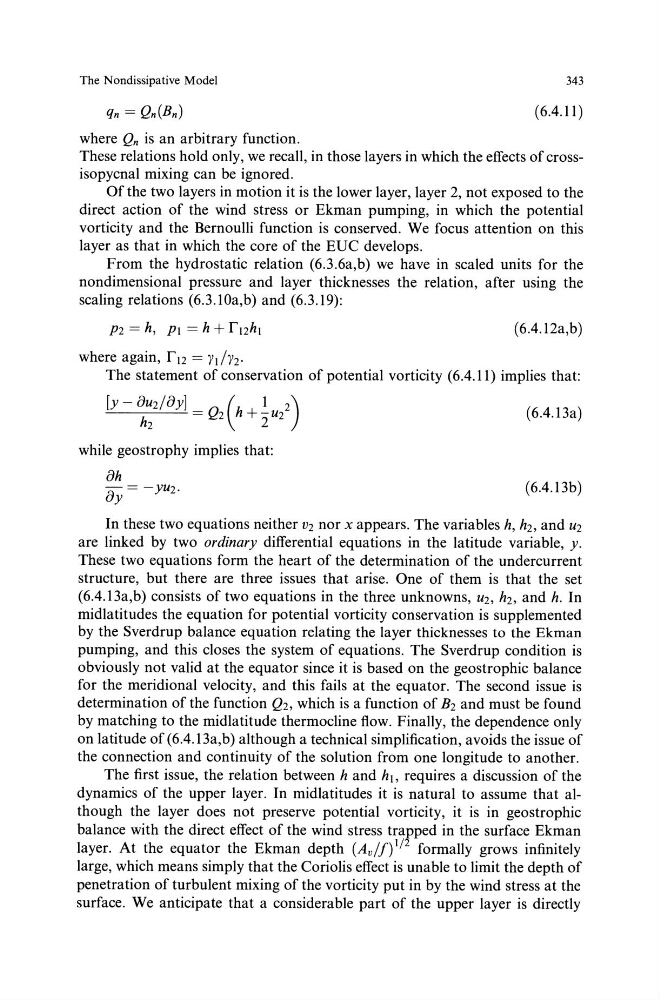
From the hydrostatic relation (6.3.6a,b) we have in scaled units for the
nondimensional pressure and layer thicknesses the relation, after using the
scaling relations (6.3.10a,b) and (6.3.19):
(6.4.12a,b)
where again, r12 = Yl!Y2·
The statement of conservation of potential vorticity (6.4.11) implies that:
[y- au2/8y]- Q (h ~ 2)
h2
- 2
+ 2 U2
(6.4.13a)
while geostrophy implies that:
8h
ay = -yu2.
(6.4.13b)
In these two equations neither v2 nor x appears. The variables h, h2, and u 2
are linked by two ordinary differential equations in the latitude variable, y.
These two equations form the heart of the determination of the undercurrent
structure, but there are three issues that arise. One of them is that the set
(6.4.13a,b) consists of two equations in the three unknowns, u2 , h2 , and h. In
midlatitudes the equation for potential vorticity conservation is supplemented
by the Sverdrup balance equation relating the layer thicknesses to the Ekman
pumping, and this closes the system of equations. The Sverdrup condition is
obviously not valid at the equator since it is based on the geostrophic balance
for the meridional velocity, and this fails at the equator. The second issue is
determination of the function Q2, which is a function of B2 and must be found
by matching to the midlatitude thermocline flow. Finally, the dependence only
on latitude of(6.4.13a,b) although a technical simplification, avoids the issue of
the connection and continuity of the solution from one longitude to another.
The first issue, the relation between hand h1, requires a discussion of the
dynamics of the upper layer. In midlatitudes it is natural to assume that although the layer does not preserve potential vorticity, it is in geostrophic
balance with the direct effect of the wind stress trapped in the surface Ekman
layer. At the equator the Ekman depth (Av/f) l/ 2 formally grows infinitely
large, which means simply that the Corio lis effect is unable to limit the depth of
penetration of turbulent mixing of the vorticity put in by the wind stress at the
surface. We anticipate that a considerable part of the upper layer is directly
343
(6.4.11)
where Qn is an arbitrary function.
These relations hold only, we recall, in those layers in which the effects of crossisopycnal mixing can be ignored.
Of the two layers in motion it is the lower layer, layer 2, not exposed to the
direct action of the wind stress or Ekman pumping, in which the potential
vorticity and the Bernoulli function is conserved. We focus attention on this
layer as that in which the core of the EUC develops.
From the hydrostatic relation (6.3.6a,b) we have in scaled units for the
nondimensional pressure and layer thicknesses the relation, after using the
scaling relations (6.3.10a,b) and (6.3.19):
(6.4.12a,b)
where again, r12 = Yl!Y2·
The statement of conservation of potential vorticity (6.4.11) implies that:
[y- au2/8y]- Q (h ~ 2)
h2
- 2
+ 2 U2
(6.4.13a)
while geostrophy implies that:
8h
ay = -yu2.
(6.4.13b)
In these two equations neither v2 nor x appears. The variables h, h2, and u 2
are linked by two ordinary differential equations in the latitude variable, y.
These two equations form the heart of the determination of the undercurrent
structure, but there are three issues that arise. One of them is that the set
(6.4.13a,b) consists of two equations in the three unknowns, u2 , h2 , and h. In
midlatitudes the equation for potential vorticity conservation is supplemented
by the Sverdrup balance equation relating the layer thicknesses to the Ekman
pumping, and this closes the system of equations. The Sverdrup condition is
obviously not valid at the equator since it is based on the geostrophic balance
for the meridional velocity, and this fails at the equator. The second issue is
determination of the function Q2, which is a function of B2 and must be found
by matching to the midlatitude thermocline flow. Finally, the dependence only
on latitude of(6.4.13a,b) although a technical simplification, avoids the issue of
the connection and continuity of the solution from one longitude to another.
The first issue, the relation between hand h1, requires a discussion of the
dynamics of the upper layer. In midlatitudes it is natural to assume that although the layer does not preserve potential vorticity, it is in geostrophic
balance with the direct effect of the wind stress trapped in the surface Ekman
layer. At the equator the Ekman depth (Av/f) l/ 2 formally grows infinitely
large, which means simply that the Corio lis effect is unable to limit the depth of
penetration of turbulent mixing of the vorticity put in by the wind stress at the
surface. We anticipate that a considerable part of the upper layer is directly