

0
(m)
100
200
Introduction
140° E
180°
..... . •
• :=
140°
I
I.
1oo·
327
· ..
. . lj .
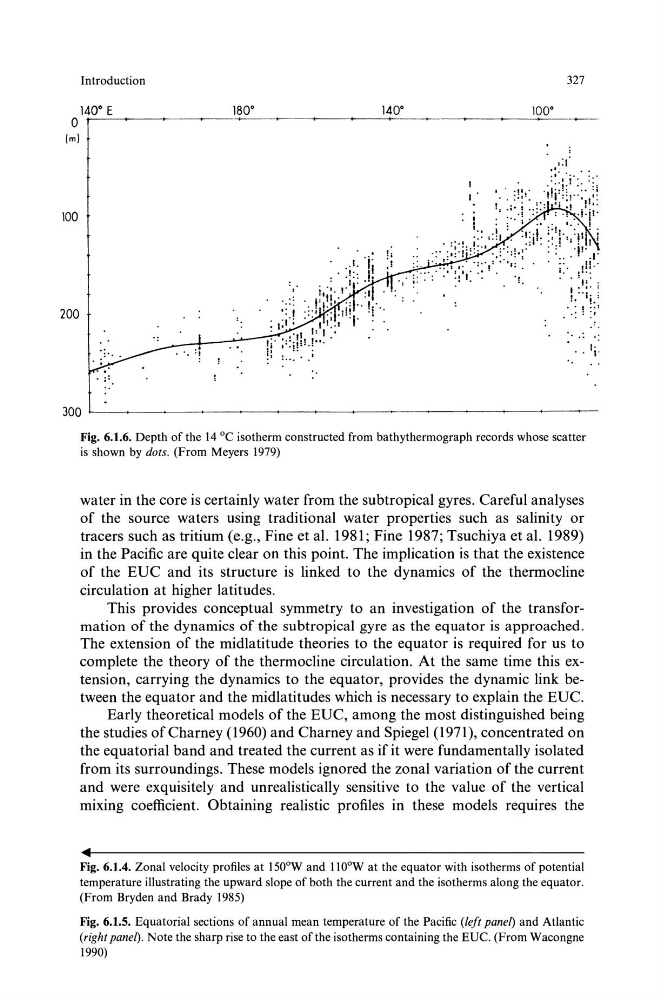
Fig. 6.1.6. Depth of the 14 °C isotherm constructed from bathythermograph records whose scatter
is shown by dots. (From Meyers 1979)
water in the core is certainly water from the subtropical gyres. Careful analyses
of the source waters using traditional water properties such as salinity or
tracers such as tritium (e.g., Fine et al. 1981; Fine 1987; Tsuchiya et al. 1989)
in the Pacific are quite clear on this point. The implication is that the existence
of the EUC and its structure is linked to the dynamics of the thermocline
circulation at higher latitudes.
This provides conceptual symmetry to an investigation of the transformation of the dynamics of the subtropical gyre as the equator is approached.
The extension of the midlatitude theories to the equator is required for us to
complete the theory of the thermocline circulation. At the same time this extension, carrying the dynamics to the equator, provides the dynamic link between the equator and the midlatitudes which is necessary to explain the EUC.
Early theoretical models of the EUC, among the most distinguished being
the studies of Charney (1960) and Charney and Spiegel (1971), concentrated on
the equatorial band and treated the current as if it were fundamentally isolated
from its surroundings. These models ignored the zonal variation of the current
and were exquisitely and unrealistically sensitive to the value of the vertical
mixing coefficient. Obtaining realistic profiles in these models requires the
Fig. 6.1.4. Zonal velocity profiles at 150°W and llOOW at the equator with isotherms of potential
temperature illustrating the upward slope of both the current and the isotherms along the equator.
(From Bryden and Brady 1985)
Fig. 6.1.5. Equatorial sections of annual mean temperature of the Pacific (left panel) and Atlantic
(right panel). Note the sharp rise to the east of the isotherms containing the EUC. (From Wacongne
1990)
(m)
100
200
Introduction
140° E
180°
..... . •
• :=
140°
I
I.
1oo·
327
· ..
. . lj .
Fig. 6.1.6. Depth of the 14 °C isotherm constructed from bathythermograph records whose scatter
is shown by dots. (From Meyers 1979)
water in the core is certainly water from the subtropical gyres. Careful analyses
of the source waters using traditional water properties such as salinity or
tracers such as tritium (e.g., Fine et al. 1981; Fine 1987; Tsuchiya et al. 1989)
in the Pacific are quite clear on this point. The implication is that the existence
of the EUC and its structure is linked to the dynamics of the thermocline
circulation at higher latitudes.
This provides conceptual symmetry to an investigation of the transformation of the dynamics of the subtropical gyre as the equator is approached.
The extension of the midlatitude theories to the equator is required for us to
complete the theory of the thermocline circulation. At the same time this extension, carrying the dynamics to the equator, provides the dynamic link between the equator and the midlatitudes which is necessary to explain the EUC.
Early theoretical models of the EUC, among the most distinguished being
the studies of Charney (1960) and Charney and Spiegel (1971), concentrated on
the equatorial band and treated the current as if it were fundamentally isolated
from its surroundings. These models ignored the zonal variation of the current
and were exquisitely and unrealistically sensitive to the value of the vertical
mixing coefficient. Obtaining realistic profiles in these models requires the
Fig. 6.1.4. Zonal velocity profiles at 150°W and llOOW at the equator with isotherms of potential
temperature illustrating the upward slope of both the current and the isotherms along the equator.
(From Bryden and Brady 1985)
Fig. 6.1.5. Equatorial sections of annual mean temperature of the Pacific (left panel) and Atlantic
(right panel). Note the sharp rise to the east of the isotherms containing the EUC. (From Wacongne
1990)