

312
Buoyancy Forced Circulation and Cross-Gyre Flow
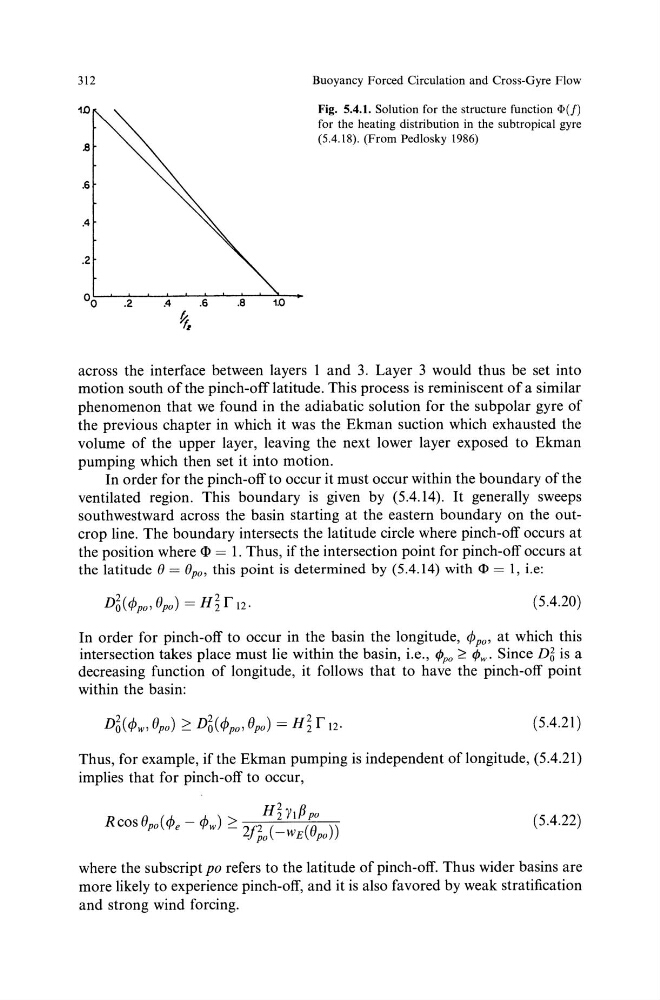
Fig. 5.4.1. Solution for the structure function if>(J)
for the heating distribution in the subtropical gyre
(5.4.18). (From Pedlosky 1986)
across the interface between layers 1 and 3. Layer 3 would thus be set into
motion south of the pinch-off latitude. This process is reminiscent of a similar
phenomenon that we found in the adiabatic solution for the subpolar gyre of
the previous chapter in which it was the Ekman suction which exhausted the
volume of the upper layer, leaving the next lower layer exposed to Ekman
pumping which then set it into motion.
In order for the pinch-off to occur it must occur within the boundary of the
ventilated region. This boundary is given by (5.4.14). It generally sweeps
southwestward across the basin starting at the eastern boundary on the outcrop line. The boundary intersects the latitude circle where pinch-off occurs at
the position where = 1. Thus, if the intersection point for pinch-off occurs at
the latitude () = epa, this point is determined by (5.4.14) with = 1' i.e:
( 5.4.20)
In order for pinch-off to occur in the basin the longitude, ¢po' at which this
intersection takes place must lie within the basin, i.e., l/Jpo;;:: ¢w· Since D'fi is a
decreasing function of longitude, it follows that to have the pinch-off point
within the basin:
( 5.4.21)
Thus, for example, if the Ekman pumping is independent of longitude, (5.4.21)
implies that for pinch-off to occur,
e ( A. A. )
H~ Ytf3 po
Rcos po '1-'e- 'f'w 2 2 '!2 (- (B ))
po
WE po
( 5.4.22)
where the subscript po refers to the latitude of pinch-off. Thus wider basins are
more likely to experience pinch-off, and it is also favored by weak stratification
and strong wind forcing.
Buoyancy Forced Circulation and Cross-Gyre Flow
Fig. 5.4.1. Solution for the structure function if>(J)
for the heating distribution in the subtropical gyre
(5.4.18). (From Pedlosky 1986)
across the interface between layers 1 and 3. Layer 3 would thus be set into
motion south of the pinch-off latitude. This process is reminiscent of a similar
phenomenon that we found in the adiabatic solution for the subpolar gyre of
the previous chapter in which it was the Ekman suction which exhausted the
volume of the upper layer, leaving the next lower layer exposed to Ekman
pumping which then set it into motion.
In order for the pinch-off to occur it must occur within the boundary of the
ventilated region. This boundary is given by (5.4.14). It generally sweeps
southwestward across the basin starting at the eastern boundary on the outcrop line. The boundary intersects the latitude circle where pinch-off occurs at
the position where = 1. Thus, if the intersection point for pinch-off occurs at
the latitude () = epa, this point is determined by (5.4.14) with = 1' i.e:
( 5.4.20)
In order for pinch-off to occur in the basin the longitude, ¢po' at which this
intersection takes place must lie within the basin, i.e., l/Jpo;;:: ¢w· Since D'fi is a
decreasing function of longitude, it follows that to have the pinch-off point
within the basin:
( 5.4.21)
Thus, for example, if the Ekman pumping is independent of longitude, (5.4.21)
implies that for pinch-off to occur,
e ( A. A. )
H~ Ytf3 po
Rcos po '1-'e- 'f'w 2 2 '!2 (- (B ))
po
WE po
( 5.4.22)
where the subscript po refers to the latitude of pinch-off. Thus wider basins are
more likely to experience pinch-off, and it is also favored by weak stratification
and strong wind forcing.