

The Buoyancy- and Wind-Driven Subtropical Gyre: Analytical Solutions
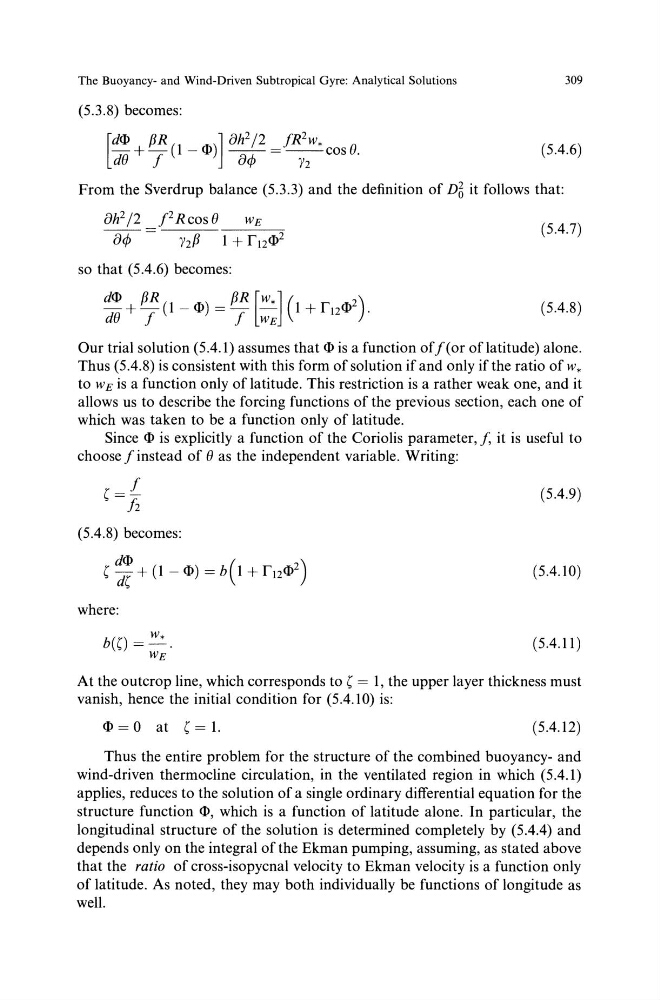
(5.3.8) becomes:
[ d PR (l _ "")] 8h 2 /2 =fR 2 w.
()
d() + f
"' 8¢
Y2 cos .
309
(5.4.6)
From the Sverdrup balance (5.3.3) and the definition of D~ it follows that:
f 2 Rcos () WE
Y2P
I+r12«<> 2
(5.4.7)
so that (5.4.6) becomes:
(5.4.8)
Our trial solution (5.4.1) assumes that«<> is a function off(or oflatitude) alone.
Thus (5.4.8) is consistent with this form of solution if and only if the ratio of w.
to WE is a function only oflatitude. This restriction is a rather weak one, and it
allows us to describe the forcing functions of the previous section, each one of
which was taken to be a function only of latitude.
Since «<> is explicitly a function of the Corio lis parameter, f, it is useful to
choose f instead of () as the independent variable. Writing:
' = [ _
/2
(5.4.9)
(5.4.8) becomes:
(5.4.10)
where:
b(C) = w •.
WE
(5.4.11)
At the outcrop line, which corresponds to C = 1, the upper layer thickness must
vanish, hence the initial condition for (5.4.10) is:
«<> = 0 at C = 1.
(5.4.12)
Thus the entire problem for the structure of the combined buoyancy- and
wind-driven thermocline circulation, in the ventilated region in which (5.4.1)
applies, reduces to the solution of a single ordinary differential equation for the
structure function «1>, which is a function of latitude alone. In particular, the
longitudinal structure of the solution is determined completely by (5.4.4) and
depends only on the integral of the Ekman pumping, assuming, as stated above
that the ratio of cross-isopycnal velocity to Ekman velocity is a function only
of latitude. As noted, they may both individually be functions of longitude as
well.
(5.3.8) becomes:
[ d
()
d() + f
"' 8¢
Y2 cos .
309
(5.4.6)
From the Sverdrup balance (5.3.3) and the definition of D~ it follows that:
f 2 Rcos () WE
Y2P
I+r12«<> 2
(5.4.7)
so that (5.4.6) becomes:
(5.4.8)
Our trial solution (5.4.1) assumes that«<> is a function off(or oflatitude) alone.
Thus (5.4.8) is consistent with this form of solution if and only if the ratio of w.
to WE is a function only oflatitude. This restriction is a rather weak one, and it
allows us to describe the forcing functions of the previous section, each one of
which was taken to be a function only of latitude.
Since «<> is explicitly a function of the Corio lis parameter, f, it is useful to
choose f instead of () as the independent variable. Writing:
' = [ _
/2
(5.4.9)
(5.4.8) becomes:
(5.4.10)
where:
b(C) = w •.
WE
(5.4.11)
At the outcrop line, which corresponds to C = 1, the upper layer thickness must
vanish, hence the initial condition for (5.4.10) is:
«<> = 0 at C = 1.
(5.4.12)
Thus the entire problem for the structure of the combined buoyancy- and
wind-driven thermocline circulation, in the ventilated region in which (5.4.1)
applies, reduces to the solution of a single ordinary differential equation for the
structure function «1>, which is a function of latitude alone. In particular, the
longitudinal structure of the solution is determined completely by (5.4.4) and
depends only on the integral of the Ekman pumping, assuming, as stated above
that the ratio of cross-isopycnal velocity to Ekman velocity is a function only
of latitude. As noted, they may both individually be functions of longitude as
well.