

Observations and Numerical Models
267
26.50
- C')
~
Age (years)
:::. 26.80
>....
·c;;
ABOVE
50
c:
Q)
40 - 50
Cl
30 - 40
a; 27.10
25 - 30
:;:::::
c:
20 - 25
Q)
15 - 20
.... 0
10 - 15
a..
8 -
10
27.40
68
46
24
1 -
2
BELOW
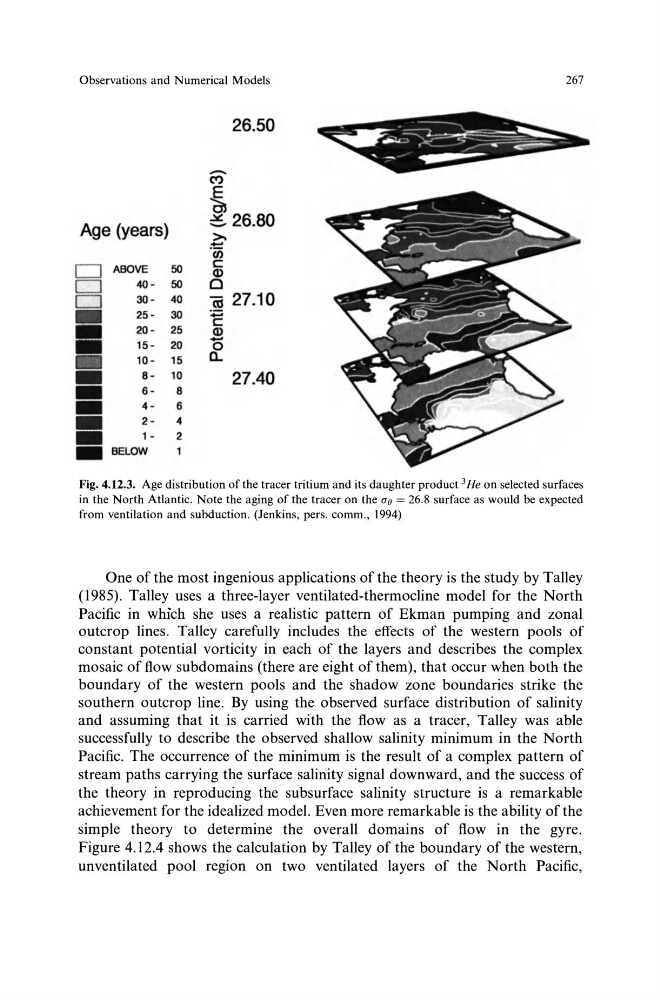
Fig. 4.12.3. Age distribution of the tracer tritium and its daughter product 3 He on selected surfaces
in the North Atlantic. Note the aging of the tracer on the ao = 26.8 surface as would be expected
from ventilation and subduction. (Jenkins, pers. comm., 1994)
One of the most ingenious applications of the theory is the study by Talley
(1985). Talley uses a three-layer ventilated-thermocline model for the North
Pacific in which she uses a realistic pattern of Ekman pumping and zonal
outcrop lines. Talley carefully includes the effects of the western pools of
constant potential vorticity in each of the layers and describes the complex
mosaic of flow subdomains (there are eight of them), that occur when both the
boundary of the western pools and the shadow zone boundaries strike the
southern outcrop line. By using the observed surface distribution of salinity
and assuming that it is carried with the flow as a tracer, Talley was able
successfully to describe the observed shallow salinity minimum in the North
Pacific. The occurrence of the minimum is the result of a complex pattern of
stream paths carrying the surface salinity signal downward, and the success of
the theory in reproducing the subsurface salinity structure is a remarkable
achievement for the idealized model. Even more remarkable is the ability of the
simple theory to determine the overall domains of flow in the gyre.
Figure 4.12.4 shows the calculation by Talley of the boundary of the western,
unventilated pool region on two ventilated layers of the North Pacific,
267
26.50
- C')
~
Age (years)
:::. 26.80
>....
·c;;
ABOVE
50
c:
Q)
40 - 50
Cl
30 - 40
a; 27.10
25 - 30
:;:::::
c:
20 - 25
Q)
15 - 20
.... 0
10 - 15
a..
8 -
10
27.40
68
46
24
1 -
2
BELOW
Fig. 4.12.3. Age distribution of the tracer tritium and its daughter product 3 He on selected surfaces
in the North Atlantic. Note the aging of the tracer on the ao = 26.8 surface as would be expected
from ventilation and subduction. (Jenkins, pers. comm., 1994)
One of the most ingenious applications of the theory is the study by Talley
(1985). Talley uses a three-layer ventilated-thermocline model for the North
Pacific in which she uses a realistic pattern of Ekman pumping and zonal
outcrop lines. Talley carefully includes the effects of the western pools of
constant potential vorticity in each of the layers and describes the complex
mosaic of flow subdomains (there are eight of them), that occur when both the
boundary of the western pools and the shadow zone boundaries strike the
southern outcrop line. By using the observed surface distribution of salinity
and assuming that it is carried with the flow as a tracer, Talley was able
successfully to describe the observed shallow salinity minimum in the North
Pacific. The occurrence of the minimum is the result of a complex pattern of
stream paths carrying the surface salinity signal downward, and the success of
the theory in reproducing the subsurface salinity structure is a remarkable
achievement for the idealized model. Even more remarkable is the ability of the
simple theory to determine the overall domains of flow in the gyre.
Figure 4.12.4 shows the calculation by Talley of the boundary of the western,
unventilated pool region on two ventilated layers of the North Pacific,