

Observations and Numerical Models
'
s '
' ' ' ' '
',
' ' ' ' ' ' '
265
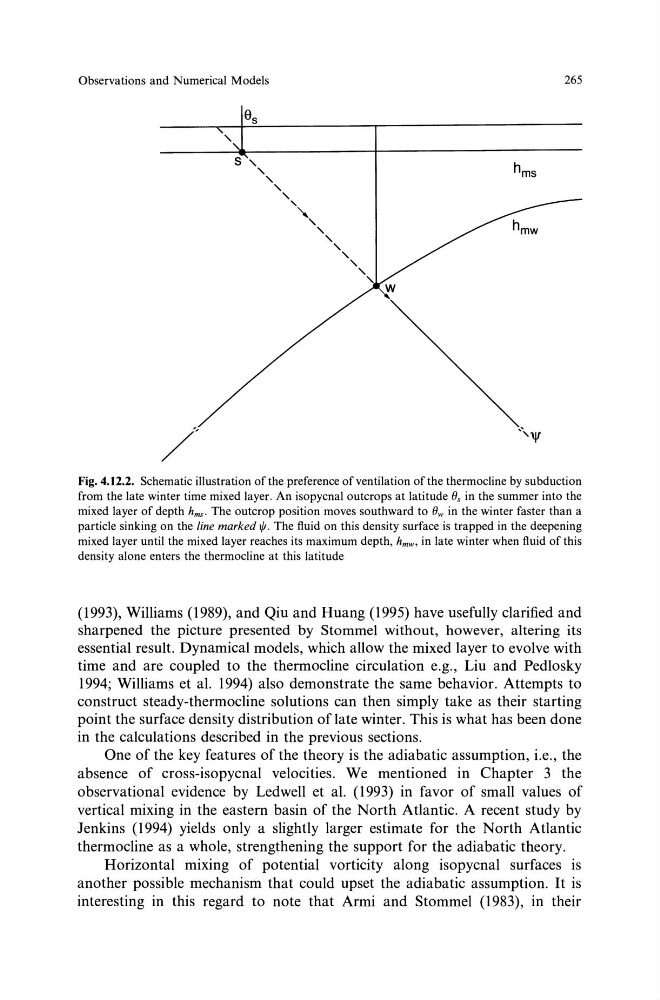
Fig. 4.12.2. Schematic illustration of the preference of ventilation of the thermocline by subduction
from the late winter time mixed layer. An isopycnal outcrops at latitude Os in the summer into the
mixed layer of depth hms. The outcrop position moves southward to Ow in the winter faster than a
particle sinking on the line marked lj!. The fluid on this density surface is trapped in the deepening
mixed layer until the mixed layer reaches its maximum depth, hmw. in late winter when fluid of this
density alone enters the thermocline at this latitude
(1993), Williams (1989), and Qiu and Huang (1995) have usefully clarified and
sharpened the picture presented by Stommel without, however, altering its
essential result. Dynamical models, which allow the mixed layer to evolve with
time and are coupled to the thermocline circulation e.g., Liu and Pedlosky
1994; Williams et al. 1994) also demonstrate the same behavior. Attempts to
construct steady-thermocline solutions can then simply take as their starting
point the surface density distribution of late winter. This is what has been done
in the calculations described in the previous sections.
One of the key features of the theory is the adiabatic assumption, i.e., the
absence of cross-isopycnal velocities. We mentioned in Chapter 3 the
observational evidence by Ledwell et al. (1993) in favor of small values of
vertical mixing in the eastern basin of the North Atlantic. A recent study by
Jenkins (1994) yields only a slightly larger estimate for the North Atlantic
thermocline as a whole, strengthening the support for the adiabatic theory.
Horizontal mixing of potential vorticity along isopycnal surfaces is
another possible mechanism that could upset the adiabatic assumption. It is
interesting in this regard to note that Armi and Stommel (1983), in their
'
s '
' ' ' ' '
',
' ' ' ' ' ' '
265
Fig. 4.12.2. Schematic illustration of the preference of ventilation of the thermocline by subduction
from the late winter time mixed layer. An isopycnal outcrops at latitude Os in the summer into the
mixed layer of depth hms. The outcrop position moves southward to Ow in the winter faster than a
particle sinking on the line marked lj!. The fluid on this density surface is trapped in the deepening
mixed layer until the mixed layer reaches its maximum depth, hmw. in late winter when fluid of this
density alone enters the thermocline at this latitude
(1993), Williams (1989), and Qiu and Huang (1995) have usefully clarified and
sharpened the picture presented by Stommel without, however, altering its
essential result. Dynamical models, which allow the mixed layer to evolve with
time and are coupled to the thermocline circulation e.g., Liu and Pedlosky
1994; Williams et al. 1994) also demonstrate the same behavior. Attempts to
construct steady-thermocline solutions can then simply take as their starting
point the surface density distribution of late winter. This is what has been done
in the calculations described in the previous sections.
One of the key features of the theory is the adiabatic assumption, i.e., the
absence of cross-isopycnal velocities. We mentioned in Chapter 3 the
observational evidence by Ledwell et al. (1993) in favor of small values of
vertical mixing in the eastern basin of the North Atlantic. A recent study by
Jenkins (1994) yields only a slightly larger estimate for the North Atlantic
thermocline as a whole, strengthening the support for the adiabatic theory.
Horizontal mixing of potential vorticity along isopycnal surfaces is
another possible mechanism that could upset the adiabatic assumption. It is
interesting in this regard to note that Armi and Stommel (1983), in their