

Observations and Numerical Models
263
MIXED LAYER DEPTH
JAN FEI MAR APR
OCT NOV DEC JAN
0
--. ...
50
.... ............
100
I 150
'\
%:
.... A. 200
...
- - 35.5N, 55.5W ATLANTIC
0
- - - 31.5N, ".4.5E PACIFIC
250
300
,00
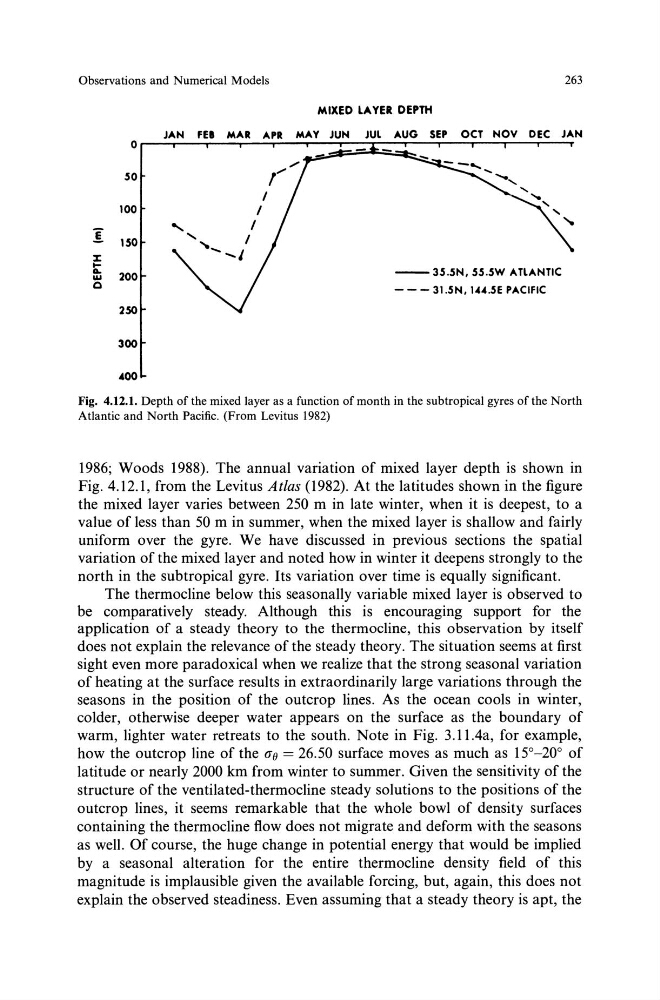
Fig. 4.12.1. Depth of the mixed layer as a function of month in the subtropical gyres of the North
Atlantic and North Pacific. (From Levitus 1982)
1986; Woods 1988). The annual variation of mixed layer depth is shown in
Fig. 4.12.1, from the Levitus Atlas (1982). At the latitudes shown in the figure
the mixed layer varies between 250 m in late winter, when it is deepest, to a
value of less than 50 m in summer, when the mixed layer is shallow and fairly
uniform over the gyre. We have discussed in previous sections the spatial
variation of the mixed layer and noted how in winter it deepens strongly to the
north in the subtropical gyre. Its variation over time is equally significant.
The thermocline below this seasonally variable mixed layer is observed to
be comparatively steady. Although this is encouraging support for the
application of a steady theory to the thermocline, this observation by itself
does not explain the relevance of the steady theory. The situation seems at first
sight even more paradoxical when we realize that the strong seasonal variation
of heating at the surface results in extraordinarily large variations through the
seasons in the position of the outcrop lines. As the ocean cools in winter,
colder, otherwise deeper water appears on the surface as the boundary of
warm, lighter water retreats to the south. Note in Fig. 3.11.4a, for example,
how the outcrop line of the (J' o = 26.50 surface moves as much as 15°-20° of
latitude or nearly 2000 km from winter to summer. Given the sensitivity of the
structure of the ventilated-thermocline steady solutions to the positions of the
outcrop lines, it seems remarkable that the whole bowl of density surfaces
containing the thermocline flow does not migrate and deform with the seasons
as well. Of course, the huge change in potential energy that would be implied
by a seasonal alteration for the entire thermocline density field of this
magnitude is implausible given the available forcing, but, again, this does not
explain the observed steadiness. Even assuming that a steady theory is apt, the
263
MIXED LAYER DEPTH
JAN FEI MAR APR
OCT NOV DEC JAN
0
--. ...
50
.... ............
100
I 150
'\
%:
.... A. 200
...
- - 35.5N, 55.5W ATLANTIC
0
- - - 31.5N, ".4.5E PACIFIC
250
300
,00
Fig. 4.12.1. Depth of the mixed layer as a function of month in the subtropical gyres of the North
Atlantic and North Pacific. (From Levitus 1982)
1986; Woods 1988). The annual variation of mixed layer depth is shown in
Fig. 4.12.1, from the Levitus Atlas (1982). At the latitudes shown in the figure
the mixed layer varies between 250 m in late winter, when it is deepest, to a
value of less than 50 m in summer, when the mixed layer is shallow and fairly
uniform over the gyre. We have discussed in previous sections the spatial
variation of the mixed layer and noted how in winter it deepens strongly to the
north in the subtropical gyre. Its variation over time is equally significant.
The thermocline below this seasonally variable mixed layer is observed to
be comparatively steady. Although this is encouraging support for the
application of a steady theory to the thermocline, this observation by itself
does not explain the relevance of the steady theory. The situation seems at first
sight even more paradoxical when we realize that the strong seasonal variation
of heating at the surface results in extraordinarily large variations through the
seasons in the position of the outcrop lines. As the ocean cools in winter,
colder, otherwise deeper water appears on the surface as the boundary of
warm, lighter water retreats to the south. Note in Fig. 3.11.4a, for example,
how the outcrop line of the (J' o = 26.50 surface moves as much as 15°-20° of
latitude or nearly 2000 km from winter to summer. Given the sensitivity of the
structure of the ventilated-thermocline steady solutions to the positions of the
outcrop lines, it seems remarkable that the whole bowl of density surfaces
containing the thermocline flow does not migrate and deform with the seasons
as well. Of course, the huge change in potential energy that would be implied
by a seasonal alteration for the entire thermocline density field of this
magnitude is implausible given the available forcing, but, again, this does not
explain the observed steadiness. Even assuming that a steady theory is apt, the