

256
Theory of the Ventilated Thermocline
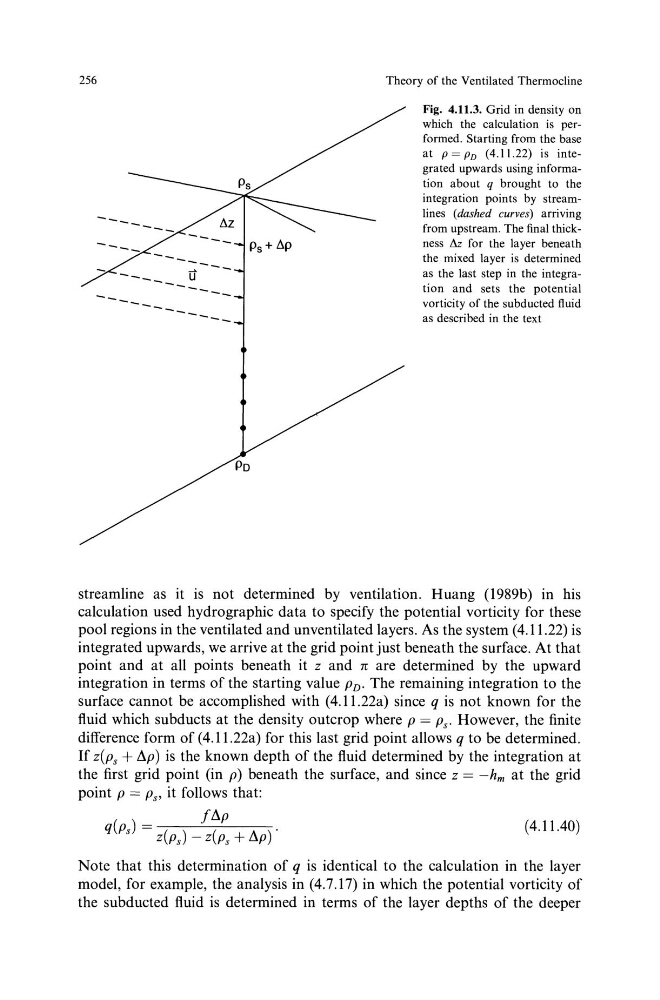
Fig. 4.11.3. Grid in density on
which the calculation is performed. Starting from the base
at p=pv (4.11.22) is integrated upwards using information about q brought to the
integration points by streamlines (dashed curves) arriving
from upstream. The final thickness t<.z for the layer beneath
the mixed layer is determined
as the last step in the integration and sets the potential
vorticity of the subducted fluid
as described in the text
streamline as it is not determined by ventilation. Huang (1989b) in his
calculation used hydrographic data to specify the potential vorticity for these
pool regions in the ventilated and unventilated layers. As the system ( 4.11.22) is
integrated upwards, we arrive at the grid point just beneath the surface. At that
point and at all points beneath it z and n are determined by the upward
integration in terms of the starting value Pn· The remaining integration to the
surface cannot be accomplished with (4.11.22a) since q is not known for the
fluid which subducts at the density outcrop where p = Ps· However, the finite
difference form of ( 4.11.22a) for this last grid point allows q to be determined.
If z(p 8 + !::J.p) is the known depth of the fluid determined by the integration at
the first grid point (in p) beneath the surface, and since z = -hm at the grid
point p = p 8 , it follows that:
f!::J.p
q(ps) = z(ps)- z(ps + !::J.p)'
(4.11.40)
Note that this determination of q is identical to the calculation in the layer
model, for example, the analysis in ( 4. 7 .17) in which the potential vorticity of
the subducted fluid is determined in terms of the layer depths of the deeper
Theory of the Ventilated Thermocline
Fig. 4.11.3. Grid in density on
which the calculation is performed. Starting from the base
at p=pv (4.11.22) is integrated upwards using information about q brought to the
integration points by streamlines (dashed curves) arriving
from upstream. The final thickness t<.z for the layer beneath
the mixed layer is determined
as the last step in the integration and sets the potential
vorticity of the subducted fluid
as described in the text
streamline as it is not determined by ventilation. Huang (1989b) in his
calculation used hydrographic data to specify the potential vorticity for these
pool regions in the ventilated and unventilated layers. As the system ( 4.11.22) is
integrated upwards, we arrive at the grid point just beneath the surface. At that
point and at all points beneath it z and n are determined by the upward
integration in terms of the starting value Pn· The remaining integration to the
surface cannot be accomplished with (4.11.22a) since q is not known for the
fluid which subducts at the density outcrop where p = Ps· However, the finite
difference form of ( 4.11.22a) for this last grid point allows q to be determined.
If z(p 8 + !::J.p) is the known depth of the fluid determined by the integration at
the first grid point (in p) beneath the surface, and since z = -hm at the grid
point p = p 8 , it follows that:
f!::J.p
q(ps) = z(ps)- z(ps + !::J.p)'
(4.11.40)
Note that this determination of q is identical to the calculation in the layer
model, for example, the analysis in ( 4. 7 .17) in which the potential vorticity of
the subducted fluid is determined in terms of the layer depths of the deeper