

254
Theory of the Ventilated Thermocline
different approaches have thus far been taken to this problem, but none of
them is completely satisfactory. Huang (1989a) assumed a structure for the
compensating flow on the eastern boundary as a function of density. This
introduces, however, an arbitrary element in the calculation. Williams (1989)
instead took a mixed layer that had vanishing thickness on the eastern
boundary to avoid altogether a zonal mass flux impinging on the eastern wall
of the basin. This is a rather unrealistic condition and has important
consequences in limiting the flow from the mixed layer into the thermocline.
Huang (1989b) finally settled on a boundary condition in which the zonal
velocity is forced to vanish on each density surface below the mixed layer at the
eastern wall. This implies that on the eastern wall the density surfaces below
the mixed layer are horizontal. This condition is reminiscent of the result we
found in Section 4.10 and shown in Fig. 4.10.4 where we saw that even if we
balance the mixed layer zonal transport with a compensating flow in the layer
beneath it, the base of that layer is very nearly independent of latitude along
the eastern wall. That is, compared to the overall slopes of the thermocline the
slope on the eastern wall induced by the mixed layer transport is negligible.
Huang (1989b) argues that the continuous model has the same behavior and
thus imposes the condition of no zonal veloctiy on the geostrophic flow. This
condition implies that the model unfortunately leaks fluid continuously from
the mixed layer out of the basin at the eastern boundary. Huang argues that
this is a small effect, and that this deficiency in the mass flux of the mixed layer
is more than compensated by the improved realism in the structure of the
density field on the eastern boundary.
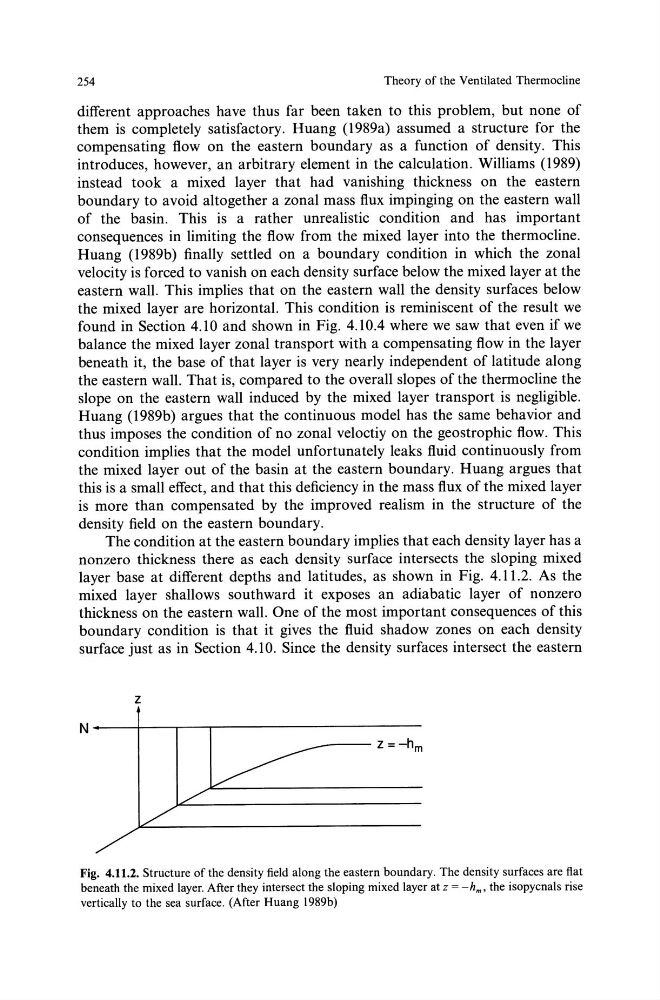
The condition at the eastern boundary implies that each density layer has a
nonzero thickness there as each density surface intersects the sloping mixed
layer base at different depths and latitudes, as shown in Fig. 4.11.2. As the
mixed layer shallows southward it exposes an adiabatic layer of nonzero
thickness on the eastern wall. One of the most important consequences of this
boundary condition is that it gives the fluid shadow zones on each density
surface just as in Section 4.1 0. Since the density surfaces intersect the eastern
z
N----~--,--.--------------------------Z=-hm
Fig. 4.11.2. Structure of the density field along the eastern boundary. The density surfaces are flat
beneath the mixed layer. After they intersect the sloping mixed layer at z = -hm, the isopycnals rise
vertically to the sea surface. (After Huang 1989b)
Theory of the Ventilated Thermocline
different approaches have thus far been taken to this problem, but none of
them is completely satisfactory. Huang (1989a) assumed a structure for the
compensating flow on the eastern boundary as a function of density. This
introduces, however, an arbitrary element in the calculation. Williams (1989)
instead took a mixed layer that had vanishing thickness on the eastern
boundary to avoid altogether a zonal mass flux impinging on the eastern wall
of the basin. This is a rather unrealistic condition and has important
consequences in limiting the flow from the mixed layer into the thermocline.
Huang (1989b) finally settled on a boundary condition in which the zonal
velocity is forced to vanish on each density surface below the mixed layer at the
eastern wall. This implies that on the eastern wall the density surfaces below
the mixed layer are horizontal. This condition is reminiscent of the result we
found in Section 4.10 and shown in Fig. 4.10.4 where we saw that even if we
balance the mixed layer zonal transport with a compensating flow in the layer
beneath it, the base of that layer is very nearly independent of latitude along
the eastern wall. That is, compared to the overall slopes of the thermocline the
slope on the eastern wall induced by the mixed layer transport is negligible.
Huang (1989b) argues that the continuous model has the same behavior and
thus imposes the condition of no zonal veloctiy on the geostrophic flow. This
condition implies that the model unfortunately leaks fluid continuously from
the mixed layer out of the basin at the eastern boundary. Huang argues that
this is a small effect, and that this deficiency in the mass flux of the mixed layer
is more than compensated by the improved realism in the structure of the
density field on the eastern boundary.
The condition at the eastern boundary implies that each density layer has a
nonzero thickness there as each density surface intersects the sloping mixed
layer base at different depths and latitudes, as shown in Fig. 4.11.2. As the
mixed layer shallows southward it exposes an adiabatic layer of nonzero
thickness on the eastern wall. One of the most important consequences of this
boundary condition is that it gives the fluid shadow zones on each density
surface just as in Section 4.1 0. Since the density surfaces intersect the eastern
z
N----~--,--.--------------------------Z=-hm
Fig. 4.11.2. Structure of the density field along the eastern boundary. The density surfaces are flat
beneath the mixed layer. After they intersect the sloping mixed layer at z = -hm, the isopycnals rise
vertically to the sea surface. (After Huang 1989b)