

252
Theory of the Ventilated Thermocline
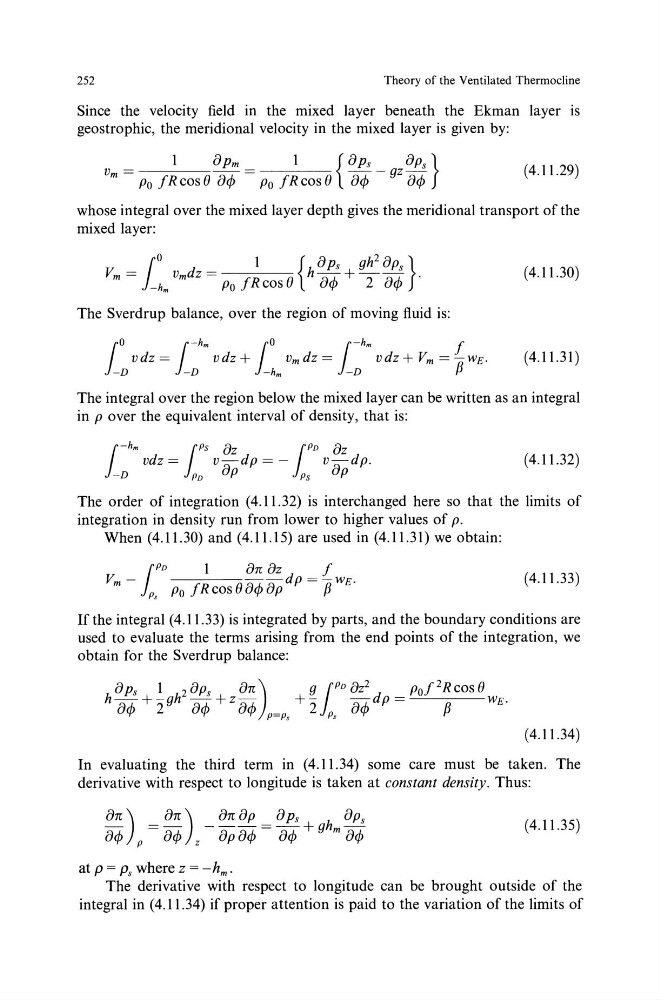
Since the velocity field in the mixed layer beneath the Ekman layer is
geostrophic, the meridional velocity in the mixed layer is given by:
1
apm
1
{aPs
aps}
Vm = Po f R cos (} a¢ = Po f R cos (} a¢ - gz a¢
( 4.11.29)
whose integral over the mixed layer depth gives the meridional transport of the
mixed layer:
1 °
1
{ a Ps gh 2 aps }
Vm = -hm Vmdz= Po fRcosO h a¢ +2 a¢ .
(4.11.30)
The Sverdrup balance, over the region of moving fluid is:
1 0
1-hm
10
1-hm
J
vdz=
vdz+
Vmdz=
vdz+ Vm =-pWE·
-D
-D
-hm
-D
(4.11.31)
The integral over the region below the mixed layer can be written as an integral
in p over the equivalent interval of density, that is:
1 -hm 1Ps az 1PD az
vdz =
vadp = -
vadp.
-D
PD
p
Ps
p
(4.11.32)
The order of integration ( 4.11.32) is interchanged here so that the limits of
integration in density run from lower to higher values of p.
When (4.11.30) and (4.11.15) are used in (4.11.31) we obtain:
rD 1 an 8z f
Vm- }p, PofRcosOa¢apdp=pwE.
(4.11.33)
If the integral ( 4.11.33) is integrated by parts, and the boundary conditions are
used to evaluate the terms arising from the end points of the integration, we
obtain for the Sverdrup balance:
(4.11.34)
In evaluating the third term in ( 4.11.34) some care must be taken. The
derivative with respect to longitude is taken at constant density. Thus:
an) _ an) _ an ap _ a Ps
h aps
a¢ p - a¢ z ap a¢ - a¢ + g m a¢
at p = Ps where z = -hm.
( 4.11.35)
The derivative with respect to longitude can be brought outside of the
integral in ( 4.11.34) if proper attention is paid to the variation of the limits of
Theory of the Ventilated Thermocline
Since the velocity field in the mixed layer beneath the Ekman layer is
geostrophic, the meridional velocity in the mixed layer is given by:
1
apm
1
{aPs
aps}
Vm = Po f R cos (} a¢ = Po f R cos (} a¢ - gz a¢
( 4.11.29)
whose integral over the mixed layer depth gives the meridional transport of the
mixed layer:
1 °
1
{ a Ps gh 2 aps }
Vm = -hm Vmdz= Po fRcosO h a¢ +2 a¢ .
(4.11.30)
The Sverdrup balance, over the region of moving fluid is:
1 0
1-hm
10
1-hm
J
vdz=
vdz+
Vmdz=
vdz+ Vm =-pWE·
-D
-D
-hm
-D
(4.11.31)
The integral over the region below the mixed layer can be written as an integral
in p over the equivalent interval of density, that is:
1 -hm 1Ps az 1PD az
vdz =
vadp = -
vadp.
-D
PD
p
Ps
p
(4.11.32)
The order of integration ( 4.11.32) is interchanged here so that the limits of
integration in density run from lower to higher values of p.
When (4.11.30) and (4.11.15) are used in (4.11.31) we obtain:
rD 1 an 8z f
Vm- }p, PofRcosOa¢apdp=pwE.
(4.11.33)
If the integral ( 4.11.33) is integrated by parts, and the boundary conditions are
used to evaluate the terms arising from the end points of the integration, we
obtain for the Sverdrup balance:
(4.11.34)
In evaluating the third term in ( 4.11.34) some care must be taken. The
derivative with respect to longitude is taken at constant density. Thus:
an) _ an) _ an ap _ a Ps
h aps
a¢ p - a¢ z ap a¢ - a¢ + g m a¢
at p = Ps where z = -hm.
( 4.11.35)
The derivative with respect to longitude can be brought outside of the
integral in ( 4.11.34) if proper attention is paid to the variation of the limits of