

250
Theory of the Ventilated Thermocline
z
unventilated thermocline
----- -- --stagnant fluid
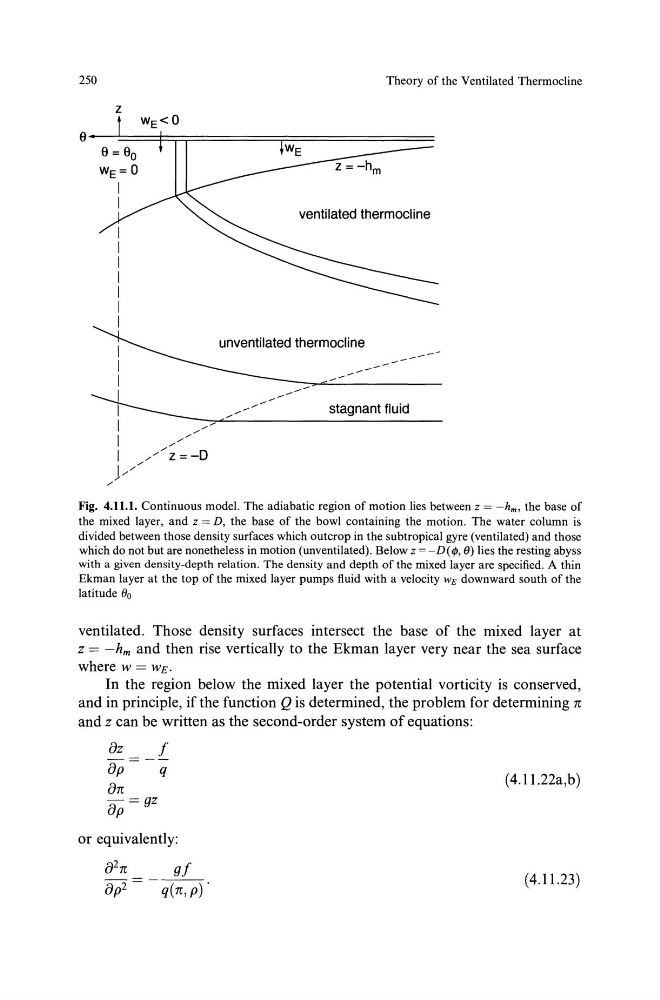
Fig. 4.11.1. Continuous model. The adiabatic region of motion lies between z = -hm, the base of
the mixed layer, and z = D, the base of the bowl containing the motion. The water column is
divided between those density surfaces which outcrop in the subtropical gyre (ventilated) and those
which do not but are nonetheless in motion (unventilated). Below z = -D(t{l, 8) lies the resting abyss
with a given density-depth relation. The density and depth of the mixed layer are specified. A thin
Ekman layer at the top of the mixed layer pumps fluid with a velocity WE downward south of the
latitude 8o
ventilated. Those density surfaces intersect the base of the mixed layer at
z = -hm and then rise vertically to the Ekman layer very near the sea surface
where w = W£.
In the region below the mixed layer the potential vorticity is conserved,
and in principle, if the function Q is determined, the problem for determining n
and z can be written as the second-order system of equations:
az f
8p
q
an
-=gz
ap
or equivalently:
gf
- q(n,p)"
( 4.11.22a,b)
( 4.11.23)
Theory of the Ventilated Thermocline
z
unventilated thermocline
----- -- --stagnant fluid
Fig. 4.11.1. Continuous model. The adiabatic region of motion lies between z = -hm, the base of
the mixed layer, and z = D, the base of the bowl containing the motion. The water column is
divided between those density surfaces which outcrop in the subtropical gyre (ventilated) and those
which do not but are nonetheless in motion (unventilated). Below z = -D(t{l, 8) lies the resting abyss
with a given density-depth relation. The density and depth of the mixed layer are specified. A thin
Ekman layer at the top of the mixed layer pumps fluid with a velocity WE downward south of the
latitude 8o
ventilated. Those density surfaces intersect the base of the mixed layer at
z = -hm and then rise vertically to the Ekman layer very near the sea surface
where w = W£.
In the region below the mixed layer the potential vorticity is conserved,
and in principle, if the function Q is determined, the problem for determining n
and z can be written as the second-order system of equations:
az f
8p
q
an
-=gz
ap
or equivalently:
gf
- q(n,p)"
( 4.11.22a,b)
( 4.11.23)