

Effect of Finite Mixed Layer Depth
233
outcrop line for constant pv fs < f < fn
flfs
felfs=4
fnlfs= 10
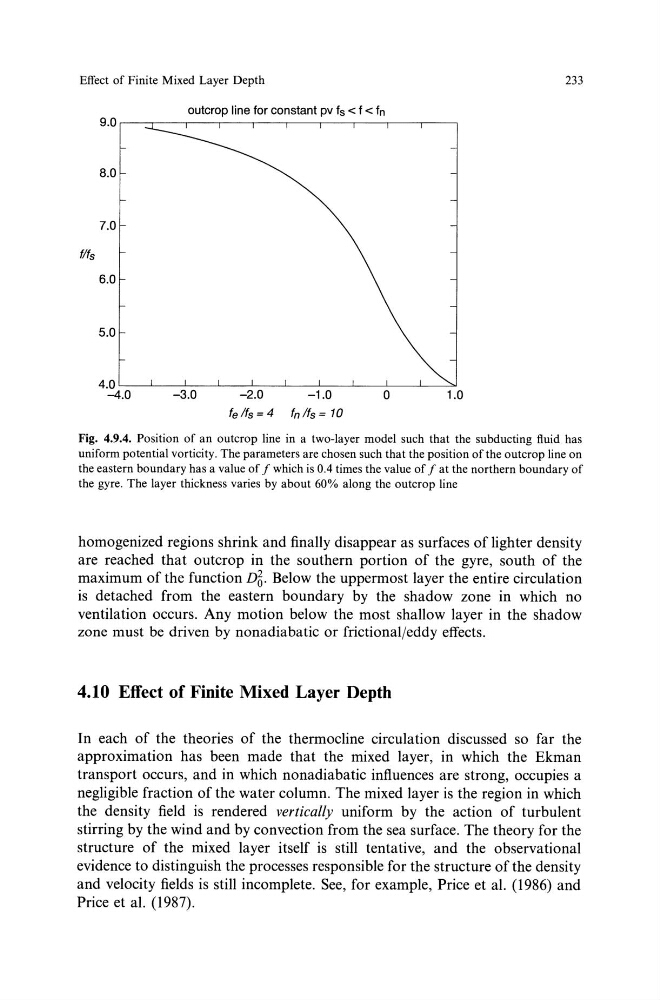
Fig. 4.9.4. Position of an outcrop line in a two-layer model such that the subducting fluid has
uniform potential vorticity. The parameters are chosen such that the position of the outcrop line on
the eastern boundary has a value off which is 0.4 times the value off at the northern boundary of
the gyre. The layer thickness varies by about 60% along the outcrop line
homogenized regions shrink and finally disappear as surfaces of lighter density
are reached that outcrop in the southern portion of the gyre, south of the
maximum of the function D5. Below the uppermost layer the entire circulation
is detached from the eastern boundary by the shadow zone in which no
ventilation occurs. Any motion below the most shallow layer in the shadow
zone must be driven by nonadiabatic or frictional/eddy effects.
4.10 Effect of Finite Mixed Layer Depth
In each of the theories of the thermocline circulation discussed so far the
approximation has been made that the mixed layer, in which the Ekman
transport occurs, and in which nonadiabatic influences are strong, occupies a
negligible fraction of the water column. The mixed layer is the region in which
the density field is rendered vertically uniform by the action of turbulent
stirring by the wind and by convection from the sea surface. The theory for the
structure of the mixed layer itself is still tentative, and the observational
evidence to distinguish the processes responsible for the structure of the density
and velocity fields is still incomplete. See, for example, Price et al. (1986) and
Price et al. (1987).
233
outcrop line for constant pv fs < f < fn
flfs
felfs=4
fnlfs= 10
Fig. 4.9.4. Position of an outcrop line in a two-layer model such that the subducting fluid has
uniform potential vorticity. The parameters are chosen such that the position of the outcrop line on
the eastern boundary has a value off which is 0.4 times the value off at the northern boundary of
the gyre. The layer thickness varies by about 60% along the outcrop line
homogenized regions shrink and finally disappear as surfaces of lighter density
are reached that outcrop in the southern portion of the gyre, south of the
maximum of the function D5. Below the uppermost layer the entire circulation
is detached from the eastern boundary by the shadow zone in which no
ventilation occurs. Any motion below the most shallow layer in the shadow
zone must be driven by nonadiabatic or frictional/eddy effects.
4.10 Effect of Finite Mixed Layer Depth
In each of the theories of the thermocline circulation discussed so far the
approximation has been made that the mixed layer, in which the Ekman
transport occurs, and in which nonadiabatic influences are strong, occupies a
negligible fraction of the water column. The mixed layer is the region in which
the density field is rendered vertically uniform by the action of turbulent
stirring by the wind and by convection from the sea surface. The theory for the
structure of the mixed layer itself is still tentative, and the observational
evidence to distinguish the processes responsible for the structure of the density
and velocity fields is still incomplete. See, for example, Price et al. (1986) and
Price et al. (1987).