

218
Theory of the Ventilated Thermocline
in the schematic in Fig. 4.8.la. Examination of Fig. 4.7.4 shows the solution
found by Luyten et al. exhibiting the surfacing of the interface in the 50°W
meridional cross section. Thus in the subpolar gyre the outcrop lines cannot be
arbitrarily assigned as in the subtropical gyre. Their positions are determined
by the Ekman suction distribution.
It might be thought that the surface density distribution should be a
boundary condition that can be consistently applied everywhere to the
circulation problem, and this is in fact true. Why then does it appear that
the subpolar gyre determines its own surface density? The crucial physical
distinction is that in the subtropical gyre the surface density signal is
advectively carried downward by the motion and determines the density
structure below the surface. In the subpolar gyre the reverse is true. The
dynamics of the subsurface flow in the presence of the Ekman suction brings
fluid with density already determined at depth towards the surface. If this
density is not equal to the surface density of an applied boundary condition
(and there is no reason why it should be) the discrepancy between the two
densities must be smoothed away in a dissipative boundary layer near the
upper surface as described by Pedlosky (1987a). This boundary layer is a
balance between downward diffusion of the surface density signal and
upward advection of subsurface density. This mathematical balance, which
is needed only in the subpolar gyre, can also exist mathematically only in
the subpolar gyre where the Ekman velocity is upward. Within the context
of a purely nondissipative theory, which ignores this thin, dissipative
sublayer, the surface boundary condition on the density field must be
relaxed in the subpolar gyre and the solution allowed to determine its own
surface density.
Along the subpolar outcrop line the thickness of layer 3 vanishes as the
square root of the distance to the outcrop line, as shown in Fig. 4.8.1 b, i.e., as
v'¢- Cl>3. This means that the velocity along the outcropping line is weakly
singular with a geostrophic velocity along the outcropping line which goes as
( lfJ- 4> 3 )- 112 • The transport, i.e., the velocity times the depth, remains
bounded. The reader should check that in the subtropical gyre, on the other
hand, the layer depth increases linearly from the outcrop line, and that no
singularity in the velocity occurs there.
North and west of the outcrop line layer 4 is now exposed directly to
Ekman suction and is forced into motion. The solution in this region can easily
be found if we assume that layer 5 and deeper layers are at rest. Thus in the
region where layer 4 is exposed to Ekman pumping, the application of the
Sverdrup balance (4.3.15) yields, after using the relation Z~ = (H3 +H4) 2 :
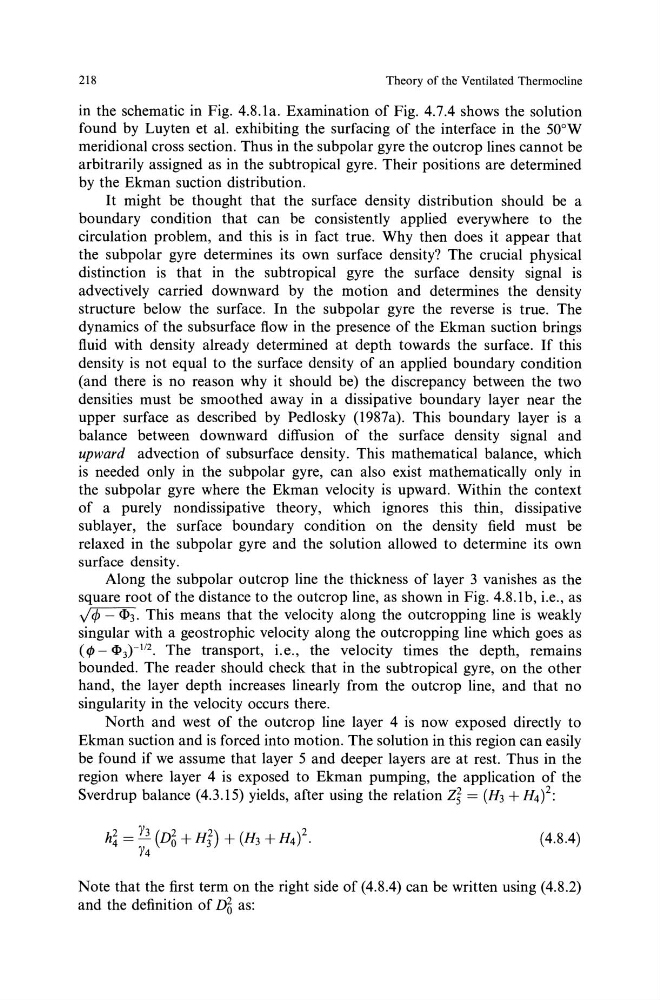
(4.8.4)
Note that the first term on the right side of (4.8.4) can be written using (4.8.2)
and the definition of Dij as:
Theory of the Ventilated Thermocline
in the schematic in Fig. 4.8.la. Examination of Fig. 4.7.4 shows the solution
found by Luyten et al. exhibiting the surfacing of the interface in the 50°W
meridional cross section. Thus in the subpolar gyre the outcrop lines cannot be
arbitrarily assigned as in the subtropical gyre. Their positions are determined
by the Ekman suction distribution.
It might be thought that the surface density distribution should be a
boundary condition that can be consistently applied everywhere to the
circulation problem, and this is in fact true. Why then does it appear that
the subpolar gyre determines its own surface density? The crucial physical
distinction is that in the subtropical gyre the surface density signal is
advectively carried downward by the motion and determines the density
structure below the surface. In the subpolar gyre the reverse is true. The
dynamics of the subsurface flow in the presence of the Ekman suction brings
fluid with density already determined at depth towards the surface. If this
density is not equal to the surface density of an applied boundary condition
(and there is no reason why it should be) the discrepancy between the two
densities must be smoothed away in a dissipative boundary layer near the
upper surface as described by Pedlosky (1987a). This boundary layer is a
balance between downward diffusion of the surface density signal and
upward advection of subsurface density. This mathematical balance, which
is needed only in the subpolar gyre, can also exist mathematically only in
the subpolar gyre where the Ekman velocity is upward. Within the context
of a purely nondissipative theory, which ignores this thin, dissipative
sublayer, the surface boundary condition on the density field must be
relaxed in the subpolar gyre and the solution allowed to determine its own
surface density.
Along the subpolar outcrop line the thickness of layer 3 vanishes as the
square root of the distance to the outcrop line, as shown in Fig. 4.8.1 b, i.e., as
v'¢- Cl>3. This means that the velocity along the outcropping line is weakly
singular with a geostrophic velocity along the outcropping line which goes as
( lfJ- 4> 3 )- 112 • The transport, i.e., the velocity times the depth, remains
bounded. The reader should check that in the subtropical gyre, on the other
hand, the layer depth increases linearly from the outcrop line, and that no
singularity in the velocity occurs there.
North and west of the outcrop line layer 4 is now exposed directly to
Ekman suction and is forced into motion. The solution in this region can easily
be found if we assume that layer 5 and deeper layers are at rest. Thus in the
region where layer 4 is exposed to Ekman pumping, the application of the
Sverdrup balance (4.3.15) yields, after using the relation Z~ = (H3 +H4) 2 :
(4.8.4)
Note that the first term on the right side of (4.8.4) can be written using (4.8.2)
and the definition of Dij as: