

188
Theory of the Ventilated Thermocline
eastern boundary. In addition, they can make this escape without the necessity
for them to close on themselves as in the Rhines and Young mechanism
discussed in Chapter 3. The existence of outcropping twists the qn isolines
around to encounter the outcrop line where the mixed layer feeds the layer
both fluid and potential vorticity, sending ventilated fluid on its way to depths
where it is not directly in contact with Ekman pumping.
4.4 The Ventilated Thermocline: The Two-Layer Model
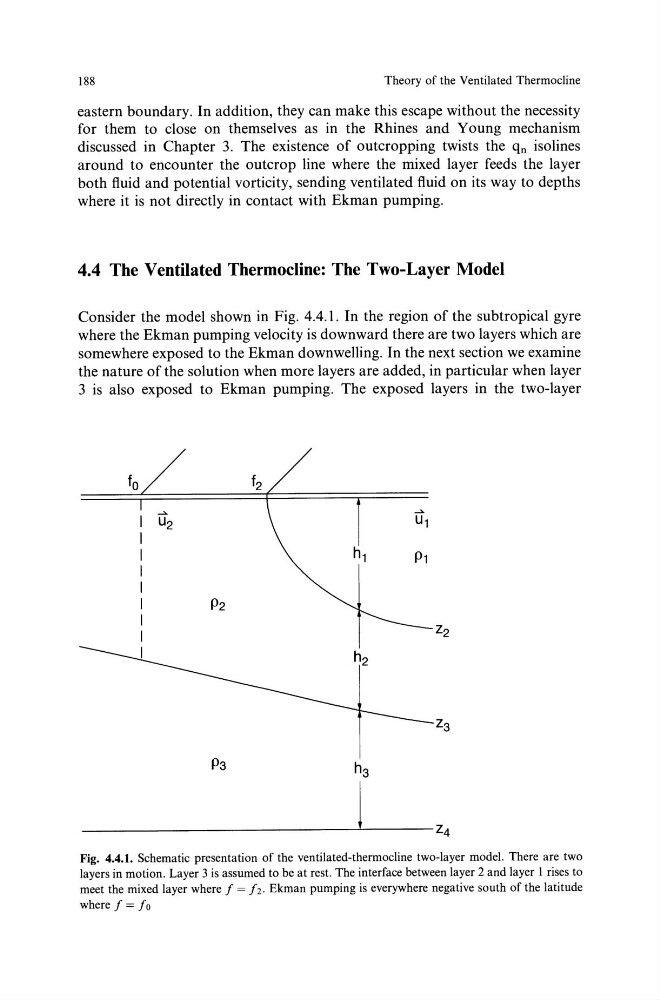
Consider the model shown in Fig. 4.4.1. In the region of the subtropical gyre
where the Ekman pumping velocity is downward there are two layers which are
somewhere exposed to the Ekman downwelling. In the next section we examine
the nature of the solution when more layers are added, in particular when layer
3 is also exposed to Ekman pumping. The exposed layers in the two-layer
Fig. 4.4.1. Schematic presentation of the ventilated-thermocline two-layer model. There are two
layers in motion. Layer 3 is assumed to be at rest. The interface between layer 2 and layer I rises to
meet the mixed layer where f = fz. Ekman pumping is everywhere negative south of the latitude
where f = fo
Theory of the Ventilated Thermocline
eastern boundary. In addition, they can make this escape without the necessity
for them to close on themselves as in the Rhines and Young mechanism
discussed in Chapter 3. The existence of outcropping twists the qn isolines
around to encounter the outcrop line where the mixed layer feeds the layer
both fluid and potential vorticity, sending ventilated fluid on its way to depths
where it is not directly in contact with Ekman pumping.
4.4 The Ventilated Thermocline: The Two-Layer Model
Consider the model shown in Fig. 4.4.1. In the region of the subtropical gyre
where the Ekman pumping velocity is downward there are two layers which are
somewhere exposed to the Ekman downwelling. In the next section we examine
the nature of the solution when more layers are added, in particular when layer
3 is also exposed to Ekman pumping. The exposed layers in the two-layer
Fig. 4.4.1. Schematic presentation of the ventilated-thermocline two-layer model. There are two
layers in motion. Layer 3 is assumed to be at rest. The interface between layer 2 and layer I rises to
meet the mixed layer where f = fz. Ekman pumping is everywhere negative south of the latitude
where f = fo