

186
Theory of the Ventilated Thermocline
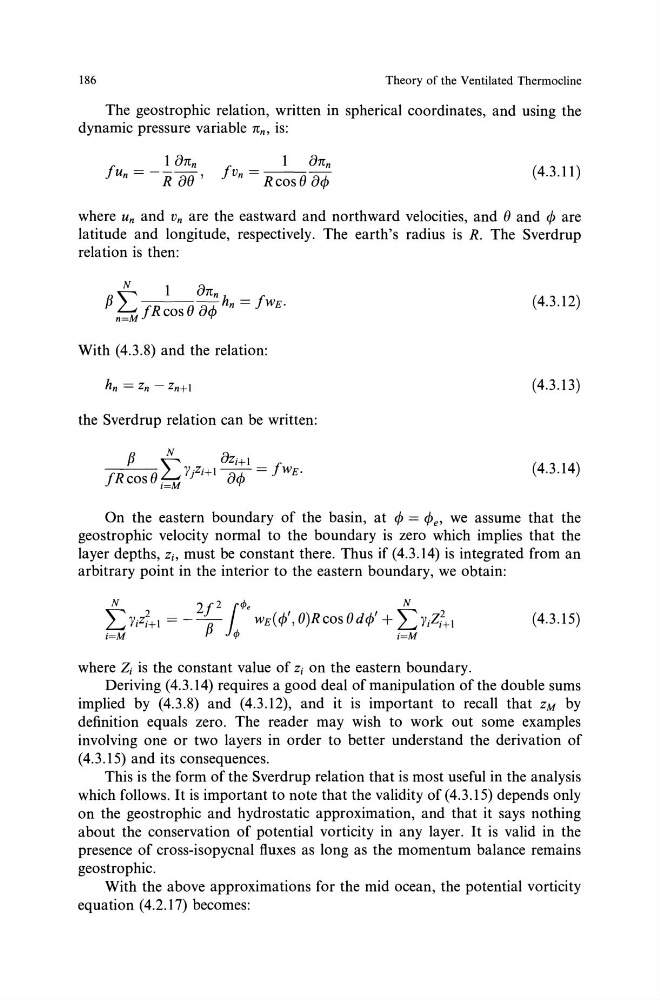
The geostrophic relation, written in spherical coordinates, and using the
dynamic pressure variable nn, is:
( 4.3.11)
where Un and Vn are the eastward and northward velocities, and fJ and 41 are
latitude and longitude, respectively. The earth's radius is R. The Sverdrup
relation is then:
(4.3.12)
With (4.3.8) and the relation:
(4.3.13)
the Sverdrup relation can be written:
(4.3.14)
On the eastern boundary of the basin, at 41 = 41e, we assume that the
geostrophic velocity normal to the boundary is zero which implies that the
layer depths, z;, must be constant there. Thus if (4.3.14) is integrated from an
arbitrary point in the interior to the eastern boundary, we obtain:
(4.3.15)
where Z; is the constant value of z; on the eastern boundary.
Deriving (4.3.14) requires a good deal of manipulation of the double sums
implied by (4.3.8) and (4.3.12), and it is important to recall that zM by
definition equals zero. The reader may wish to work out some examples
involving one or two layers in order to better understand the derivation of
(4.3.15) and its consequences.
This is the form of the Sverdrup relation that is most useful in the analysis
which follows. It is important to note that the validity of (4.3.15) depends only
on the geostrophic and hydrostatic approximation, and that it says nothing
about the conservation of potential vorticity in any layer. It is valid in the
presence of cross-isopycnal fluxes as long as the momentum balance remains
geostrophic.
With the above approximations for the mid ocean, the potential vorticity
equation ( 4.2.17) becomes:
Theory of the Ventilated Thermocline
The geostrophic relation, written in spherical coordinates, and using the
dynamic pressure variable nn, is:
( 4.3.11)
where Un and Vn are the eastward and northward velocities, and fJ and 41 are
latitude and longitude, respectively. The earth's radius is R. The Sverdrup
relation is then:
(4.3.12)
With (4.3.8) and the relation:
(4.3.13)
the Sverdrup relation can be written:
(4.3.14)
On the eastern boundary of the basin, at 41 = 41e, we assume that the
geostrophic velocity normal to the boundary is zero which implies that the
layer depths, z;, must be constant there. Thus if (4.3.14) is integrated from an
arbitrary point in the interior to the eastern boundary, we obtain:
(4.3.15)
where Z; is the constant value of z; on the eastern boundary.
Deriving (4.3.14) requires a good deal of manipulation of the double sums
implied by (4.3.8) and (4.3.12), and it is important to recall that zM by
definition equals zero. The reader may wish to work out some examples
involving one or two layers in order to better understand the derivation of
(4.3.15) and its consequences.
This is the form of the Sverdrup relation that is most useful in the analysis
which follows. It is important to note that the validity of (4.3.15) depends only
on the geostrophic and hydrostatic approximation, and that it says nothing
about the conservation of potential vorticity in any layer. It is valid in the
presence of cross-isopycnal fluxes as long as the momentum balance remains
geostrophic.
With the above approximations for the mid ocean, the potential vorticity
equation ( 4.2.17) becomes: