

146
Vertical Structure: Baroclinic Quasi-Geostrophic Models
3.10 Quasi-Geostrophic Model with Continuous Stratification
It is relatively straightforward to move from the layer model to a formulation
of the continuous model within the quasi-geostrophic approximation.
The equations of geostrophy (3.2.3) and thermal wind apply unchanged, as
well as the relation between the pressure and the geostrophic streamfunction
(3.2.9). The equation for the relative vorticity (3.2.11) is also unaltered.
However, instead of vertically integrated equations for mass conservation for
each layer we must use the continuity equation to eliminate the horizontal
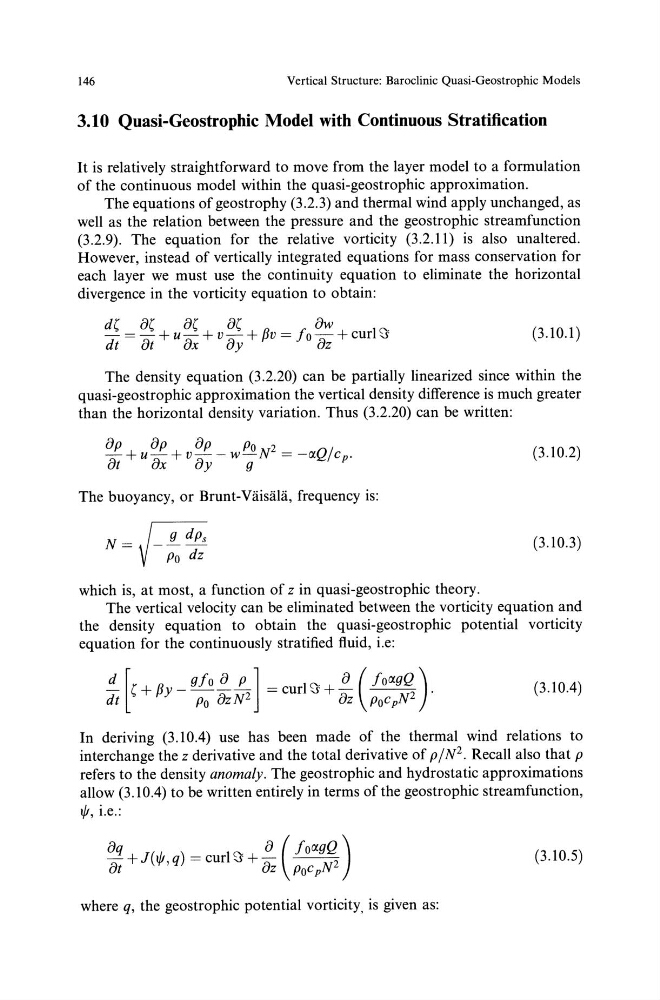
divergence in the vorticity equation to obtain:
d(
8(
8(
8(
ow
0.<
- = -+ u-+ v-+ f3v = fo-+curl:s
dt
at
ax
ay
az
(3.10.1)
The density equation (3.2.20) can be partially linearized since within the
quasi-geostrophic approximation the vertical density difference is much greater
than the horizontal density variation. Thus (3.2.20) can be written:
ap
ap
ap
Po 2
-+u-+v--w-N = -rJ.Qjc.
at
ax
ay
g
p
The buoyancy, or Brunt-Vaisala, frequency is:
N= J- g dps
Po dz
which is, at most, a function of z in quasi-geostrophic theory.
(3.10.2)
(3.10.3)
The vertical velocity can be eliminated between the vorticity equation and
the density equation to obtain the quasi-geostrophic potential vorticity
equation for the continuously stratified fluid, i.e:
(3.10.4)
In deriving (3.10.4) use has been made of the thermal wind relations to
interchange the z derivative and the total derivative of pjN 2 . Recall also that p
refers to the density anomaly. The geostrophic and hydrostatic approximations
allow (3.10.4) to be written entirely in terms of the geostrophic streamfunction,
t/J, i.e.:
aq
_ o a ( foiigQ)
--;_;-+J(tjf,q) -curl:s+!l
2
ut
uz p 0 cpN
(3.10.5)
where q, the geostrophic potential vorticity, is given as:
Vertical Structure: Baroclinic Quasi-Geostrophic Models
3.10 Quasi-Geostrophic Model with Continuous Stratification
It is relatively straightforward to move from the layer model to a formulation
of the continuous model within the quasi-geostrophic approximation.
The equations of geostrophy (3.2.3) and thermal wind apply unchanged, as
well as the relation between the pressure and the geostrophic streamfunction
(3.2.9). The equation for the relative vorticity (3.2.11) is also unaltered.
However, instead of vertically integrated equations for mass conservation for
each layer we must use the continuity equation to eliminate the horizontal
divergence in the vorticity equation to obtain:
d(
8(
8(
8(
ow
0.<
- = -+ u-+ v-+ f3v = fo-+curl:s
dt
at
ax
ay
az
(3.10.1)
The density equation (3.2.20) can be partially linearized since within the
quasi-geostrophic approximation the vertical density difference is much greater
than the horizontal density variation. Thus (3.2.20) can be written:
ap
ap
ap
Po 2
-+u-+v--w-N = -rJ.Qjc.
at
ax
ay
g
p
The buoyancy, or Brunt-Vaisala, frequency is:
N= J- g dps
Po dz
which is, at most, a function of z in quasi-geostrophic theory.
(3.10.2)
(3.10.3)
The vertical velocity can be eliminated between the vorticity equation and
the density equation to obtain the quasi-geostrophic potential vorticity
equation for the continuously stratified fluid, i.e:
(3.10.4)
In deriving (3.10.4) use has been made of the thermal wind relations to
interchange the z derivative and the total derivative of pjN 2 . Recall also that p
refers to the density anomaly. The geostrophic and hydrostatic approximations
allow (3.10.4) to be written entirely in terms of the geostrophic streamfunction,
t/J, i.e.:
aq
_ o a ( foiigQ)
--;_;-+J(tjf,q) -curl:s+!l
2
ut
uz p 0 cpN
(3.10.5)
where q, the geostrophic potential vorticity, is given as: