

142
Vertical Structure: Baroclinic Quasi-Geostrophic Models
vorticity. Were these conditions met in the present case we could set q2 equal to
its value on the outermost geostrophic contour. Since:
(3.9.10)
once q2 is known, t/1 2 is determined. The outermost geostrophic contour of the
pool is the contour which starts from the critical point (xroL). The contour can
then be thought of as running westward along y = L to the western boundary
(as well as eastward to the eastern boundary; this splitting is what defines Xr as
a critical point). Along this contour, by continuity with the region external to
the pool, t/1 2 = 0. At the critical point (xr,L) the streamfunction in the upper
layer also vanishes because there is no flow across the boundary at y = L where
t/Jn is zero. Thus q2 = {JL on the outer contour and is equal to this value
everywhere within the pool if the potential vorticity in layer 2 becomes
homogenized.
For the moment let us accept this scenario of potential vorticity
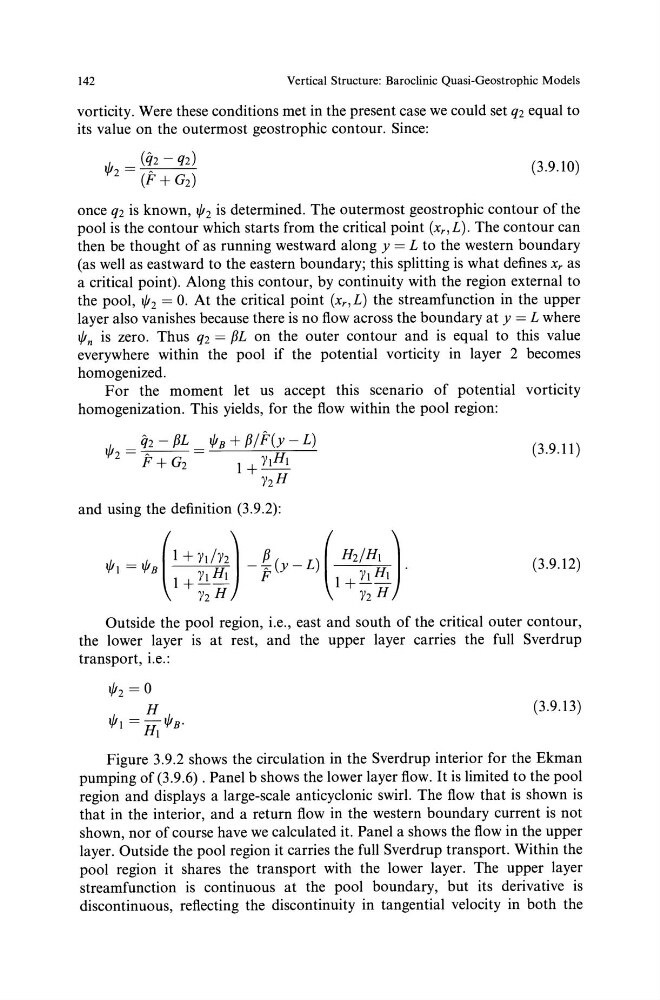
homogenization. This yields, for the flow within the pool region:
t/Jz = ~2- {JL = t/Js + {J/F(y- L)
F + G2
1 + 'hHt
YzH
(3.9.11)
and using the definition (3.9.2):
(3.9.12)
Outside the pool region, i.e., east and south of the critical outer contour,
the lower layer is at rest, and the upper layer carries the full Sverdrup
transport, i.e.:
t/12 = 0
H
t/11 = H 1 tfis·
(3.9.13)
Figure 3.9.2 shows the circulation in the Sverdrup interior for the Ekman
pumping of (3.9.6) . Panel b shows the lower layer flow. It is limited to the pool
region and displays a large-scale anticyclonic swirl. The flow that is shown is
that in the interior, and a return flow in the western boundary current is not
shown, nor of course have we calculated it. Panel a shows the flow in the upper
layer. Outside the pool region it carries the full Sverdrup transport. Within the
pool region it shares the transport with the lower layer. The upper layer
streamfunction is continuous at the pool boundary, but its derivative is
discontinuous, reflecting the discontinuity in tangential velocity in both the
Vertical Structure: Baroclinic Quasi-Geostrophic Models
vorticity. Were these conditions met in the present case we could set q2 equal to
its value on the outermost geostrophic contour. Since:
(3.9.10)
once q2 is known, t/1 2 is determined. The outermost geostrophic contour of the
pool is the contour which starts from the critical point (xroL). The contour can
then be thought of as running westward along y = L to the western boundary
(as well as eastward to the eastern boundary; this splitting is what defines Xr as
a critical point). Along this contour, by continuity with the region external to
the pool, t/1 2 = 0. At the critical point (xr,L) the streamfunction in the upper
layer also vanishes because there is no flow across the boundary at y = L where
t/Jn is zero. Thus q2 = {JL on the outer contour and is equal to this value
everywhere within the pool if the potential vorticity in layer 2 becomes
homogenized.
For the moment let us accept this scenario of potential vorticity
homogenization. This yields, for the flow within the pool region:
t/Jz = ~2- {JL = t/Js + {J/F(y- L)
F + G2
1 + 'hHt
YzH
(3.9.11)
and using the definition (3.9.2):
(3.9.12)
Outside the pool region, i.e., east and south of the critical outer contour,
the lower layer is at rest, and the upper layer carries the full Sverdrup
transport, i.e.:
t/12 = 0
H
t/11 = H 1 tfis·
(3.9.13)
Figure 3.9.2 shows the circulation in the Sverdrup interior for the Ekman
pumping of (3.9.6) . Panel b shows the lower layer flow. It is limited to the pool
region and displays a large-scale anticyclonic swirl. The flow that is shown is
that in the interior, and a return flow in the western boundary current is not
shown, nor of course have we calculated it. Panel a shows the flow in the upper
layer. Outside the pool region it carries the full Sverdrup transport. Within the
pool region it shares the transport with the lower layer. The upper layer
streamfunction is continuous at the pool boundary, but its derivative is
discontinuous, reflecting the discontinuity in tangential velocity in both the