

112
Vertical Structure: Baroclinic Quasi-Geostrophic Models
against the current. In regions west of this point there is then no requirement
that layer 2 be at rest. The position of this critical point depends on the value of
the arrest speed given by (3.4.11) and the strength of the gyre's zonal flow. The
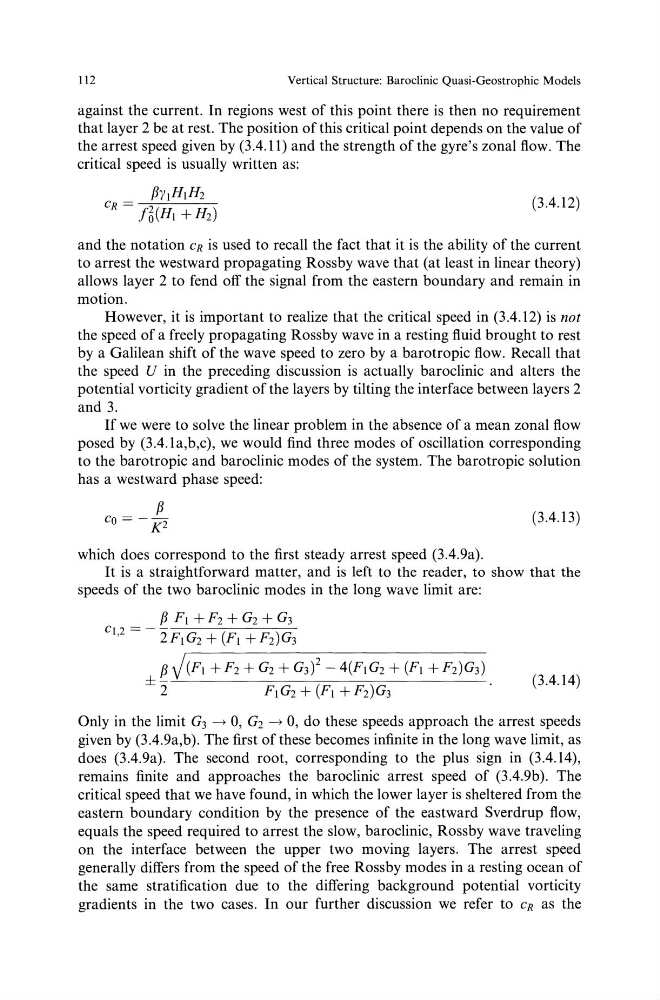
critical speed is usually written as:
(3.4.12)
and the notation CR is used to recall the fact that it is the ability of the current
to arrest the westward propagating Rossby wave that (at least in linear theory)
allows layer 2 to fend off the signal from the eastern boundary and remain in
motion.
However, it is important to realize that the critical speed in (3.4.12) is not
the speed of a freely propagating Ross by wave in a resting fluid brought to rest
by a Galilean shift of the wave speed to zero by a barotropic flow. Recall that
the speed U in the preceding discussion is actually baroclinic and alters the
potential vorticity gradient of the layers by tilting the interface between layers 2
and 3.
If we were to solve the linear problem in the absence of a mean zonal flow
posed by (3.4.1a,b,c), we would find three modes of oscillation corresponding
to the barotropic and baroclinic modes of the system. The barotropic solution
has a westward phase speed:
f3
co=-- K2
which does correspond to the first steady arrest speed (3.4.9a).
(3.4.13)
It is a straightforward matter, and is left to the reader, to show that the
speeds of the two baroclinic modes in the long wave limit are:
f3 F1 + F2 + G2 + G3
CJ2 = - -
'
2FIG2 + (FI +F2)G3
f3 V(FI + F2 + G2 + G3) 2 - 4(FI G2 + (FI + F2)G3)
±-...!......-----------,--------,--------2
F1G2 + (F1 +F2)G3
.
(3.4.14)
Only in the limit G3 ----+ 0, G2 ----+ 0, do these speeds approach the arrest speeds
given by (3.4.9a,b). The first of these becomes infinite in the long wave limit, as
does (3.4.9a). The second root, corresponding to the plus sign in (3.4.14),
remains finite and approaches the baroclinic arrest speed of (3.4.9b). The
critical speed that we have found, in which the lower layer is sheltered from the
eastern boundary condition by the presence of the eastward Sverdrup flow,
equals the speed required to arrest the slow, baroclinic, Rossby wave traveling
on the interface between the upper two moving layers. The arrest speed
generally differs from the speed of the free Ross by modes in a resting ocean of
the same stratification due to the differing background potential vorticity
gradients in the two cases. In our further discussion we refer to cR as the
Vertical Structure: Baroclinic Quasi-Geostrophic Models
against the current. In regions west of this point there is then no requirement
that layer 2 be at rest. The position of this critical point depends on the value of
the arrest speed given by (3.4.11) and the strength of the gyre's zonal flow. The
critical speed is usually written as:
(3.4.12)
and the notation CR is used to recall the fact that it is the ability of the current
to arrest the westward propagating Rossby wave that (at least in linear theory)
allows layer 2 to fend off the signal from the eastern boundary and remain in
motion.
However, it is important to realize that the critical speed in (3.4.12) is not
the speed of a freely propagating Ross by wave in a resting fluid brought to rest
by a Galilean shift of the wave speed to zero by a barotropic flow. Recall that
the speed U in the preceding discussion is actually baroclinic and alters the
potential vorticity gradient of the layers by tilting the interface between layers 2
and 3.
If we were to solve the linear problem in the absence of a mean zonal flow
posed by (3.4.1a,b,c), we would find three modes of oscillation corresponding
to the barotropic and baroclinic modes of the system. The barotropic solution
has a westward phase speed:
f3
co=-- K2
which does correspond to the first steady arrest speed (3.4.9a).
(3.4.13)
It is a straightforward matter, and is left to the reader, to show that the
speeds of the two baroclinic modes in the long wave limit are:
f3 F1 + F2 + G2 + G3
CJ2 = - -
'
2FIG2 + (FI +F2)G3
f3 V(FI + F2 + G2 + G3) 2 - 4(FI G2 + (FI + F2)G3)
±-...!......-----------,--------,--------2
F1G2 + (F1 +F2)G3
.
(3.4.14)
Only in the limit G3 ----+ 0, G2 ----+ 0, do these speeds approach the arrest speeds
given by (3.4.9a,b). The first of these becomes infinite in the long wave limit, as
does (3.4.9a). The second root, corresponding to the plus sign in (3.4.14),
remains finite and approaches the baroclinic arrest speed of (3.4.9b). The
critical speed that we have found, in which the lower layer is sheltered from the
eastern boundary condition by the presence of the eastward Sverdrup flow,
equals the speed required to arrest the slow, baroclinic, Rossby wave traveling
on the interface between the upper two moving layers. The arrest speed
generally differs from the speed of the free Ross by modes in a resting ocean of
the same stratification due to the differing background potential vorticity
gradients in the two cases. In our further discussion we refer to cR as the