

110
Vertical Structure: Baroclinic Quasi-Geostrophic Models
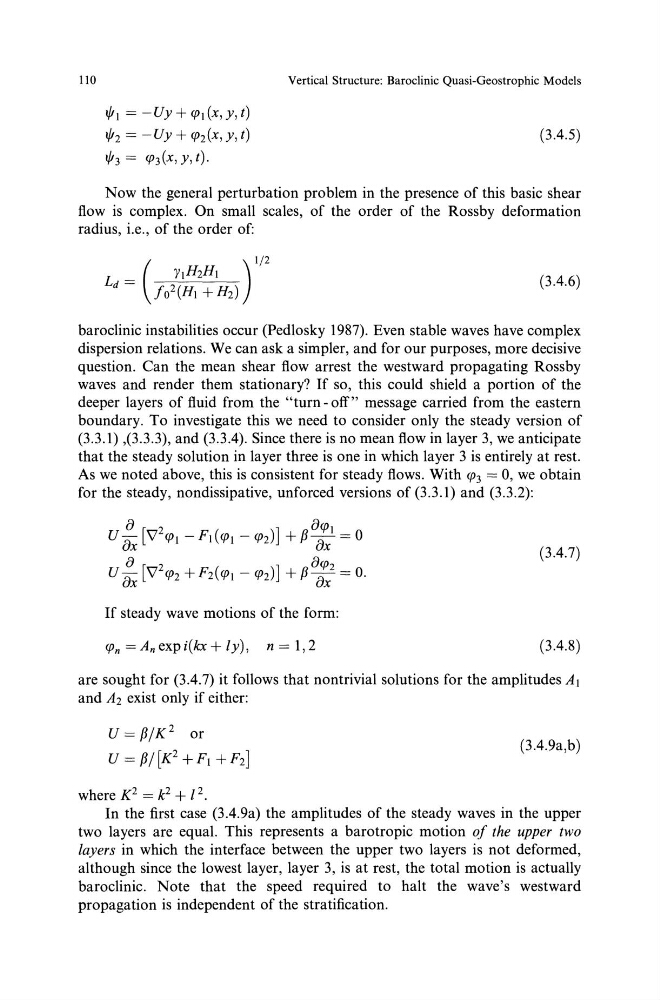
1/11 = -Uy +
Now the general perturbation problem in the presence of this basic shear
flow is complex. On small scales, of the order of the Rossby deformation
radius, i.e., of the order of:
(3.4.6)
baroclinic instabilities occur (Pedlosky 1987). Even stable waves have complex
dispersion relations. We can ask a simpler, and for our purposes, more decisive
question. Can the mean shear flow arrest the westward propagating Rossby
waves and render them stationary? If so, this could shield a portion of the
deeper layers of fluid from the "turn- off" message carried from the eastern
boundary. To investigate this we need to consider only the steady version of
(3.3.1) ,(3.3.3), and (3.3.4). Since there is no mean flow in layer 3, we anticipate
that the steady solution in layer three is one in which layer 3 is entirely at rest.
As we noted above, this is consistent for steady flows. With for the steady, nondissipative, unforced versions of (3.3.1) and (3.3.2):
(3.4.7)
If steady wave motions of the form:
are sought for (3.4.7) it follows that nontrivial solutions for the amplitudes A 1
and A2 exist only if either:
U = f3/K 2 or
U = f3/[K 2 +F, +F2]
(3.4.9a,b)
where K 2 = k 2 + 1 2 •
In the first case (3.4.9a) the amplitudes of the steady waves in the upper
two layers are equal. This represents a barotropic motion of the upper two
layers in which the interface between the upper two layers is not deformed,
although since the lowest layer, layer 3, is at rest, the total motion is actually
baroclinic. Note that the speed required to halt the wave's westward
propagation is independent of the stratification.
Vertical Structure: Baroclinic Quasi-Geostrophic Models
1/11 = -Uy +
Now the general perturbation problem in the presence of this basic shear
flow is complex. On small scales, of the order of the Rossby deformation
radius, i.e., of the order of:
(3.4.6)
baroclinic instabilities occur (Pedlosky 1987). Even stable waves have complex
dispersion relations. We can ask a simpler, and for our purposes, more decisive
question. Can the mean shear flow arrest the westward propagating Rossby
waves and render them stationary? If so, this could shield a portion of the
deeper layers of fluid from the "turn- off" message carried from the eastern
boundary. To investigate this we need to consider only the steady version of
(3.3.1) ,(3.3.3), and (3.3.4). Since there is no mean flow in layer 3, we anticipate
that the steady solution in layer three is one in which layer 3 is entirely at rest.
As we noted above, this is consistent for steady flows. With for the steady, nondissipative, unforced versions of (3.3.1) and (3.3.2):
(3.4.7)
If steady wave motions of the form:
are sought for (3.4.7) it follows that nontrivial solutions for the amplitudes A 1
and A2 exist only if either:
U = f3/K 2 or
U = f3/[K 2 +F, +F2]
(3.4.9a,b)
where K 2 = k 2 + 1 2 •
In the first case (3.4.9a) the amplitudes of the steady waves in the upper
two layers are equal. This represents a barotropic motion of the upper two
layers in which the interface between the upper two layers is not deformed,
although since the lowest layer, layer 3, is at rest, the total motion is actually
baroclinic. Note that the speed required to halt the wave's westward
propagation is independent of the stratification.