

108
Vertical Structure: Baroclinic Quasi-Geostrophic Models
the motion is linearized about a state of rest and is set into motion by the
application at time t = 0 by the imposition of an Ekman pumping. The
equations of motion are the linearized versions of (3.3.1 ), (3.3.3), and (3.3.4).
We are also particularly interested in the 2+ layer limit described in the
previous section where the depth of layer 3 becomes very large.
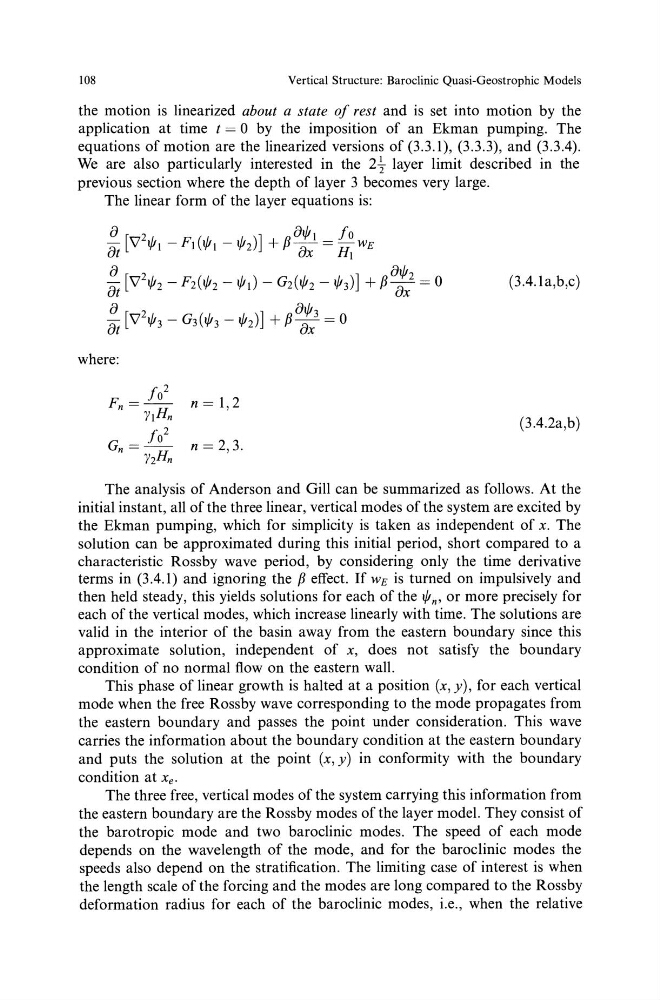
The linear form of the layer equations is:
(3.4.la,b,c)
where:
n = 1,2
(3.4.2a,b)
n = 2,3.
The analysis of Anderson and Gill can be summarized as follows. At the
initial instant, all of the three linear, vertical modes of the system are excited by
the Ekman pumping, which for simplicity is taken as independent of x. The
solution can be approximated during this initial period, short compared to a
characteristic Rossby wave period, by considering only the time derivative
terms in (3.4.1) and ignoring the f3 effect. If W£ is turned on impulsively and
then held steady, this yields solutions for each of the t/Jn, or more precisely for
each of the vertical modes, which increase linearly with time. The solutions are
valid in the interior of the basin away from the eastern boundary since this
approximate solution, independent of x, does not satisfy the boundary
condition of no normal flow on the eastern wall.
This phase of linear growth is halted at a position (x, y), for each vertical
mode when the free Rossby wave corresponding to the mode propagates from
the eastern boundary and passes the point under consideration. This wave
carries the information about the boundary condition at the eastern boundary
and puts the solution at the point (x, y) in conformity with the boundary
condition at Xe.
The three free, vertical modes of the system carrying this information from
the eastern boundary are the Ross by modes of the layer model. They consist of
the barotropic mode and two baroclinic modes. The speed of each mode
depends on the wavelength of the mode, and for the baroclinic modes the
speeds also depend on the stratification. The limiting case of interest is when
the length scale of the forcing and the modes are long compared to the Ross by
deformation radius for each of the baroclinic modes, i.e., when the relative
Vertical Structure: Baroclinic Quasi-Geostrophic Models
the motion is linearized about a state of rest and is set into motion by the
application at time t = 0 by the imposition of an Ekman pumping. The
equations of motion are the linearized versions of (3.3.1 ), (3.3.3), and (3.3.4).
We are also particularly interested in the 2+ layer limit described in the
previous section where the depth of layer 3 becomes very large.
The linear form of the layer equations is:
(3.4.la,b,c)
where:
n = 1,2
(3.4.2a,b)
n = 2,3.
The analysis of Anderson and Gill can be summarized as follows. At the
initial instant, all of the three linear, vertical modes of the system are excited by
the Ekman pumping, which for simplicity is taken as independent of x. The
solution can be approximated during this initial period, short compared to a
characteristic Rossby wave period, by considering only the time derivative
terms in (3.4.1) and ignoring the f3 effect. If W£ is turned on impulsively and
then held steady, this yields solutions for each of the t/Jn, or more precisely for
each of the vertical modes, which increase linearly with time. The solutions are
valid in the interior of the basin away from the eastern boundary since this
approximate solution, independent of x, does not satisfy the boundary
condition of no normal flow on the eastern wall.
This phase of linear growth is halted at a position (x, y), for each vertical
mode when the free Rossby wave corresponding to the mode propagates from
the eastern boundary and passes the point under consideration. This wave
carries the information about the boundary condition at the eastern boundary
and puts the solution at the point (x, y) in conformity with the boundary
condition at Xe.
The three free, vertical modes of the system carrying this information from
the eastern boundary are the Ross by modes of the layer model. They consist of
the barotropic mode and two baroclinic modes. The speed of each mode
depends on the wavelength of the mode, and for the baroclinic modes the
speeds also depend on the stratification. The limiting case of interest is when
the length scale of the forcing and the modes are long compared to the Ross by
deformation radius for each of the baroclinic modes, i.e., when the relative