

106
Vertical Structure: Baroclinic Quasi-Geostrophic Models
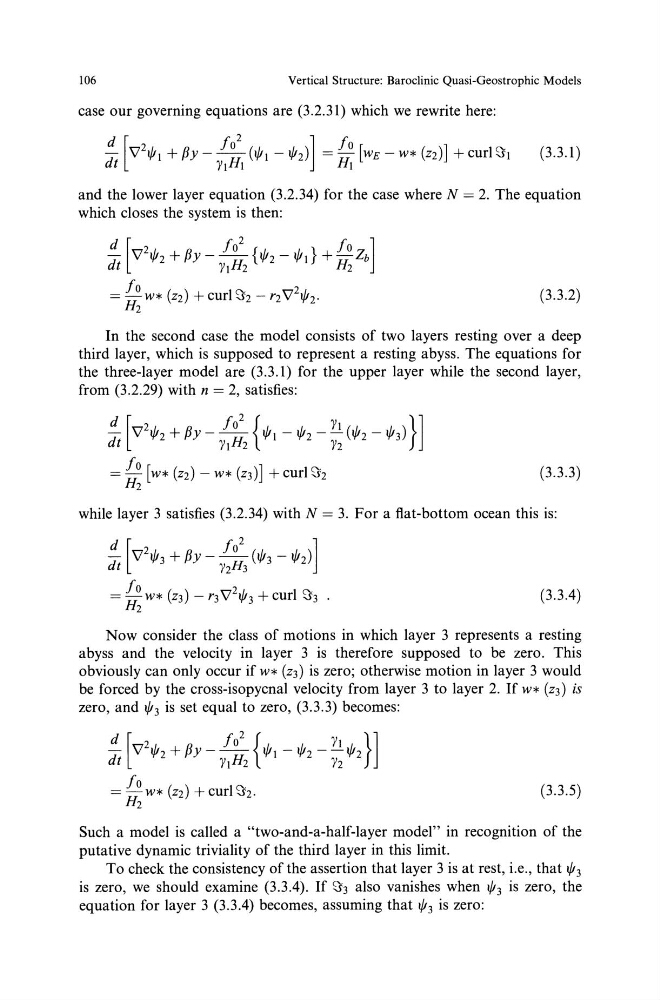
case our governing equations are (3.2.31) which we rewrite here:
(3.3.1)
and the lower layer equation (3.2.34) for the case where N = 2. The equation
which closes the system is then:
(3.3.2)
In the second case the model consists of two layers resting over a deep
third layer, which is supposed to represent a resting abyss. The equations for
the three-layer model are (3.3.1) for the upper layer while the second layer,
from (3.2.29) with n = 2, satisfies:
!!__ ["i l 2 l/12 + f3y- fo
2 {l/11 -l/12- 11 (l/12 -l/13)}]
dt
Y1H2
1' 2
= fo [w* (z2)- W* (z3)] +curl ~2
H2
(3.3.3)
while layer 3 satisfies (3.2.34) with N = 3. For a flat-bottom ocean this is:
(3.3.4)
Now consider the class of motions in which layer 3 represents a resting
abyss and the velocity in layer 3 is therefore supposed to be zero. This
obviously can only occur if W* (z3) is zero; otherwise motion in layer 3 would
be forced by the cross-isopycnal velocity from layer 3 to layer 2. If W* (z3) is
zero, and ljJ 3 is set equal to zero, (3.3.3) becomes:
(3.3.5)
Such a model is called a "two-and-a-half-layer model" in recognition of the
putative dynamic triviality of the third layer in this limit.
To check the consistency of the assertion that layer 3 is at rest, i.e., that l/1 3
is zero, we should examine (3.3.4). If ~3 also vanishes when l/1 3 is zero, the
equation for layer 3 (3.3.4) becomes, assuming that l/1 3 is zero:
Vertical Structure: Baroclinic Quasi-Geostrophic Models
case our governing equations are (3.2.31) which we rewrite here:
(3.3.1)
and the lower layer equation (3.2.34) for the case where N = 2. The equation
which closes the system is then:
(3.3.2)
In the second case the model consists of two layers resting over a deep
third layer, which is supposed to represent a resting abyss. The equations for
the three-layer model are (3.3.1) for the upper layer while the second layer,
from (3.2.29) with n = 2, satisfies:
!!__ ["i l 2 l/12 + f3y- fo
2 {l/11 -l/12- 11 (l/12 -l/13)}]
dt
Y1H2
1' 2
= fo [w* (z2)- W* (z3)] +curl ~2
H2
(3.3.3)
while layer 3 satisfies (3.2.34) with N = 3. For a flat-bottom ocean this is:
(3.3.4)
Now consider the class of motions in which layer 3 represents a resting
abyss and the velocity in layer 3 is therefore supposed to be zero. This
obviously can only occur if W* (z3) is zero; otherwise motion in layer 3 would
be forced by the cross-isopycnal velocity from layer 3 to layer 2. If W* (z3) is
zero, and ljJ 3 is set equal to zero, (3.3.3) becomes:
(3.3.5)
Such a model is called a "two-and-a-half-layer model" in recognition of the
putative dynamic triviality of the third layer in this limit.
To check the consistency of the assertion that layer 3 is at rest, i.e., that l/1 3
is zero, we should examine (3.3.4). If ~3 also vanishes when l/1 3 is zero, the
equation for layer 3 (3.3.4) becomes, assuming that l/1 3 is zero: