

94
90S
60
30
i
Vertical Structure: Baroclinic Quasi-Geostrophic Models
LA IllUDE
EQ
30
b"
600
800
2000
3000
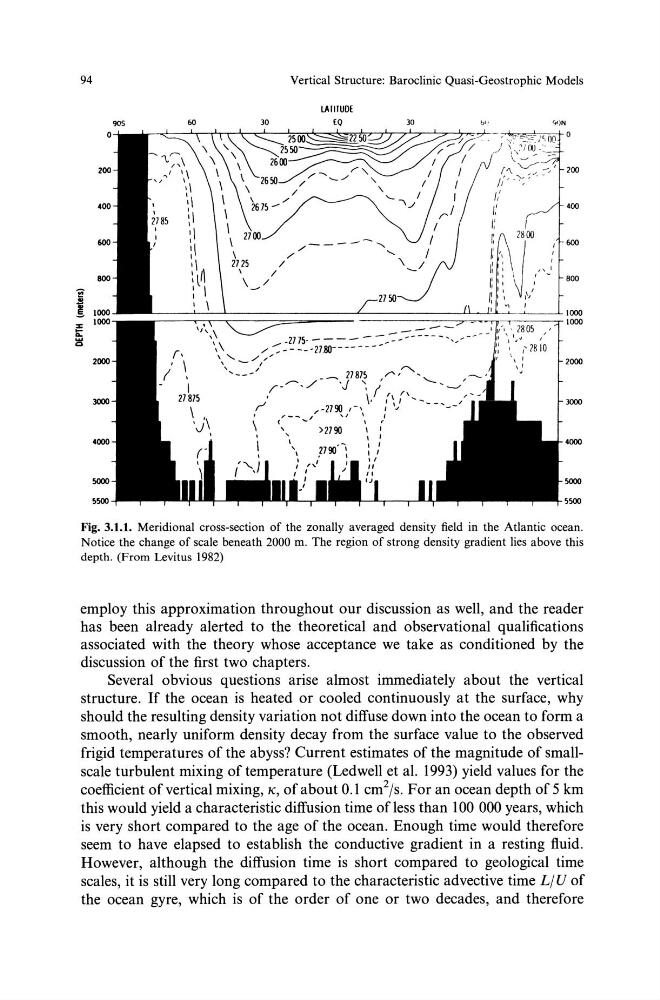
Fig. 3.1.1. Meridional cross-section of the zonally averaged density field in the Atlantic ocean.
Notice the change of scale beneath 2000 m. The region of strong density gradient lies above this
depth. (From Levitus 1982)
employ this approximation throughout our discussion as well, and the reader
has been already alerted to the theoretical and observational qualifications
associated with the theory whose acceptance we take as conditioned by the
discussion of the first two chapters.
Several obvious questions arise almost immediately about the vertical
structure. If the ocean is heated or cooled continuously at the surface, why
should the resulting density variation not diffuse down into the ocean to form a
smooth, nearly uniform density decay from the surface value to the observed
frigid temperatures of the abyss? Current estimates of the magnitude of smallscale turbulent mixing of temperature (Ledwell et al. 1993) yield values for the
coefficient of vertical mixing, K, of about 0.1 cm 2 /s. For an ocean depth of 5 km
this would yield a characteristic diffusion time ofless than 100 000 years, which
is very short compared to the age of the ocean. Enough time would therefore
seem to have elapsed to establish the conductive gradient in a resting fluid.
However, although the diffusion time is short compared to geological time
scales, it is still very long compared to the characteristic advective time L/ U of
the ocean gyre, which is of the order of one or two decades, and therefore
90S
60
30
i
Vertical Structure: Baroclinic Quasi-Geostrophic Models
LA IllUDE
EQ
30
b"
600
800
2000
3000
Fig. 3.1.1. Meridional cross-section of the zonally averaged density field in the Atlantic ocean.
Notice the change of scale beneath 2000 m. The region of strong density gradient lies above this
depth. (From Levitus 1982)
employ this approximation throughout our discussion as well, and the reader
has been already alerted to the theoretical and observational qualifications
associated with the theory whose acceptance we take as conditioned by the
discussion of the first two chapters.
Several obvious questions arise almost immediately about the vertical
structure. If the ocean is heated or cooled continuously at the surface, why
should the resulting density variation not diffuse down into the ocean to form a
smooth, nearly uniform density decay from the surface value to the observed
frigid temperatures of the abyss? Current estimates of the magnitude of smallscale turbulent mixing of temperature (Ledwell et al. 1993) yield values for the
coefficient of vertical mixing, K, of about 0.1 cm 2 /s. For an ocean depth of 5 km
this would yield a characteristic diffusion time ofless than 100 000 years, which
is very short compared to the age of the ocean. Enough time would therefore
seem to have elapsed to establish the conductive gradient in a resting fluid.
However, although the diffusion time is short compared to geological time
scales, it is still very long compared to the characteristic advective time L/ U of
the ocean gyre, which is of the order of one or two decades, and therefore