

a, b
90
Homogeneous Models of the Ocean Circulation
c
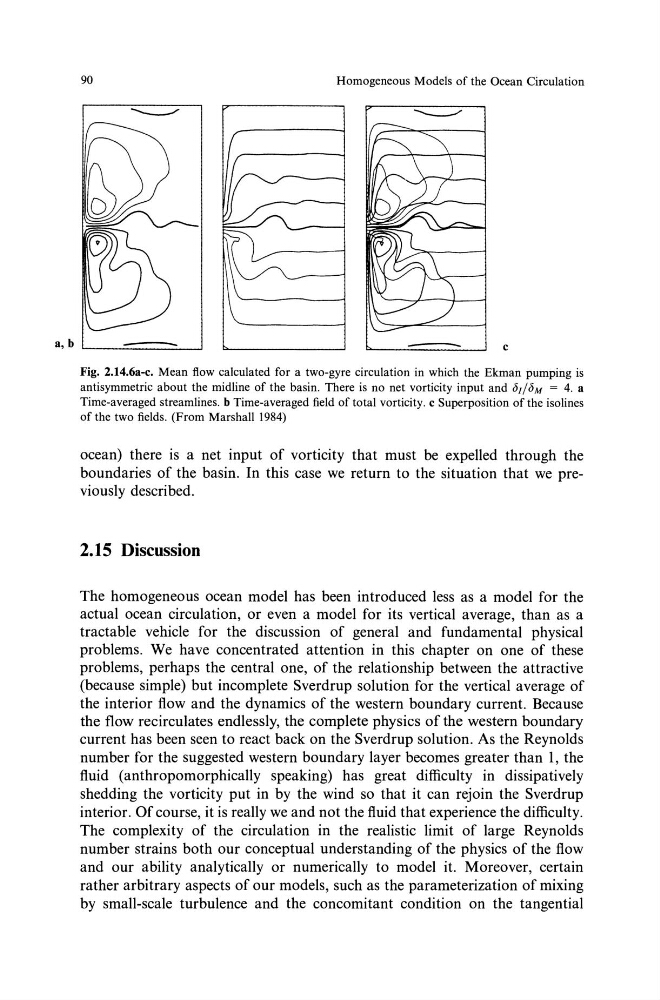
Fig. 2.14.6a-c. Mean flow calculated for a two-gyre circulation in which the Ekman pumping is
antisymmetric about the midline of the basin. There is no net vorticity input and ih/bM = 4. a
Time-averaged streamlines. b Time-averaged field of total vorticity. c Superposition of the isolines
of the two fields. (From Marshall 1984)
ocean) there is a net input of vorticity that must be expelled through the
boundaries of the basin. In this case we return to the situation that we previously described.
2.15 Discussion
The homogeneous ocean model has been introduced less as a model for the
actual ocean circulation, or even a model for its vertical average, than as a
tractable vehicle for the discussion of general and fundamental physical
problems. We have concentrated attention in this chapter on one of these
problems, perhaps the central one, of the relationship between the attractive
(because simple) but incomplete Sverdrup solution for the vertical average of
the interior flow and the dynamics of the western boundary current. Because
the flow recirculates endlessly, the complete physics of the western boundary
current has been seen to react back on the Sverdrup solution. As the Reynolds
number for the suggested western boundary layer becomes greater than 1, the
fluid (anthropomorphically speaking) has great difficulty in dissipatively
shedding the vorticity put in by the wind so that it can rejoin the Sverdrup
interior. Of course, it is really we and not the fluid that experience the difficulty.
The complexity of the circulation in the realistic limit of large Reynolds
number strains both our conceptual understanding of the physics of the flow
and our ability analytically or numerically to model it. Moreover, certain
rather arbitrary aspects of our models, such as the parameterization of mixing
by small-scale turbulence and the concomitant condition on the tangential
90
Homogeneous Models of the Ocean Circulation
c
Fig. 2.14.6a-c. Mean flow calculated for a two-gyre circulation in which the Ekman pumping is
antisymmetric about the midline of the basin. There is no net vorticity input and ih/bM = 4. a
Time-averaged streamlines. b Time-averaged field of total vorticity. c Superposition of the isolines
of the two fields. (From Marshall 1984)
ocean) there is a net input of vorticity that must be expelled through the
boundaries of the basin. In this case we return to the situation that we previously described.
2.15 Discussion
The homogeneous ocean model has been introduced less as a model for the
actual ocean circulation, or even a model for its vertical average, than as a
tractable vehicle for the discussion of general and fundamental physical
problems. We have concentrated attention in this chapter on one of these
problems, perhaps the central one, of the relationship between the attractive
(because simple) but incomplete Sverdrup solution for the vertical average of
the interior flow and the dynamics of the western boundary current. Because
the flow recirculates endlessly, the complete physics of the western boundary
current has been seen to react back on the Sverdrup solution. As the Reynolds
number for the suggested western boundary layer becomes greater than 1, the
fluid (anthropomorphically speaking) has great difficulty in dissipatively
shedding the vorticity put in by the wind so that it can rejoin the Sverdrup
interior. Of course, it is really we and not the fluid that experience the difficulty.
The complexity of the circulation in the realistic limit of large Reynolds
number strains both our conceptual understanding of the physics of the flow
and our ability analytically or numerically to model it. Moreover, certain
rather arbitrary aspects of our models, such as the parameterization of mixing
by small-scale turbulence and the concomitant condition on the tangential