

Contributions to Global Ocean Observations
61
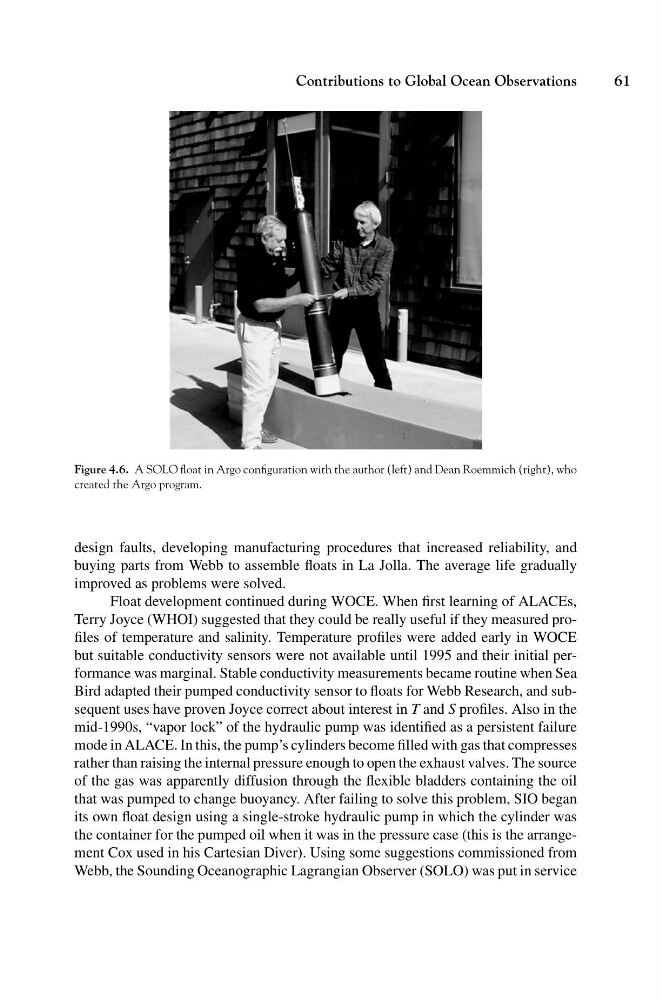
Figure 4.6. A SOLO float in Argo configuration with the author (left) and Dean Roemmich (right), who
created the Argo program.
design faults, developing manufacturing procedures that increased reliability, and
buying parts from Webb to assemble floats in La Jolla. The average life gradually
improved as problems were solved.
Float development continued during WOCE. When first learning of ALACEs,
Terry Joyce (WHOI) suggested that they could be really useful if they measured profiles of temperature and salinity. Temperature profiles were added early in WOCE
but suitable conductivity sensors were not available until 1995 and their initial performance was marginal. Stable conductivity measurements became routine when Sea
Bird adapted their pumped conductivity sensor to floats for Webb Research, and subsequent uses have proven Joyce correct about interest in T and S profiles. Also in the
mid-1990s, “vapor lock” of the hydraulic pump was identified as a persistent failure
mode in ALACE. In this, the pump’s cylinders become filled with gas that compresses
rather than raising the internal pressure enough to open the exhaust valves. The source
of the gas was apparently diffusion through the flexible bladders containing the oil
that was pumped to change buoyancy. After failing to solve this problem, SIO began
its own float design using a single-stroke hydraulic pump in which the cylinder was
the container for the pumped oil when it was in the pressure case (this is the arrangement Cox used in his Cartesian Diver). Using some suggestions commissioned from
Webb, the Sounding Oceanographic Lagrangian Observer (SOLO) was put in service
61
Figure 4.6. A SOLO float in Argo configuration with the author (left) and Dean Roemmich (right), who
created the Argo program.
design faults, developing manufacturing procedures that increased reliability, and
buying parts from Webb to assemble floats in La Jolla. The average life gradually
improved as problems were solved.
Float development continued during WOCE. When first learning of ALACEs,
Terry Joyce (WHOI) suggested that they could be really useful if they measured profiles of temperature and salinity. Temperature profiles were added early in WOCE
but suitable conductivity sensors were not available until 1995 and their initial performance was marginal. Stable conductivity measurements became routine when Sea
Bird adapted their pumped conductivity sensor to floats for Webb Research, and subsequent uses have proven Joyce correct about interest in T and S profiles. Also in the
mid-1990s, “vapor lock” of the hydraulic pump was identified as a persistent failure
mode in ALACE. In this, the pump’s cylinders become filled with gas that compresses
rather than raising the internal pressure enough to open the exhaust valves. The source
of the gas was apparently diffusion through the flexible bladders containing the oil
that was pumped to change buoyancy. After failing to solve this problem, SIO began
its own float design using a single-stroke hydraulic pump in which the cylinder was
the container for the pumped oil when it was in the pressure case (this is the arrangement Cox used in his Cartesian Diver). Using some suggestions commissioned from
Webb, the Sounding Oceanographic Lagrangian Observer (SOLO) was put in service