

Contributions to Global Ocean Observations
53
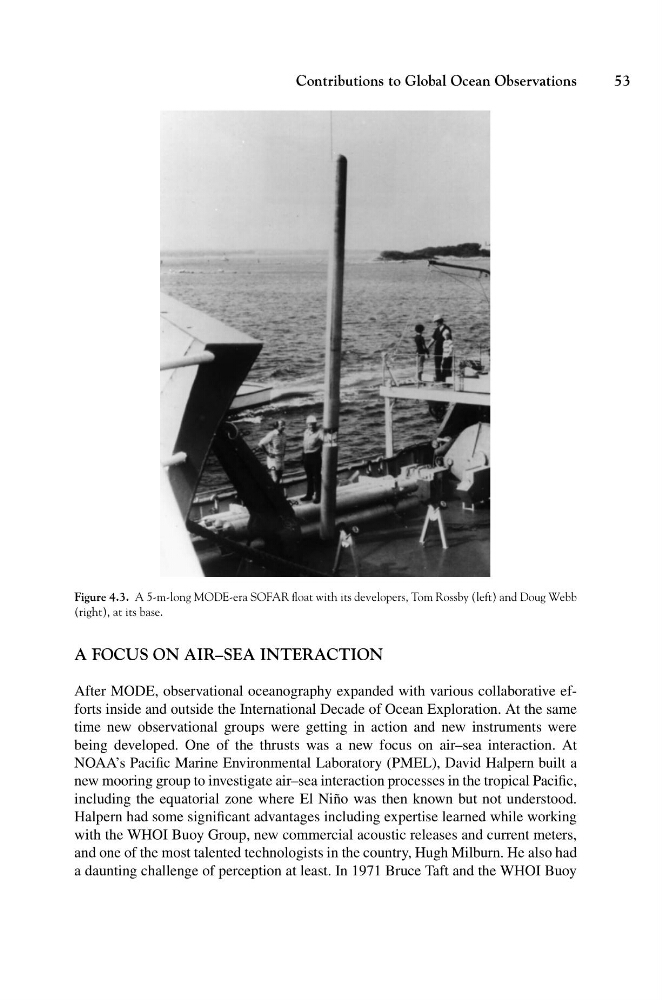
Figure 4.3. A 5-m-long MODE-era SOFAR float with its developers, Tom Rossby (left) and Doug Webb
(right), at its base.
A FOCUS ON AIR–SEA INTERACTION
After MODE, observational oceanography expanded with various collaborative efforts inside and outside the International Decade of Ocean Exploration. At the same
time new observational groups were getting in action and new instruments were
being developed. One of the thrusts was a new focus on air–sea interaction. At
NOAA’s Pacific Marine Environmental Laboratory (PMEL), David Halpern built a
new mooring group to investigate air–sea interaction processes in the tropical Pacific,
including the equatorial zone where El Ni˜ no was then known but not understood.
Halpern had some significant advantages including expertise learned while working
with the WHOI Buoy Group, new commercial acoustic releases and current meters,
and one of the most talented technologists in the country, Hugh Milburn. He also had
a daunting challenge of perception at least. In 1971 Bruce Taft and the WHOI Buoy
53
Figure 4.3. A 5-m-long MODE-era SOFAR float with its developers, Tom Rossby (left) and Doug Webb
(right), at its base.
A FOCUS ON AIR–SEA INTERACTION
After MODE, observational oceanography expanded with various collaborative efforts inside and outside the International Decade of Ocean Exploration. At the same
time new observational groups were getting in action and new instruments were
being developed. One of the thrusts was a new focus on air–sea interaction. At
NOAA’s Pacific Marine Environmental Laboratory (PMEL), David Halpern built a
new mooring group to investigate air–sea interaction processes in the tropical Pacific,
including the equatorial zone where El Ni˜ no was then known but not understood.
Halpern had some significant advantages including expertise learned while working
with the WHOI Buoy Group, new commercial acoustic releases and current meters,
and one of the most talented technologists in the country, Hugh Milburn. He also had
a daunting challenge of perception at least. In 1971 Bruce Taft and the WHOI Buoy