

Contributions to Global Ocean Observations
47
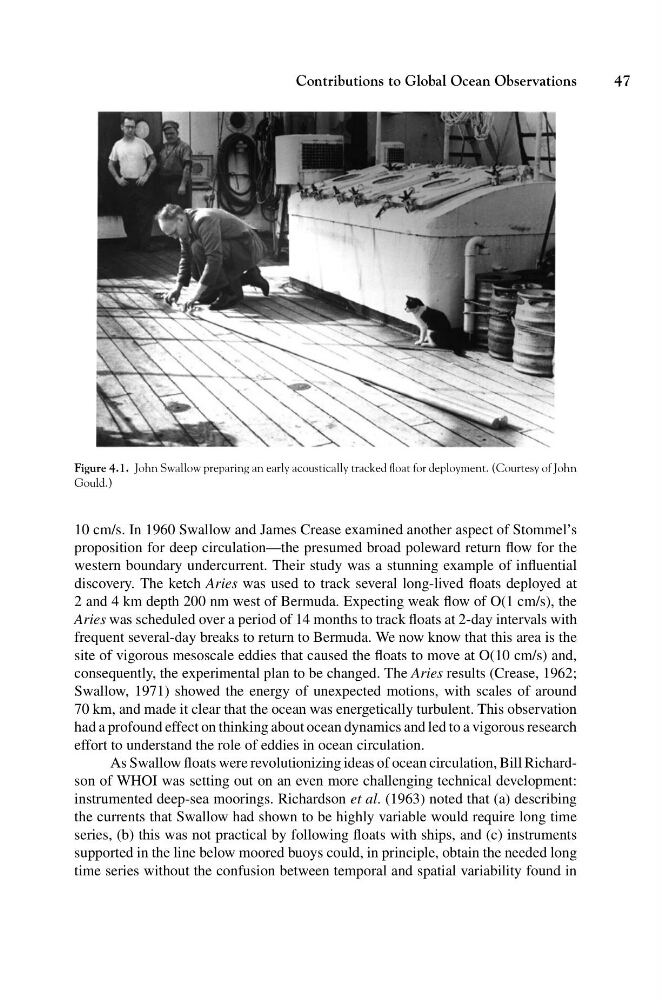
Figure 4.1. John Swallow preparing an early acoustically tracked float for deployment. (Courtesy of John
Gould.)
10 cm/s. In 1960 Swallow and James Crease examined another aspect of Stommel’s
proposition for deep circulation—the presumed broad poleward return flow for the
western boundary undercurrent. Their study was a stunning example of influential
discovery. The ketch Aries was used to track several long-lived floats deployed at
2 and 4 km depth 200 nm west of Bermuda. Expecting weak flow of O(1 cm/s), the
Aries was scheduled over a period of 14 months to track floats at 2-day intervals with
frequent several-day breaks to return to Bermuda. We now know that this area is the
site of vigorous mesoscale eddies that caused the floats to move at O(10 cm/s) and,
consequently, the experimental plan to be changed. The Aries results (Crease, 1962;
Swallow, 1971) showed the energy of unexpected motions, with scales of around
70 km, and made it clear that the ocean was energetically turbulent. This observation
had a profound effect on thinking about ocean dynamics and led to a vigorous research
effort to understand the role of eddies in ocean circulation.
As Swallow floats were revolutionizing ideas of ocean circulation, Bill Richardson of WHOI was setting out on an even more challenging technical development:
instrumented deep-sea moorings. Richardson et al. (1963) noted that (a) describing
the currents that Swallow had shown to be highly variable would require long time
series, (b) this was not practical by following floats with ships, and (c) instruments
supported in the line below moored buoys could, in principle, obtain the needed long
time series without the confusion between temporal and spatial variability found in
47
Figure 4.1. John Swallow preparing an early acoustically tracked float for deployment. (Courtesy of John
Gould.)
10 cm/s. In 1960 Swallow and James Crease examined another aspect of Stommel’s
proposition for deep circulation—the presumed broad poleward return flow for the
western boundary undercurrent. Their study was a stunning example of influential
discovery. The ketch Aries was used to track several long-lived floats deployed at
2 and 4 km depth 200 nm west of Bermuda. Expecting weak flow of O(1 cm/s), the
Aries was scheduled over a period of 14 months to track floats at 2-day intervals with
frequent several-day breaks to return to Bermuda. We now know that this area is the
site of vigorous mesoscale eddies that caused the floats to move at O(10 cm/s) and,
consequently, the experimental plan to be changed. The Aries results (Crease, 1962;
Swallow, 1971) showed the energy of unexpected motions, with scales of around
70 km, and made it clear that the ocean was energetically turbulent. This observation
had a profound effect on thinking about ocean dynamics and led to a vigorous research
effort to understand the role of eddies in ocean circulation.
As Swallow floats were revolutionizing ideas of ocean circulation, Bill Richardson of WHOI was setting out on an even more challenging technical development:
instrumented deep-sea moorings. Richardson et al. (1963) noted that (a) describing
the currents that Swallow had shown to be highly variable would require long time
series, (b) this was not practical by following floats with ships, and (c) instruments
supported in the line below moored buoys could, in principle, obtain the needed long
time series without the confusion between temporal and spatial variability found in