

36
Kirk Bryan
grid, an amazingly high resolution for the limited computing resources available.
North Atlantic simulations with essentially the same experimental design are now
being carried out with 1/10
◦
× 1/10
◦ latitude–longitude spacing (Smith et al., 2000).
This amounts to a factor of 20 in improved horizontal resolution. The modern calculations are able to capture a rich range of synoptic variability, but it is amazing how
much Cox’s prototype numerical experiment, 30 years earlier, captures the essential
features of the large-scale circulation of the World Ocean.
The Takano et al. (NAS,1975) model was developed at UCLA by Yale Mintz’s
group. Takano’s model was not actually ready at the time of the conference, but appears
in the Academy Report. It was based on a somewhat idealized geometry of the World
Ocean. It represents one of the earliest calculations of the World Ocean circulation
with a forward model, in which the temperature and salinity fields are predicted from a
resting initial state. The model contained some important improvements in numerics,
which greatly simplified filtering the external waves in the original (Bryan, 1969)
model.
In recent years all publicly funded, nonclassified projects must publish their
software, making it available to the community. This was not always the case, and
Joe Smagorinsky, who was very advanced in his thinking in other ways, thought that
publication with a detailed description of methods was sufficient. The old assembly
language codes that he was accustomed to would be of little use to another group, in
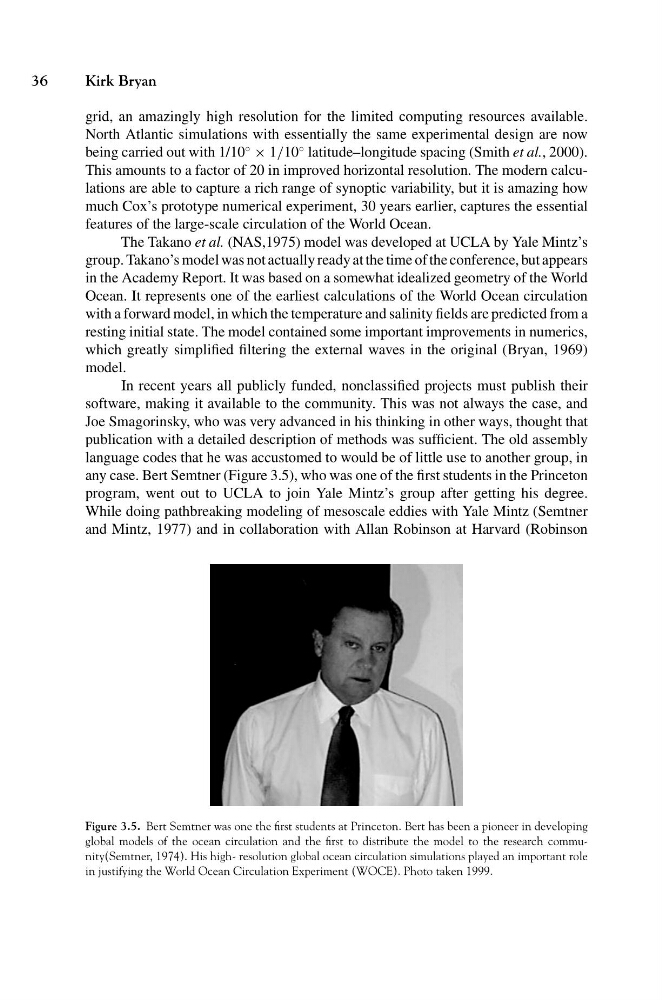
any case. Bert Semtner (Figure 3.5), who was one of the first students in the Princeton
program, went out to UCLA to join Yale Mintz’s group after getting his degree.
While doing pathbreaking modeling of mesoscale eddies with Yale Mintz (Semtner
and Mintz, 1977) and in collaboration with Allan Robinson at Harvard (Robinson
Figure 3.5. Bert Semtner was one the first students at Princeton. Bert has been a pioneer in developing
global models of the ocean circulation and the first to distribute the model to the research community(Semtner, 1974). His high- resolution global ocean circulation simulations played an important role
in justifying the World Ocean Circulation Experiment (WOCE). Photo taken 1999.
Kirk Bryan
grid, an amazingly high resolution for the limited computing resources available.
North Atlantic simulations with essentially the same experimental design are now
being carried out with 1/10
◦
× 1/10
◦ latitude–longitude spacing (Smith et al., 2000).
This amounts to a factor of 20 in improved horizontal resolution. The modern calculations are able to capture a rich range of synoptic variability, but it is amazing how
much Cox’s prototype numerical experiment, 30 years earlier, captures the essential
features of the large-scale circulation of the World Ocean.
The Takano et al. (NAS,1975) model was developed at UCLA by Yale Mintz’s
group. Takano’s model was not actually ready at the time of the conference, but appears
in the Academy Report. It was based on a somewhat idealized geometry of the World
Ocean. It represents one of the earliest calculations of the World Ocean circulation
with a forward model, in which the temperature and salinity fields are predicted from a
resting initial state. The model contained some important improvements in numerics,
which greatly simplified filtering the external waves in the original (Bryan, 1969)
model.
In recent years all publicly funded, nonclassified projects must publish their
software, making it available to the community. This was not always the case, and
Joe Smagorinsky, who was very advanced in his thinking in other ways, thought that
publication with a detailed description of methods was sufficient. The old assembly
language codes that he was accustomed to would be of little use to another group, in
any case. Bert Semtner (Figure 3.5), who was one of the first students in the Princeton
program, went out to UCLA to join Yale Mintz’s group after getting his degree.
While doing pathbreaking modeling of mesoscale eddies with Yale Mintz (Semtner
and Mintz, 1977) and in collaboration with Allan Robinson at Harvard (Robinson
Figure 3.5. Bert Semtner was one the first students at Princeton. Bert has been a pioneer in developing
global models of the ocean circulation and the first to distribute the model to the research community(Semtner, 1974). His high- resolution global ocean circulation simulations played an important role
in justifying the World Ocean Circulation Experiment (WOCE). Photo taken 1999.