

Interview with Klaus Wyrtki
211
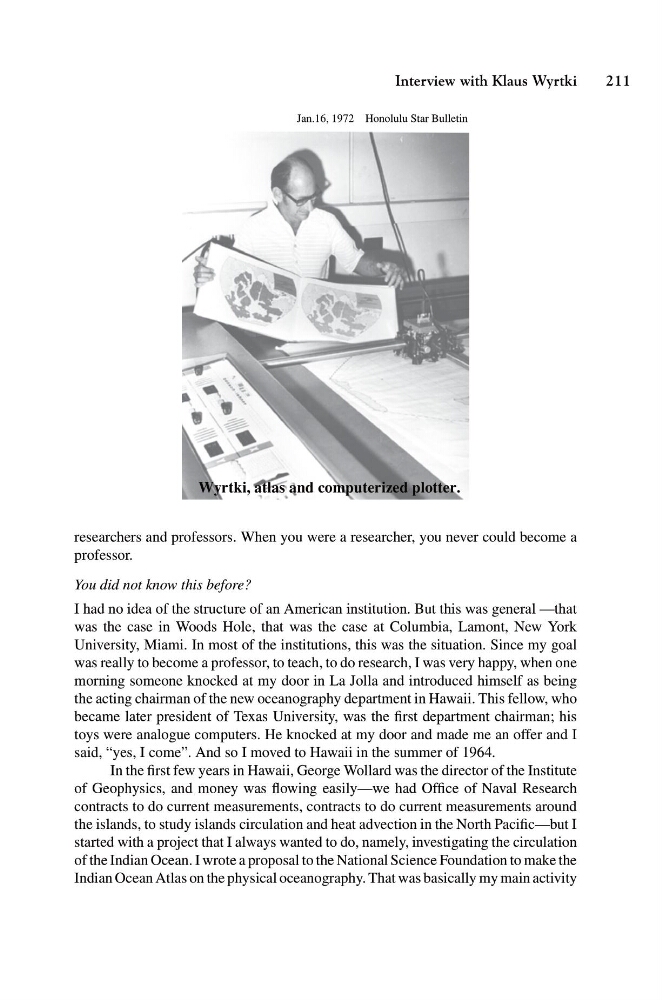
Wyrtki, atlas and computerized plotter.
Jan.16, 1972 Honolulu Star Bulletin
researchers and professors. When you were a researcher, you never could become a
professor.
You did not know this before?
I had no idea of the structure of an American institution. But this was general —that
was the case in Woods Hole, that was the case at Columbia, Lamont, New York
University, Miami. In most of the institutions, this was the situation. Since my goal
was really to become a professor, to teach, to do research, I was very happy, when one
morning someone knocked at my door in La Jolla and introduced himself as being
the acting chairman of the new oceanography department in Hawaii. This fellow, who
became later president of Texas University, was the first department chairman; his
toys were analogue computers. He knocked at my door and made me an offer and I
said, “yes, I come”. And so I moved to Hawaii in the summer of 1964.
In the first few years in Hawaii, George Wollard was the director of the Institute
of Geophysics, and money was flowing easily—we had Office of Naval Research
contracts to do current measurements, contracts to do current measurements around
the islands, to study islands circulation and heat advection in the North Pacific—but I
started with a project that I always wanted to do, namely, investigating the circulation
of the Indian Ocean. I wrote a proposal to the National Science Foundation to make the
Indian Ocean Atlas on the physical oceanography. That was basically my main activity
211
Wyrtki, atlas and computerized plotter.
Jan.16, 1972 Honolulu Star Bulletin
researchers and professors. When you were a researcher, you never could become a
professor.
You did not know this before?
I had no idea of the structure of an American institution. But this was general —that
was the case in Woods Hole, that was the case at Columbia, Lamont, New York
University, Miami. In most of the institutions, this was the situation. Since my goal
was really to become a professor, to teach, to do research, I was very happy, when one
morning someone knocked at my door in La Jolla and introduced himself as being
the acting chairman of the new oceanography department in Hawaii. This fellow, who
became later president of Texas University, was the first department chairman; his
toys were analogue computers. He knocked at my door and made me an offer and I
said, “yes, I come”. And so I moved to Hawaii in the summer of 1964.
In the first few years in Hawaii, George Wollard was the director of the Institute
of Geophysics, and money was flowing easily—we had Office of Naval Research
contracts to do current measurements, contracts to do current measurements around
the islands, to study islands circulation and heat advection in the North Pacific—but I
started with a project that I always wanted to do, namely, investigating the circulation
of the Indian Ocean. I wrote a proposal to the National Science Foundation to make the
Indian Ocean Atlas on the physical oceanography. That was basically my main activity