

Interview with Klaus Wyrtki
207
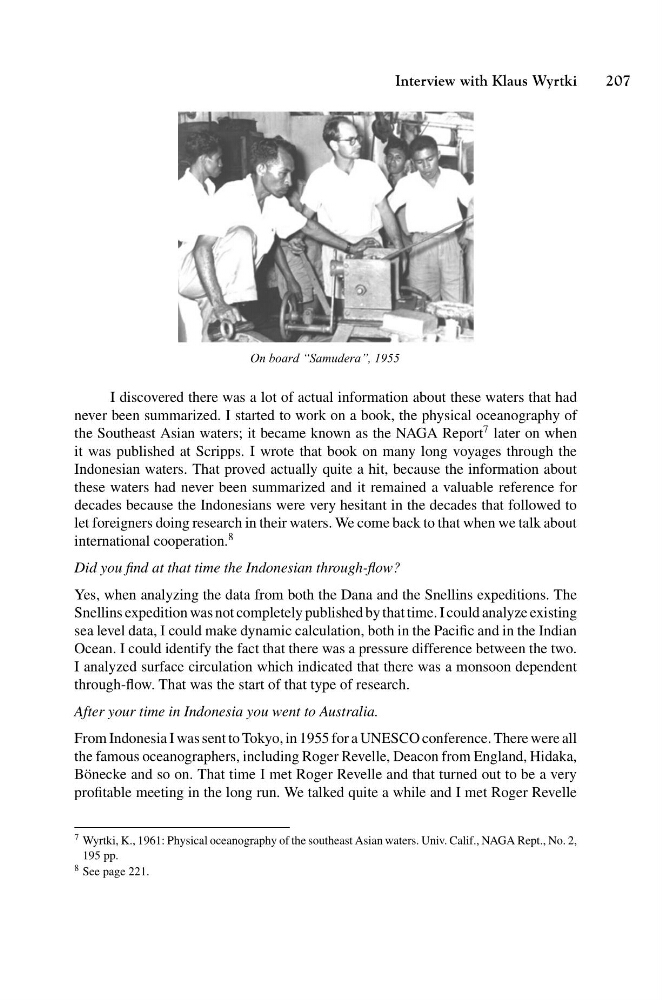
On board “Samudera”, 1955
I discovered there was a lot of actual information about these waters that had
never been summarized. I started to work on a book, the physical oceanography of
the Southeast Asian waters; it became known as the NAGA Report
7 later on when
it was published at Scripps. I wrote that book on many long voyages through the
Indonesian waters. That proved actually quite a hit, because the information about
these waters had never been summarized and it remained a valuable reference for
decades because the Indonesians were very hesitant in the decades that followed to
let foreigners doing research in their waters. We come back to that when we talk about
international cooperation.
8
Did you find at that time the Indonesian through-flow?
Yes, when analyzing the data from both the Dana and the Snellins expeditions. The
Snellins expedition was not completely published by that time. I could analyze existing
sea level data, I could make dynamic calculation, both in the Pacific and in the Indian
Ocean. I could identify the fact that there was a pressure difference between the two.
I analyzed surface circulation which indicated that there was a monsoon dependent
through-flow. That was the start of that type of research.
After your time in Indonesia you went to Australia.
From Indonesia I was sent to Tokyo, in 1955 for a UNESCO conference. There were all
the famous oceanographers, including Roger Revelle, Deacon from England, Hidaka,
B¨ onecke and so on. That time I met Roger Revelle and that turned out to be a very
profitable meeting in the long run. We talked quite a while and I met Roger Revelle
7 Wyrtki, K., 1961: Physical oceanography of the southeast Asian waters. Univ. Calif., NAGA Rept., No. 2,
195 pp.
8 See page 221.
207
On board “Samudera”, 1955
I discovered there was a lot of actual information about these waters that had
never been summarized. I started to work on a book, the physical oceanography of
the Southeast Asian waters; it became known as the NAGA Report
7 later on when
it was published at Scripps. I wrote that book on many long voyages through the
Indonesian waters. That proved actually quite a hit, because the information about
these waters had never been summarized and it remained a valuable reference for
decades because the Indonesians were very hesitant in the decades that followed to
let foreigners doing research in their waters. We come back to that when we talk about
international cooperation.
8
Did you find at that time the Indonesian through-flow?
Yes, when analyzing the data from both the Dana and the Snellins expeditions. The
Snellins expedition was not completely published by that time. I could analyze existing
sea level data, I could make dynamic calculation, both in the Pacific and in the Indian
Ocean. I could identify the fact that there was a pressure difference between the two.
I analyzed surface circulation which indicated that there was a monsoon dependent
through-flow. That was the start of that type of research.
After your time in Indonesia you went to Australia.
From Indonesia I was sent to Tokyo, in 1955 for a UNESCO conference. There were all
the famous oceanographers, including Roger Revelle, Deacon from England, Hidaka,
B¨ onecke and so on. That time I met Roger Revelle and that turned out to be a very
profitable meeting in the long run. We talked quite a while and I met Roger Revelle
7 Wyrtki, K., 1961: Physical oceanography of the southeast Asian waters. Univ. Calif., NAGA Rept., No. 2,
195 pp.
8 See page 221.