

Ocean Acoustic Tomography
125
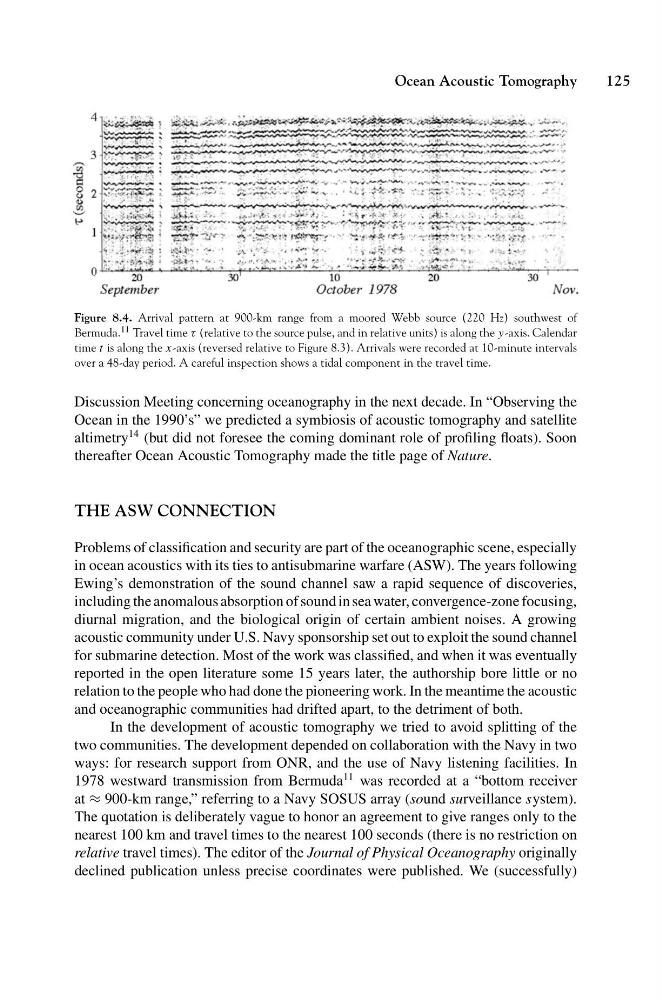
Figure 8.4. Arrival pattern at 900-km range from a moored Webb source (220 Hz) southwest of
Bermuda. 11 Travel time τ (relative to the source pulse, and in relative units) is along the y-axis. Calendar
time t is along the x-axis (reversed relative to Figure 8.3). Arrivals were recorded at 10-minute intervals
over a 48-day period. A careful inspection shows a tidal component in the travel time.
Discussion Meeting concerning oceanography in the next decade. In “Observing the
Ocean in the 1990’s” we predicted a symbiosis of acoustic tomography and satellite
altimetry
14 (but did not foresee the coming dominant role of profiling floats). Soon
thereafter Ocean Acoustic Tomography made the title page of Nature.
THE ASW CONNECTION
Problems of classification and security are part of the oceanographic scene, especially
in ocean acoustics with its ties to antisubmarine warfare (ASW). The years following
Ewing’s demonstration of the sound channel saw a rapid sequence of discoveries,
including the anomalous absorption of sound in sea water, convergence-zone focusing,
diurnal migration, and the biological origin of certain ambient noises. A growing
acoustic community under U.S. Navy sponsorship set out to exploit the sound channel
for submarine detection. Most of the work was classified, and when it was eventually
reported in the open literature some 15 years later, the authorship bore little or no
relation to the people who had done the pioneering work. In the meantime the acoustic
and oceanographic communities had drifted apart, to the detriment of both.
In the development of acoustic tomography we tried to avoid splitting of the
two communities. The development depended on collaboration with the Navy in two
ways: for research support from ONR, and the use of Navy listening facilities. In
1978 westward transmission from Bermuda
11 was recorded at a “bottom receiver
at ≈ 900-km range,” referring to a Navy SOSUS array (sound surveillance system).
The quotation is deliberately vague to honor an agreement to give ranges only to the
nearest 100 km and travel times to the nearest 100 seconds (there is no restriction on
relative travel times). The editor of the Journal of Physical Oceanography originally
declined publication unless precise coordinates were published. We (successfully)
125
Figure 8.4. Arrival pattern at 900-km range from a moored Webb source (220 Hz) southwest of
Bermuda. 11 Travel time τ (relative to the source pulse, and in relative units) is along the y-axis. Calendar
time t is along the x-axis (reversed relative to Figure 8.3). Arrivals were recorded at 10-minute intervals
over a 48-day period. A careful inspection shows a tidal component in the travel time.
Discussion Meeting concerning oceanography in the next decade. In “Observing the
Ocean in the 1990’s” we predicted a symbiosis of acoustic tomography and satellite
altimetry
14 (but did not foresee the coming dominant role of profiling floats). Soon
thereafter Ocean Acoustic Tomography made the title page of Nature.
THE ASW CONNECTION
Problems of classification and security are part of the oceanographic scene, especially
in ocean acoustics with its ties to antisubmarine warfare (ASW). The years following
Ewing’s demonstration of the sound channel saw a rapid sequence of discoveries,
including the anomalous absorption of sound in sea water, convergence-zone focusing,
diurnal migration, and the biological origin of certain ambient noises. A growing
acoustic community under U.S. Navy sponsorship set out to exploit the sound channel
for submarine detection. Most of the work was classified, and when it was eventually
reported in the open literature some 15 years later, the authorship bore little or no
relation to the people who had done the pioneering work. In the meantime the acoustic
and oceanographic communities had drifted apart, to the detriment of both.
In the development of acoustic tomography we tried to avoid splitting of the
two communities. The development depended on collaboration with the Navy in two
ways: for research support from ONR, and the use of Navy listening facilities. In
1978 westward transmission from Bermuda
11 was recorded at a “bottom receiver
at ≈ 900-km range,” referring to a Navy SOSUS array (sound surveillance system).
The quotation is deliberately vague to honor an agreement to give ranges only to the
nearest 100 km and travel times to the nearest 100 seconds (there is no restriction on
relative travel times). The editor of the Journal of Physical Oceanography originally
declined publication unless precise coordinates were published. We (successfully)