

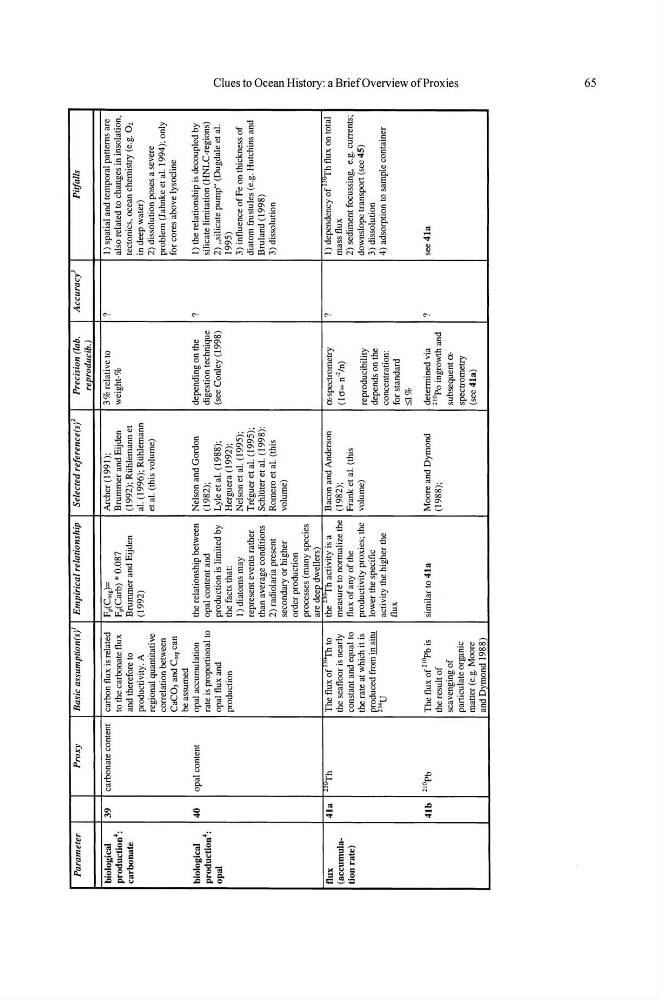
Parameter
Proxy
Basic assumption(sl Empirical relationship
biological
39
carbonate content carbon flux is related
F,(C",)production 4
:
to the carbonate flux
F,(Carb)
* 0.087
carbonate
and therefore to
Brummer and Eijden
productivity. A
(1992)
regional quantitative
correlation between
CaCO) and Corg can
be assumed
biological
40
opal content
opal accumulation
the relationship between
production 4
:
rate is proportional to opal content and
opal
opal flux and
production is limited by
production
the facts that:
1)
diatoms may
represent events rather
than average conditions
2) radiolaria present
secondary or higher
order production
processes (many species
are deep dwellers)
flux
41a ""Th
The flux of ""Th to
the
,".:IuTh activity is a
(accumula·
the seafloor is nearly
measure to normalize the
tion rate)
constant and equal to
flux of any of the
the rate at which
it is
productivity proxies; the
produced from in situ
lower the specific
2)4U
activity the higher the
flux
41b 2lOPb
The flux Of 2lO
Pb is
similar to
41a
the result of
scavenging of
particulate organic
matter (e.g. Moore
and Di'mond 1988)
Selected reference(s)'
Precision (lab.
reproducib.)
Archer (1991);
3% relative to
Brummer and Eijden
weight-%
(1992); Riihlemann et
al. (1996); Rlihlemann
et al. (this volume)
Nelson and Gordon
depending on the
(1982);
digestion technique
Lyle et al. (1988);
(see Conley (1998)
Herguera (1992);
Nelson et al. (1995);
Treguer et .1. (1995);
SchlUter et al. (1998):
Romero et al. (this
volume)
Bacon and Anderson
a-spectrometry
(1982);
Frank et al. (this
(lcr= n"/n)
volume)
reproducibility
depends on the
concentration:
for standard
g%
Moore and Dymond
determined via
(1988);
210pO
ingrowth and
subsequent
cxspectrometry
(see 413)
Accurac/
Pitfalls
?
1) spatial and temporal patterns are
also related to changes in insolation,
tectonics, ocean chemistry (e.g. O2
in deep water)
2) dissolution poses a severe
problem (Jahnke et al. 1994); only
for cores above lysocline
?
I) the relationship is decoupled by
silicate limitation (HNLC-regions)
2) •• silicate pump" (Dugdale et al.
1995)
3) influence of Fe on thickness of
diatom frustules (e.g. Hutchins and
Bruland (1998)
3)
dissolution
?
I) dependency of ""Th flux on total
mass flux
2) sediment focussing, e.g. currents;
downslope transport (see 45)
3)
dissolution
4) adsorption to sample container
?
see
41a
n
2"
<1>
'"
SO
..,
<1>
§
a:;
~
'" to
::J.
<1>
....,
~
~
~.
o
....,
~
;;;.
'"
a-,
v.
Proxy
Basic assumption(sl Empirical relationship
biological
39
carbonate content carbon flux is related
F,(C",)production 4
:
to the carbonate flux
F,(Carb)
* 0.087
carbonate
and therefore to
Brummer and Eijden
productivity. A
(1992)
regional quantitative
correlation between
CaCO) and Corg can
be assumed
biological
40
opal content
opal accumulation
the relationship between
production 4
:
rate is proportional to opal content and
opal
opal flux and
production is limited by
production
the facts that:
1)
diatoms may
represent events rather
than average conditions
2) radiolaria present
secondary or higher
order production
processes (many species
are deep dwellers)
flux
41a ""Th
The flux of ""Th to
the
,".:IuTh activity is a
(accumula·
the seafloor is nearly
measure to normalize the
tion rate)
constant and equal to
flux of any of the
the rate at which
it is
productivity proxies; the
produced from in situ
lower the specific
2)4U
activity the higher the
flux
41b 2lOPb
The flux Of 2lO
Pb is
similar to
41a
the result of
scavenging of
particulate organic
matter (e.g. Moore
and Di'mond 1988)
Selected reference(s)'
Precision (lab.
reproducib.)
Archer (1991);
3% relative to
Brummer and Eijden
weight-%
(1992); Riihlemann et
al. (1996); Rlihlemann
et al. (this volume)
Nelson and Gordon
depending on the
(1982);
digestion technique
Lyle et al. (1988);
(see Conley (1998)
Herguera (1992);
Nelson et al. (1995);
Treguer et .1. (1995);
SchlUter et al. (1998):
Romero et al. (this
volume)
Bacon and Anderson
a-spectrometry
(1982);
Frank et al. (this
(lcr= n"/n)
volume)
reproducibility
depends on the
concentration:
for standard
g%
Moore and Dymond
determined via
(1988);
210pO
ingrowth and
subsequent
cxspectrometry
(see 413)
Accurac/
Pitfalls
?
1) spatial and temporal patterns are
also related to changes in insolation,
tectonics, ocean chemistry (e.g. O2
in deep water)
2) dissolution poses a severe
problem (Jahnke et al. 1994); only
for cores above lysocline
?
I) the relationship is decoupled by
silicate limitation (HNLC-regions)
2) •• silicate pump" (Dugdale et al.
1995)
3) influence of Fe on thickness of
diatom frustules (e.g. Hutchins and
Bruland (1998)
3)
dissolution
?
I) dependency of ""Th flux on total
mass flux
2) sediment focussing, e.g. currents;
downslope transport (see 45)
3)
dissolution
4) adsorption to sample container
?
see
41a
n
2"
<1>
'"
SO
..,
<1>
§
a:;
~
'" to
::J.
<1>
....,
~
~
~.
o
....,
~
;;;.
'"
a-,
v.