

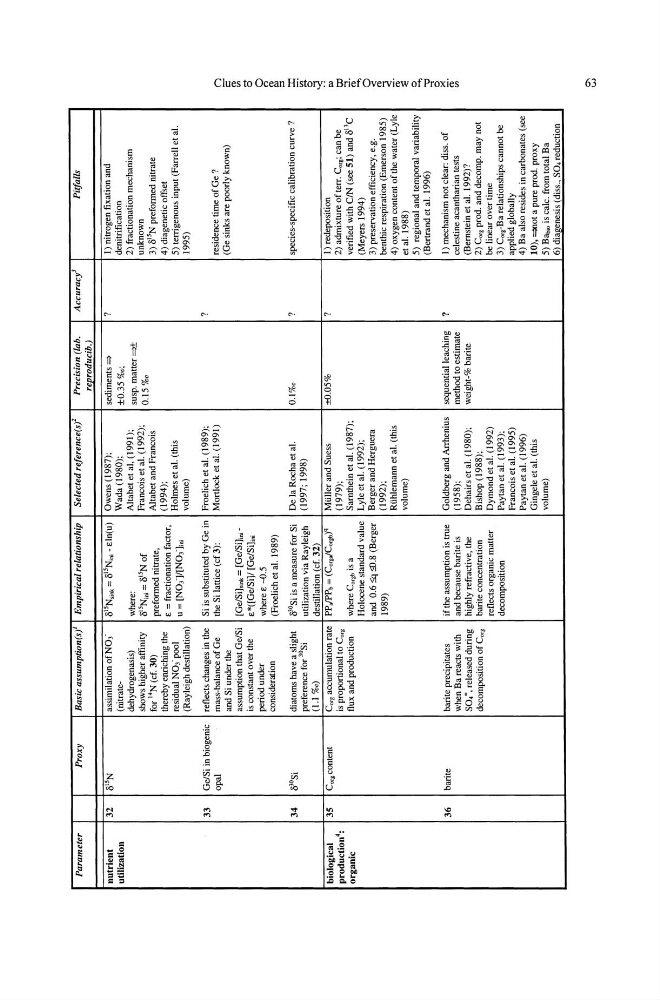
Parameter
Proxy
Basic assumption(s)' Empirical relationship
nutrient
32
/i"N
assimilation of
N03"
/i1'N.""
= /i1'N;,; - Eln(u)
utilization
(nitratedehydrogenasis)
where:
shows bigher affinity
/i1'N;,;
= /i1'N of
for I'N (cf. 30)
preformed nitrate,
thereby enriching the
E
= fractionation factor,
residual NO, pool
u
= [NO,l/[NO,-);,;
(Rayleigh destillation)
33
GeiSi in biogenic reflects cbanges in the Si is substituted
by Ge in
opal
mass-balance of Ge
the Si lattice (cf3):
and Si under the
assumption that GeiSi [GelSi),;""
= (GelSi);,;is constant over the
E *([GelSi)/ [GelSi);,;
period under
whereE
-0.5
consideration
(Froelich et al. 1989)
34
&'°Si
diatoms have a slight
&'°Si is a measure for Si
preference for 30Si
utilization via Rayleigh
(1.1 %.)
destillation (cf.
32)
biological
35
Corgcontent
Corg accumulation rate PP,lPPb -
(C • ..,ICMgb)q
production':
is proportional to
Co"
organic
flux and production
where Corgi) is a
Holocene standard value
and 0.6 ~
SO.8 (Berger
1989)
36
barite
barite precipitates
if the assumption is true
when Ba reacts with
and because barite is
SO,
=, released during highly refractive, the
decomposition of Corg barite concentration
reflects organic matter
decomposition
Selected reference(s)'
Precision (lab.
reproducib.J
Owens (1987);
sediments ;;;;;;:>
Wada (1980);
±0.35 %.;
Altabet et
ai, (1991);
susp. matrer =:d:
Francois
et al. (1992);
0.15%.
Altabet and Francois
(1994);
Holmes et al. (this
volume)
Froelich et
aI. (1989);
Mortlock et al. (1991)
De la Rocha
et al.
0.1%.
(1997; 1998)
Miiller and Suess
±O.05%
(1979);
Sarnthein et
aI. (1987);
Lyle et a!. (1992);
Berger and Hergnera
(1992);
Riihlemann et
aI. (this
volume)
Goldberg and Arrhenius sequential leaching
(1958);
method to estimate
Dehairs et al. (1980);
weight-% barite
Bishop (1988);
Dymond et al. (1992)
Paytan et al. (1993);
Francois
et al. (1995)
Paytan et
aI. (1996)
Gingele et al. (this
volume)
Accuracy'
Pitfalls
1
1) nitrogen fixation and
denitrification
2) fractionation mechanism
unknown
3) /i1'N preformed nitrate
4) diagenetic offset
5) terrigenous input (Farrell et
aI.
1995)
1
residence time of Ge ?
(Ge sinks
are poorly known)
1
species-specific calibration curve?
1
1)
redeposition
2) admixture of terr.
Co,.; can be
verified with
C/N (see 51) and /i13C
(Meyers 1994)
3) preservation efficiency, e.g.
benthic respiration (Emerson 1985)
4) oxygen content of the water (Lyle
et
aI. 1988)
5) regional and temporal variability
(Bertrand et
aI. 1996)
?
1) mechanism not clear: diss. of
celestine acantharian tests
(Bernstein et al. 1992)1
2) CM • prod. and decomp. may not
be
linear over time
3) C.,,-Ba relationships cannot be
applied globally
4)
Ba also resides in carbonates (see
10), =01
a pure prod. proxy
5) Babl. is calc. from total Ba
6) diagenesis (diss., SO, reduction
(j
[
S"
i
J .,
C;
~.
...,
r.
g,
~
CD'
C/>
0w
Proxy
Basic assumption(s)' Empirical relationship
nutrient
32
/i"N
assimilation of
N03"
/i1'N.""
= /i1'N;,; - Eln(u)
utilization
(nitratedehydrogenasis)
where:
shows bigher affinity
/i1'N;,;
= /i1'N of
for I'N (cf. 30)
preformed nitrate,
thereby enriching the
E
= fractionation factor,
residual NO, pool
u
= [NO,l/[NO,-);,;
(Rayleigh destillation)
33
GeiSi in biogenic reflects cbanges in the Si is substituted
by Ge in
opal
mass-balance of Ge
the Si lattice (cf3):
and Si under the
assumption that GeiSi [GelSi),;""
= (GelSi);,;is constant over the
E *([GelSi)/ [GelSi);,;
period under
whereE
-0.5
consideration
(Froelich et al. 1989)
34
&'°Si
diatoms have a slight
&'°Si is a measure for Si
preference for 30Si
utilization via Rayleigh
(1.1 %.)
destillation (cf.
32)
biological
35
Corgcontent
Corg accumulation rate PP,lPPb -
(C • ..,ICMgb)q
production':
is proportional to
Co"
organic
flux and production
where Corgi) is a
Holocene standard value
and 0.6 ~
SO.8 (Berger
1989)
36
barite
barite precipitates
if the assumption is true
when Ba reacts with
and because barite is
SO,
=, released during highly refractive, the
decomposition of Corg barite concentration
reflects organic matter
decomposition
Selected reference(s)'
Precision (lab.
reproducib.J
Owens (1987);
sediments ;;;;;;:>
Wada (1980);
±0.35 %.;
Altabet et
ai, (1991);
susp. matrer =:d:
Francois
et al. (1992);
0.15%.
Altabet and Francois
(1994);
Holmes et al. (this
volume)
Froelich et
aI. (1989);
Mortlock et al. (1991)
De la Rocha
et al.
0.1%.
(1997; 1998)
Miiller and Suess
±O.05%
(1979);
Sarnthein et
aI. (1987);
Lyle et a!. (1992);
Berger and Hergnera
(1992);
Riihlemann et
aI. (this
volume)
Goldberg and Arrhenius sequential leaching
(1958);
method to estimate
Dehairs et al. (1980);
weight-% barite
Bishop (1988);
Dymond et al. (1992)
Paytan et al. (1993);
Francois
et al. (1995)
Paytan et
aI. (1996)
Gingele et al. (this
volume)
Accuracy'
Pitfalls
1
1) nitrogen fixation and
denitrification
2) fractionation mechanism
unknown
3) /i1'N preformed nitrate
4) diagenetic offset
5) terrigenous input (Farrell et
aI.
1995)
1
residence time of Ge ?
(Ge sinks
are poorly known)
1
species-specific calibration curve?
1
1)
redeposition
2) admixture of terr.
Co,.; can be
verified with
C/N (see 51) and /i13C
(Meyers 1994)
3) preservation efficiency, e.g.
benthic respiration (Emerson 1985)
4) oxygen content of the water (Lyle
et
aI. 1988)
5) regional and temporal variability
(Bertrand et
aI. 1996)
?
1) mechanism not clear: diss. of
celestine acantharian tests
(Bernstein et al. 1992)1
2) CM • prod. and decomp. may not
be
linear over time
3) C.,,-Ba relationships cannot be
applied globally
4)
Ba also resides in carbonates (see
10), =01
a pure prod. proxy
5) Babl. is calc. from total Ba
6) diagenesis (diss., SO, reduction
(j
[
S"
i
J .,
C;
~.
...,
r.
g,
~
CD'
C/>
0w