

Data Management of Proxy Parameters with PANGAEA
719
larly updated. The parameter list is organized in 26
groups and consists of about 2000 parameter definitions of different types. All the proxy parameters
necessary for paleoceanography are included, together with their raw data and with the 'paleo-parameters' evaluated from the proxy data. Accessible from the EVENT field, the core description
is stored as a graphic in an interchangeable format.
Analytical methods can be defined with all the
necessary information. References for cruise reports or published data can be typed in or imported
from professional bibliography software.
In 1995, the NGDC/WDC-A published the prerelease of the Index to Marine Geological Samples
on CD (Moore 1995). From this source the metadata of cores from six of the large core repositorInstitution
ies of the USA were extracted and imported into
PANGAEA. Cores and samples from these repositories are used internationally and the analytical
data were also stored in PANGAEA. Importing
complete collections makes the import of analytical data much more efficient because the scientist
does not have to consider any further metadata before importing analytical data from a
specific core. The meta-data of sampling sites
of paleoceanographic relevance also include all
DSDP and ODP cores, the German core repositories, cores taken on French expeditions and sites
of British, Norwegian and Russian research vessels. In 1997, PANGAEA comprised about 70 000
sites of oceanic sampling, measurements and observations.
I ~ I
I
PROJECT
I
Staff
~
Area
1 1 CAMPAIGN 1 ..... 1
Basis
I
SITE
I <~
~ B "'"
ArchivE'
SampleType
SAMPLE
< 1 I .....
Method
DATA
Reference
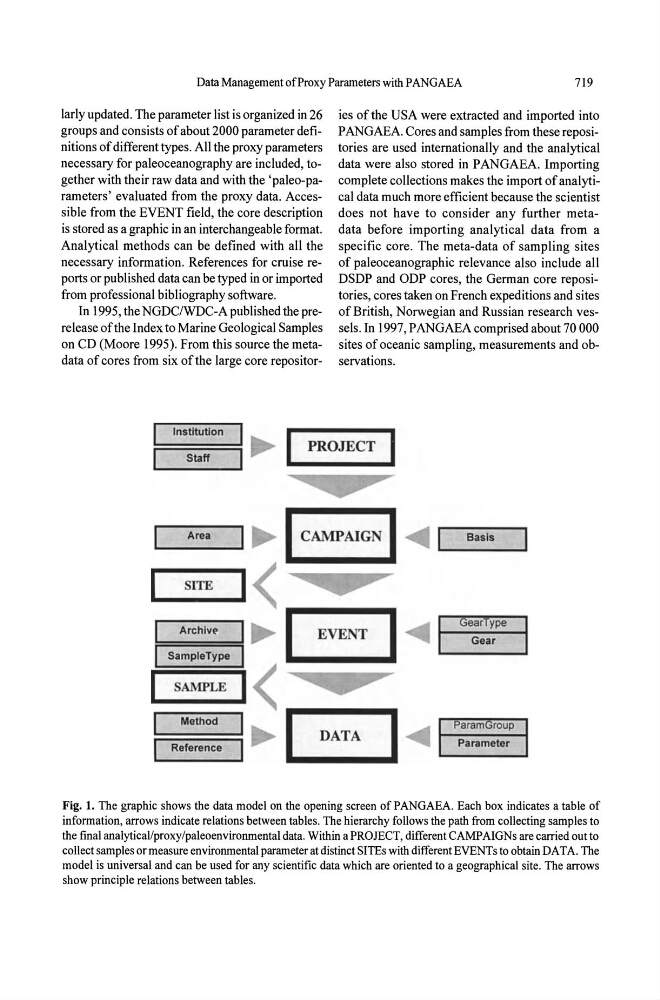
Fig.!. The graphic shows the data model on the opening screen of PANGAEA. Each box indicates a table of
information, arrows indicate relations between tables. The hierarchy follows the path from collecting samples to
the final analytical/proxy/paleoenvironmental data. Within a PROJECT, different CAMPAIGNs are carried out to
collect samples or measure environmental parameter at distinct SITEs with different EVENTs to obtain DATA. The
model is universal and can be used for any scientific data which are oriented to a geographical site. The arrows
show principle relations between tables.