

Reconstructing and Modelling the Last Glacial Maximum
695
Modem Convection Depths (lan)
IJcjqici" 80'N
u:"'~.·..:illr60'N
b- · )
,---- ' ~.: - . E 1 1 20'N
60'W
40'W
20'W
LGM Convection Depths (lan)
0'
20'E
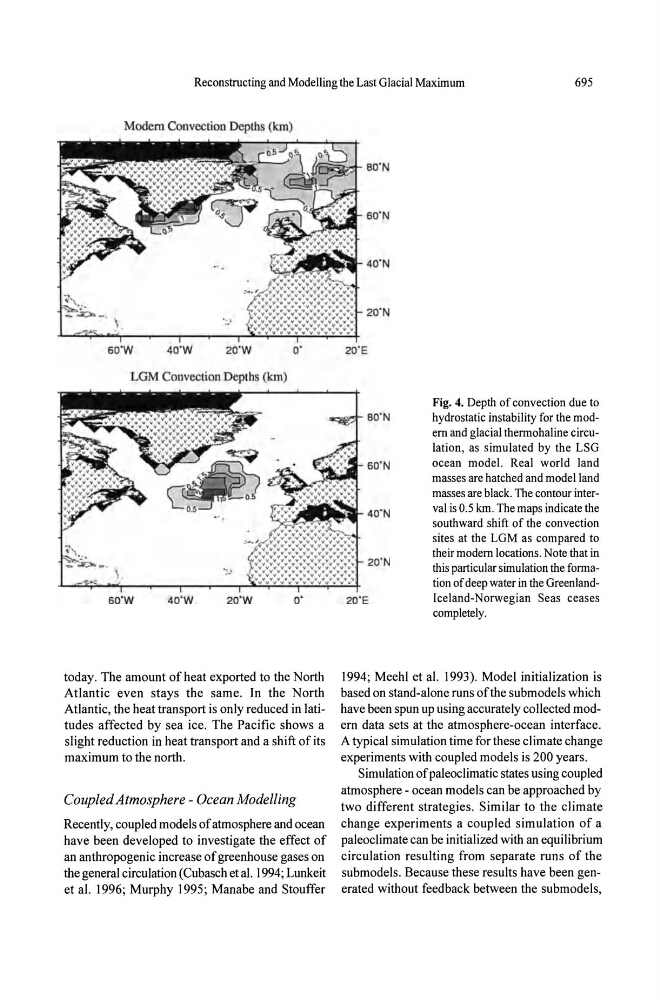
Fig. 4, Depth of convection due to
80'N
hydrostatic instability for the modem and glacial thermohaline circulation, as simulated by the LSG
60'N
ocean model. Real world land
masses are hatched and model land
masses are black. The contour inter~~!tl~~~ 40'N
val is 0.5 km. The maps indicate the
I:.
southward shift of the convection
1 ~::=.l, __ --~-~~jl~![!]jt sites at the LGM as compared to
their modem locations. Note that in
'"
20'N
this particular simulation the formation of deep water in the Greenland60'W
40'W
20'W
O'
today. The amount of heat exported to the North
Atlantic . even stays the same. In the North
Atlantic, the heat transport is only reduced in latitudes affected by sea ice. The Pacific shows a
slight reduction in heat transport and a shift of its
maximum to the north.
Coupled Atmosphere - Ocean Modelling
Recently, coupled models of atmosphere and ocean
have been developed to investigate the effect of
an anthropogenic increase of greenhouse gases on
the general circulation (Cubasch et al. 1994; Lunkeit
et al. 1996; Murphy 1995; Manabe and Stouffer
20'E
Iceland-Norwegian Seas ceases
completely.
1994; Meehl et al. 1993). Model initialization is
based on stand-alone runs of the submodels which
have been spun up using accurately collected modern data sets at the atmosphere-ocean interface.
A typical simulation time for these climate change
experiments with coupled models is 200 years.
Simulation of paleoclimatic states using coupled
atmosphere - ocean models can be approached by
two different strategies. Similar to the climate
change experiments a coupled simulation of a
paleoclimate can be initialized with an equilibrium
circulation resulting from separate runs of the
submodels. Because these results have been generated without feedback between the submodels,