

Geomagnetic Events and Relative Paleointensity Records
647
c
o
~
c
g
Cl
:;;
a:: .<::
()
End
Begin
2
"~"~4=~"~ 5
4
3
2
~ 1801 ··· · · ·· · ·· 1!I· ··· · · · ·· ··· · · ·ii··· = ·1 ·~ : t : = = : : : : : : : = ~ =~ . ~ £ ~ j :.::; - :
~ O t -...
2
125
130 135 140 145 150
Age [ka)
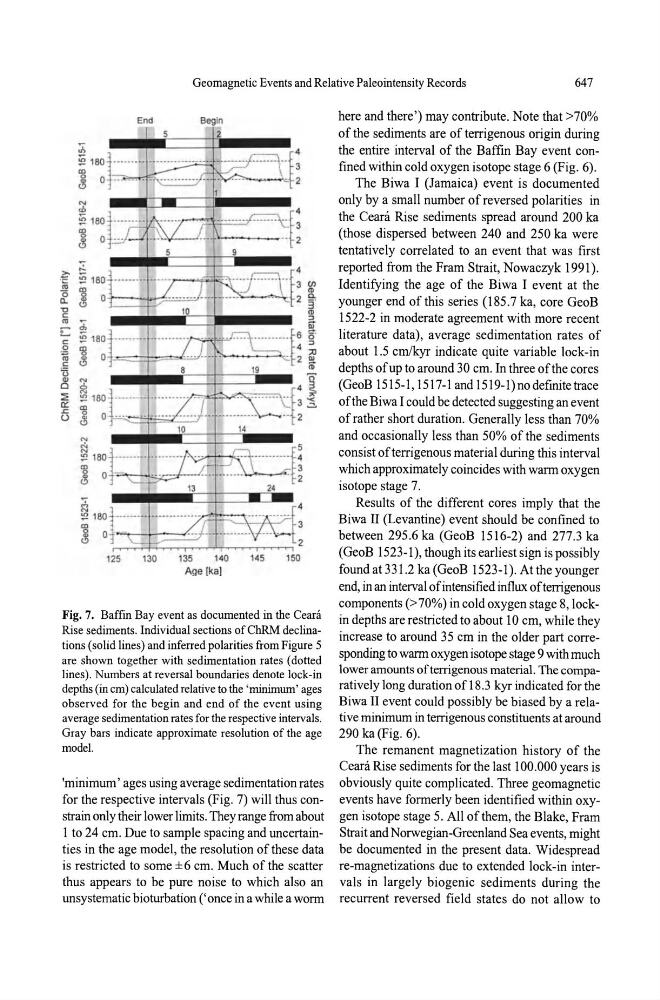
Fig. 7. Baffin Bay event as documented in the Ceara
Rise sediments. Individual sections ofChRM declinations (solid lines) and inferred polarities from Figure 5
are shown together with sedimentation rates (dotted
lines). Numbers at reversal boundaries denote lock-in
depths (in cm) calculated relative to the 'minimum' ages
observed for the begin and end of the event using
average sedimentation rates for the respective intervals.
Gray bars indicate approximate resolution of the age
model.
'minimum' ages using average sedimentation rates
for the respective intervals (Fig. 7) will thus constrain only their lower limits. They range from about
I to 24 cm. Due to sample spacing and uncertainties in the age model, the resolution of these data
is restricted to some ± 6 cm. Much of the scatter
thus appears to be pure noise to which also an
unsystematic bioturbation (' once in a while a worm
here and there') may contribute. Note that >70%
of the sediments are of terrigenous origin during
the entire interval of the Baffin Bay event confined within cold oxygen isotope stage 6 (Fig. 6).
The Biwa I (Jamaica) event is documented
only by a small number of reversed polarities in
the Ceara Rise sediments spread around 200 ka
(those dispersed between 240 and 250 ka were
tentatively correlated to an event that was first
reported from the Fram Strait, Nowaczyk 1991).
Identifying the age of the Biwa I event at the
younger end of this series (185.7 ka, core GeoB
1522-2 in moderate agreement with more recent
literature data), average sedimentation rates of
about 1.5 cm/kyr indicate quite variable lock-in
depths of up to around 30 cm. In three of the cores
(GeoB 1515-1,1517-1 and 1519-1) no definite trace
of the Biwa I could be detected suggesting an event
of rather short duration. Generally less than 70%
and occasionally less than 50% of the sediments
consist of terrigenous material during this interval
which approximately coincides with warm oxygen
isotope stage 7.
Results of the different cores imply that the
Biwa II (Levantine) event should be confined to
between 295.6 ka (GeoB 1516-2) and 277.3 ka
(GeoB 1523-1), though its earliest sign is possibly
found at 331.2 ka (GeoB 1523-1). Atthe younger
end, in an interval of intensified influx ofterrigenous
components (> 70%) in cold oxygen stage 8, lockin depths are restricted to about 10 cm, while they
increase to around 35 cm in the older part corresponding to warm oxygen isotope stage 9 with much
lower amounts of terrigenous material. The comparatively long duration of 18.3 kyr indicated for the
Biwa II event could possibly be biased by a relative minimum in terrigenous constituents at around
290 ka (Fig. 6).
The remanent magnetization history of the
Ceara Rise sediments for the last 100.000 years is
obviously quite complicated. Three geomagnetic
events have formerly been identified within oxygen isotope stage 5. All of them, the Blake, Fram
Strait and Norwegian-Greenland Sea events, might
be documented in the present data. Widespread
re-magnetizations due to extended lock-in intervals in largely biogenic sediments during the
recurrent reversed field states do not allow to