

Geomagnetic Events and Relative Paleointensity Records
641
ever been observed (Fig. 5). Except for generally
very small unstable spurious components, which
probably were imposed during sampling, handling
and/or storage, these and all other normal polarity
sediments from deeper parts of the cores displayed
a uniform, single-component magnetization upon
demagnetization. Samples yielding ChRM declinations of 180 ± 90°, indicating an intermediate to
reversed polarity (i .e., the recording of a geomagnetic event), regularly exhibit two-component
magnetizations. A less stable normal polarity overprint is oriented approximately antiparallel to the
stable ChRM. This secondary component should
be of viscous origin acquired during the prevailing
normal polarity periods of the Brunhes Chron.
As an example for the typical response of
Ceara Rise sediments to progressive AF demagnetization and to illustrate the quality of the paleomagnetic results, Figure 3 shows the downcore
variations in declination of core GeoB 1519-1 . Both
the resultant components after each AF demagnetization step (Fig. 3a) and the corresponding difference components destroyed during each step
(Fig. 3b) are displayed. All data refer to an absolute azimuth (true north) defined from relative
ChRM declinations as explained above. Already
in the original NRM core log, prior to any demagnetization, declinations close to 180° suggest a
recording of reversed polarities in two discrete
intervals at around 250 - 300 and 780 - 800 cm subbottom. At least another three additional horizons
of southerly directed declinations are uncovered
after the first \0 mT demagnetization step. As
evident from the difference component declinations, mainly a normal polarity, presumably viscous
magnetization is erased. The at this stage comparatively 'noisy' record indicates an additional
demagnetization of minor unstable, randomly oriented spurious overprints throughout most the core
(Fig. 3b, first column). Following the demagnetization at 20 mT peak amplitude altogether seven
intervals yield intermediate to reversed declinations.
Without exception these non-normal directions are
established by AF demagnetization up to 70 mT.
The difference component declination records
imply that at least a 35 mT AF demagnetization is
necessary to completely eliminate the viscous normal overprints. The last two demagnetization steps
(50 and 70 mT) give basically identical resultant
and difference component declinations confirming
high-coercive, single-component remanences.
Mostly clear trends towards the origin in Zijderveld
(1967) orthogonal component diagrams further support this interpretation ofthe demagnetization data.
Results
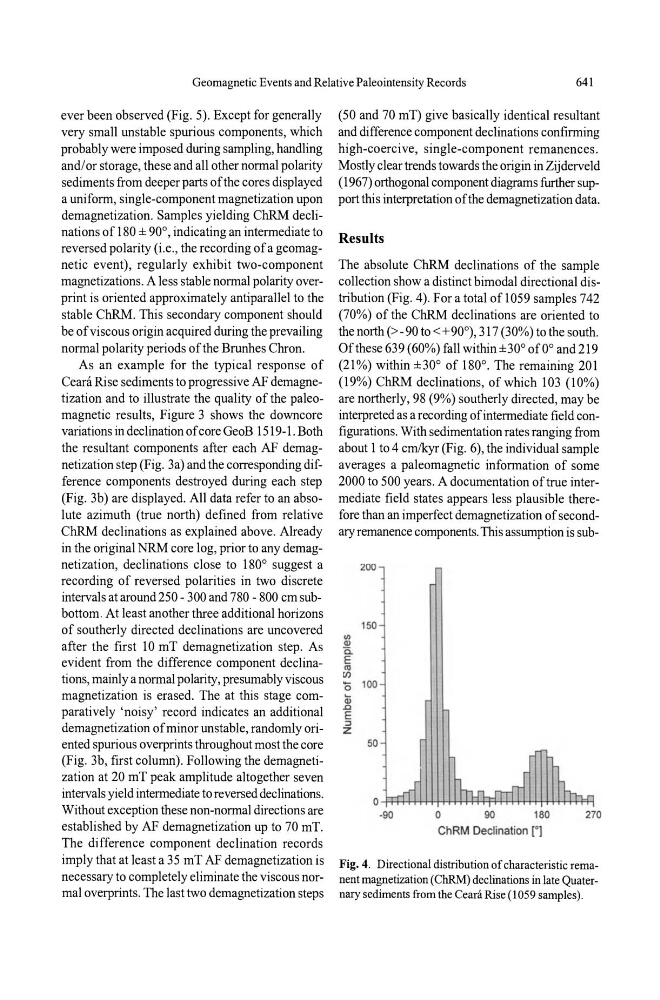
The absolute ChRM declinations of the sample
collection show a distinct bimodal directional distribution (Fig. 4). For a total of 1059 samples 742
(70%) of the ChRM declinations are oriented to
the north (> -90 to < + 90°), 317 (30%) to the south.
Of these 639 (60%) fall within ±30° of 0° and 219
(21%) within ±30° of 180°. The remaining 201
(19%) ChRM declinations, of which 103 (10%)
are northerly, 98 (9%) southerly directed, may be
interpreted as a recording of intermediate field configurations. With sedimentation rates ranging from
about 1 to 4 cmlkyr (Fig. 6), the individual sample
averages a paleomagnetic information of some
2000 to 500 years. A documentation of true intermediate field states appears less plausible therefore than an imperfect demagnetization of secondary remanence components. This assumption is sub200
150
C.
E
01
C/)
-
100
0
Qj
.
:::>
Z
50
o
90
180
270
ChRM Declination [a)
Fig. 4. Directional distribution of characteristic remanent magnetization (ChRM) declinations in late Quaternary sediments from the Ceara Rise (\ 059 samples).