

Geomagnetic Events and Relative Paleointensity Records
637
tion of sediments at the time of their deposition.
Considering the complex processes controlling the
remanence acquisition in sediments, various parameters should be of crucial importance. The magnetic mineral assemblage can efficiently be evaluated by rock magnetic methods. In contrast, it
remains difficult to quantitatively assess other significant factors related to individual sedimentary
regimes, particularly the position and range of the
lock-in zone as function of time and sediment lithology. This depth interval, where the remanent magnetization is ultimately fixed, critically depends on
sedimentation (consolidation) rate, grain-size spectrum of the sediment matrix as well as on bioturbation, all of which may widely vary over time,
not the least due to paleoclimatic and paleoceanographic changes . A most interesting problem to
address, therefore, is whether relative paleointensities are primarily proxies for variations in endogenous (Earth's core) or exogenous (environmental) processes and ifthere may be reasons to even
suggest a link between the two (Kent and Opdyke
1977; Tauxe and Shackleton 1994).
On a broad basis of prime data sets from the
equatorial Atlantic, which for the first time resolve
geomagnetic events in appropriate detail at low
latitude sites and also include paleointensity records,
the present paper is to contribute new concepts to
these topics.
Quaternary Sediments ofthe Ceara Rise
The Ceara Rise, an about 80 Ma old volcanic edifice located approximately 700 kIn to the northeast
of the Amazon river mouth, is draped with thick
series (> 1000 m) of sediments. On cruise M 16/2
of the German research vessel METEOR (Schulz
et al. 1991) the Quaternary deposits were recovered with a gravity corer at nine locations from
water depths between about 3100 and 4600 m on
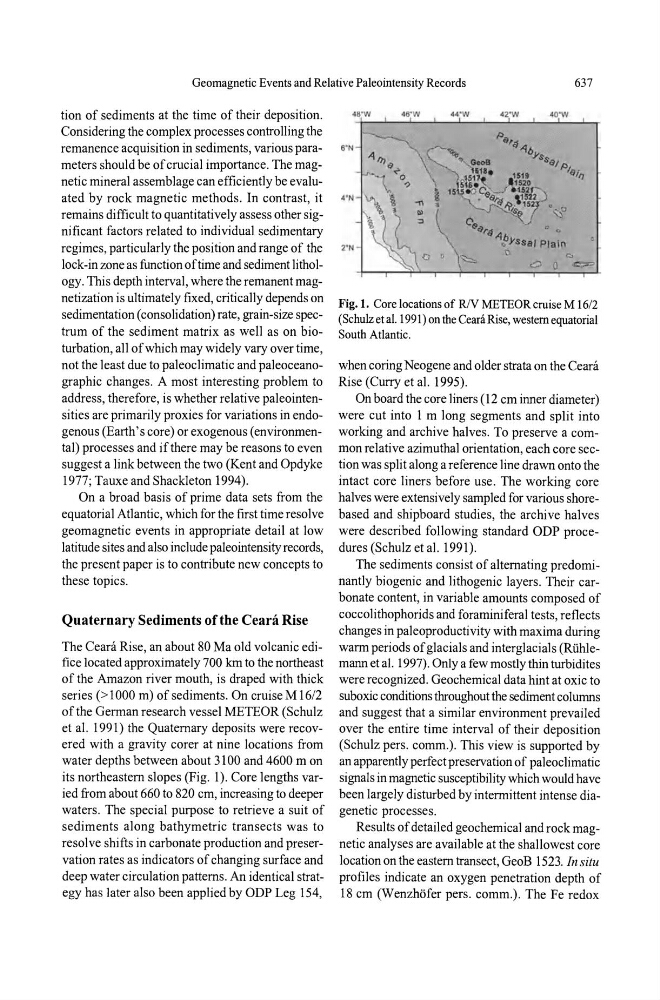
its northeastern slopes (Fig. 1). Core lengths varied from about 660 to 820 cm, increasing to deeper
waters. The special purpose to retrieve a suit of
sediments along bathymetric transects was to
resolve shifts in carbonate production and preservation rates as indicators of changing surface and
deep water circulation patterns. An identical strategy has later also been applied by ODP Leg 154,
"N
2'N
Fig,!. Core locations of RIV METEOR cruise M 16/2
(Schulz et al. 1991) on the Ceara Rise, western equatorial
South Atlantic.
when coring Neogene and older strata on the Ceara
Rise (Curry et al. 1995).
On board the core liners (12 cm inner diameter)
were cut into 1 m long segments and split into
working and archive halves. To preserve a common relative azimuthal orientation, each core section was split along a reference line drawn onto the
intact core liners before use. The working core
halves were extensively sampled for various shorebased and shipboard studies, the archive halves
were described following standard ODP procedures (Schulz et al. 1991).
The sediments consist of alternating predominantly biogenic and lithogenic layers. Their carbonate content, in variable amounts composed of
coccolithophorids and foraminiferal tests, reflects
changes in paleoproductivity with maxima during
warm periods of glacials and interglacials (Riihlemann et aJ. 1997). Only a few mostly thin turbidites
were recognized. Geochemical data hint at oxic to
suboxic conditions throughout the sediment columns
and suggest that a similar environment prevailed
over the entire time interval of their deposition
(Schulz pers. comm.). This view is supported by
an apparently perfect preservation of paleoclimatic
signals in magnetic susceptibility which would have
been largely disturbed by intermittent intense diagenetic processes.
Results of detailed geochemical and rock magnetic analyses are available at the shallowest core
location on the eastern transect, GeoB 1523. In situ
profiles indicate an oxygen penetration depth of
18 cm (Wenzhiifer pers. comm.). The Fe redox