

Using Rock Magnetic Proxy Records for Orbital Tuning and Extended Time Series Analyses
627
· , .. .... ,, '· 11.1 .. .I
I ,
t '
.! . . .. , . .. "
. . .
, ,, , .! .. , , ! . .. '! .. ! I , ,, !. , .. ' ' ' ' ' '
50
Ui
@
b
~ 100
'6' .,
1:: 150
.,
>
§.
'" 200
r]®
'" 20
-35
l
0
~
'"
-40
[L
a::
Cl
-45
0
10
20
30
40
50
60
70
80
90
100
110
Age [ka)
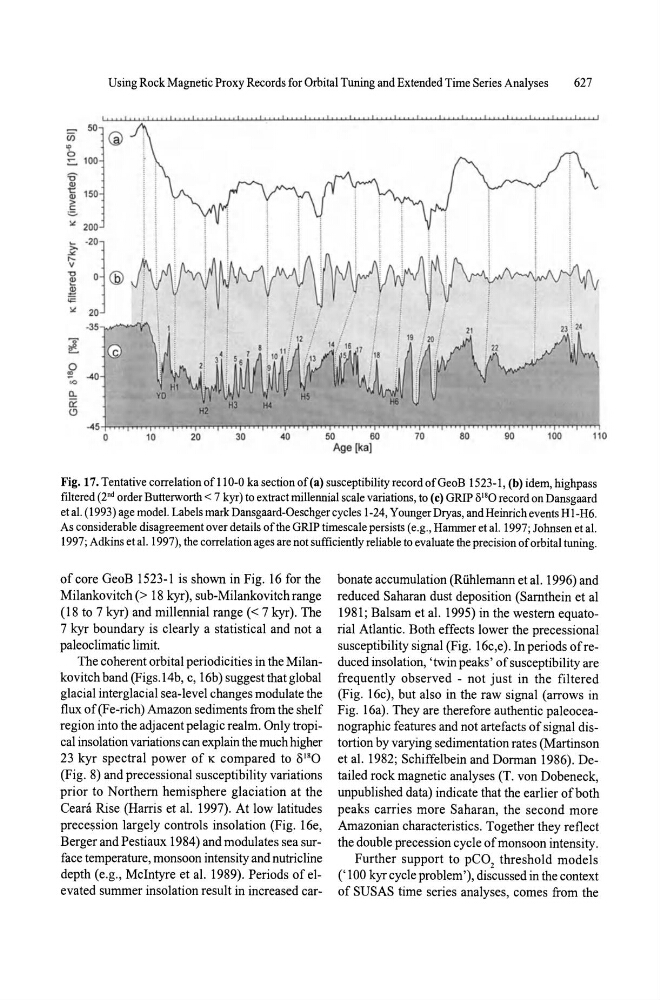
Fig. 17. Tentative correlation of 110-0 ka section of (a) susceptibility record of GeoB 1523-1, (b) idem, highpass
filtered (2 od order Butterworth < 7 kyr) to extract millennial scale variations, to (c) GRIP &1 ' 0 record on Dansgaard
et al. (1993) age model. Labels mark Dansgaard-Oeschger cycles 1-24, Younger Dryas, and Heinrich events H I-H6.
As considerable disagreement over details of the GRIP timescale persists (e.g., Hammer et al. 1997; Johnsen et al.
1997; Adkins et al. 1997), the correlation ages are not sufficiently reliable to evaluate the precision of orbital tuning.
of core GeoB 1523-1 is shown in Fig. 16 for the
Milankovitch (> 18 kyr), sub-Milankovitch range
(18 to 7 kyr) and millennial range « 7 kyr). The
7 kyr boundary is clearly a statistical and not a
paleoclimatic limit.
The coherent orbital periodicities in the Milankovitch band (Figs.14b, c, 16b) suggest that global
glacial interglacial sea-level changes modulate the
flux of (Fe-rich) Amazon sediments from the shelf
region into the adjacent pelagic realm. Only tropical insolation variations can explain the much higher
23 kyr spectral power of K compared to 8 1 ' 0
(Fig. 8) and precessional susceptibility variations
prior to Northern hemisphere glaciation at the
Ceara Rise (Harris et al. 1997). At low latitudes
precession largely controls insolation (Fig. 16e,
Berger and Pestiaux 1984) and modulates sea surface temperature, monsoon intensity and nutricline
depth (e.g., McIntyre et al. 1989). Periods of elevated summer insolation result in increased carbonate accumulation (RUhlemann et al. 1996) and
reduced Saharan dust deposition (Sarnthein et al
1981; Balsam et al. 1995) in the western equatorial Atlantic. Both effects lower the precessional
susceptibility signal (Fig. 16c,e). In periods of reduced insolation, ' twin peaks' of susceptibility are
frequently observed - not just in the filtered
(Fig. l6c), but also in the raw signal (arrows in
Fig. l6a). They are therefore authentic paleoceanographic features and not artefacts of signal distortion by varying sedimentation rates (Martinson
et al. 1982; Schiffelbein and Dorman 1986). Detailed rock magnetic analyses (T. von Dobeneck,
unpublished data) indicate that the earlier of both
peaks carries more Saharan, the second more
Amazonian characteristics. Together they reflect
the double precession cycle of monsoon intensity.
Further support to pC0 2 threshold models
(' 100 kyr cycle problem'), discussed in the context
of SUSAS time series analyses, comes from the