

Using Rock Magnetic Proxy Records for Orbital Tuning and Extended Time Series Analyses
625
Period 500 100 60
40
30 25
1/11
I
1
_J ·_.L_.L
20 18
16 15 14 13 12
11
10
9
I
l , I I, I ! L -,--~-,-1---'_..1..1.L j~
[kyr]
gj
(7)
(7)
::::: ~
§~ :!t
:!t
I
~
;J;
'"
"""
~
~
;: ~
S
f:l
~
S
I
~
'"
+
~
(')
~
~
~
:s
E
lo
E
::r:
r.~ ... ~ •. < ............. jo!.~ ....... -t.'.""-". ~ ........ "'-i-.· ···1 F're 1119
~~~4I~p"b=:_~:::::::::::'I:::~ lnI2l23-1/19
1\0'
Inl 1141-1/23
+1 /19
"-;;~i-""~"·,,,,,,·-·"·+·"·l lnII/19-1/41
~.JI~'~~J~, .. ,..I~····4 olbII/41
~_r''''''~~.···''····IM····''1 I ln11l23·1/41
"':i"H~;'-'I."1 InI 1l41+1/23
~i;,
.1119
... • ....... .,. lnI1l19-1123
= Ecc 11109
i
o
I i I
i
i
,
I
I
I
i
0.1
0.11
0.01
0.02
0.03
0.04
0.05
0.06
0.07
0.08
0.09
Frequency I , [1/kyrj
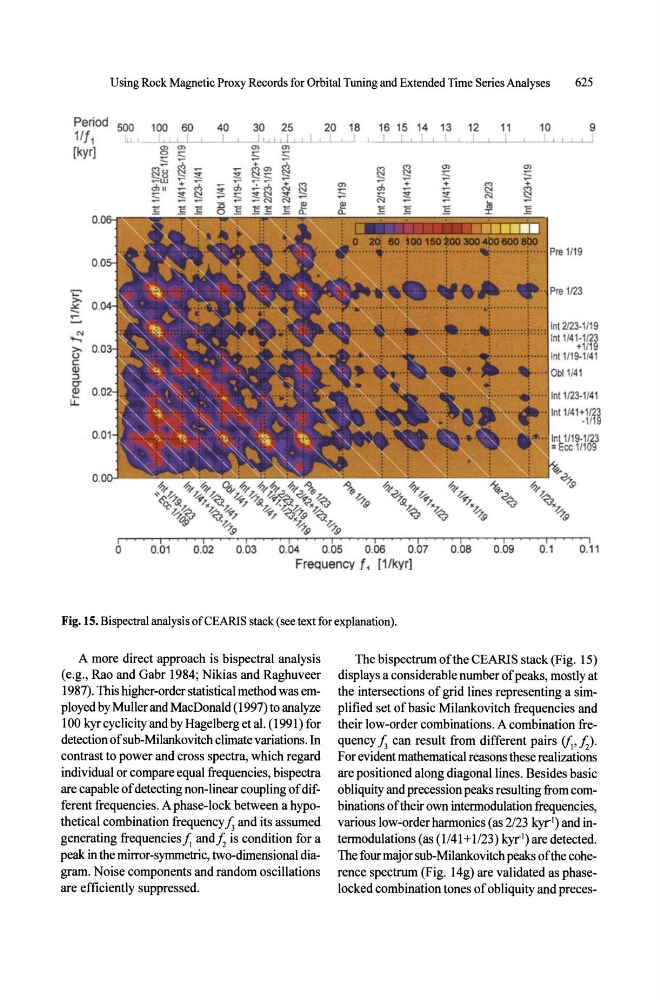
Fig. 15. Bispectral analysis ofCEARIS stack (see text for explanation).
A more direct approach is bispectral analysis
(e.g., Rao and Gabr 1984; Nikias and Raghuveer
1987). This higher-order statistical method was employed by Muller and MacDonald (1997) to analyze
100 kyr cyclicity and by Hagelberg et al. (1991) for
detection of sub-Milankovitch climate variations. In
contrast to power and cross spectra, which regard
individual or compare equal frequencies, bispectra
are capable of detecting non-linear coupling of different frequencies. A phase-lock between a hypothetical combination frequency h and its assumed
generating frequencies J; and 1;, is condition for a
peak in the mirror-symmetric, two-dimensional diagram. Noise components and random oscillations
are efficiently suppressed.
The bispectrum of the CEARIS stack (Fig. 15)
displays a considerable number of peaks, mostly at
the intersections of grid lines representing a simplified set of basic Milankovitch frequencies and
their low-order combinations. A combination frequency h can result from different pairs <1;,1;,).
For evident mathematical reasons these realizations
are positioned along diagonal lines. Besides basic
obliquity and precession peaks resulting from combinations of their own intermodulation frequencies,
various low-order harmonics (as 2/23 kyrl) and intermodulations (as (1141 + 1123) kyrl) are detected.
The four major sub-Milankovitch peaks of the coherence spectrum (Fig. 14g) are validated as phaselocked combination tones of obliquity and preces-