

594
Frederichs et al.
C\I
"
o +---'--'---'--'--'L..-J
2
E 4
.£
..c 6
a. (]) 8
Cl
§ 10
:I::
.8 12
.g 14
(J)
16
18
OJ,
[10-6 Am 2 /kg]
o
o
o
(b)
0
0
Ltl
0
0
~
0
C\I
"
(C)
~
"
0
0
0
0 C\I
"
<0
c:i
c:i c:i c:i c:i c:i
I , I I I I
(d)
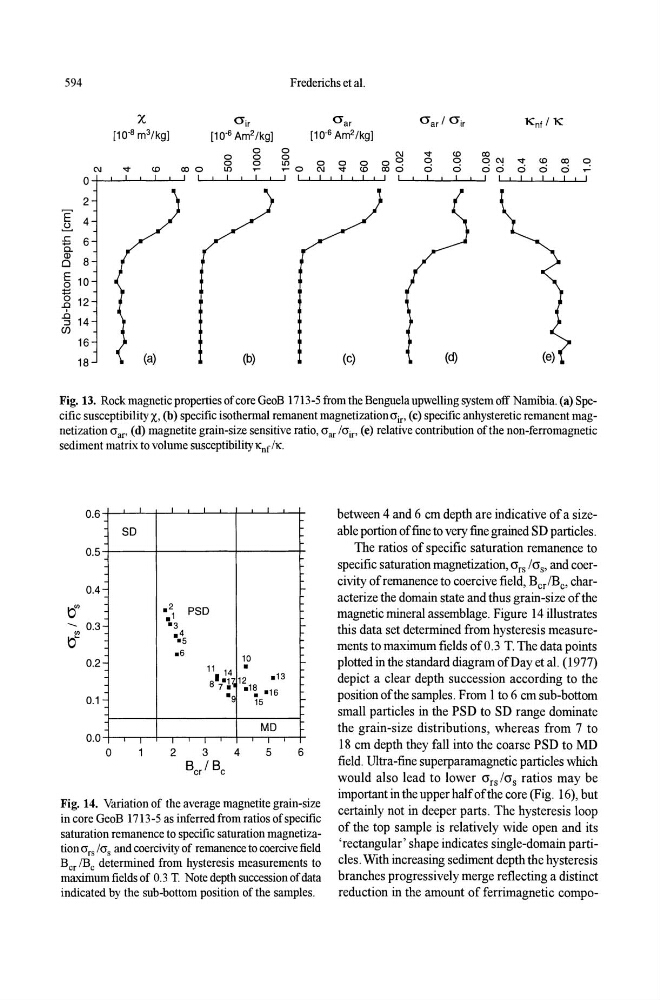
Fig. 13. Rock magnetic properties of core GeoB 1713-5 from the Bengnela upwelling system off Namibia. (a) Specific susceptibility X, (b) specific isothermal remanent magnetization air> (c) specific anhysteretic remanent magnetization (Jar' (d) magnetite grain-size sensitive ratio, (Jar/(Jir, (e) relative contribution of the non-ferromagnetic
sediment matrix to volume susceptibility ~f/K.
0.6
0.5
0.4
\:)(1)
-- 0.3
\:)~
0.2
0.1
0.0
SO
o
.2
.1
·3
.4
·5
.6
PSD
10
11 14 •
8 1 • 1 12
.13
7. .1~ .16
• 15
MO
5
6
Fig. 14. Variation of the average magnetite grain-size
in core GeoB 1713 -5 as inferred from ratios of specific
saturation remanence to specific saturation magnetization (Jrs /(J, and coercivity of remanence to coercive field
BerIB e determined from hysteresis measurements to
maximum fields of 0.3 T. Note depth succession of data
indicated by the sub-bottom position of the samples.
between 4 and 6 em depth are indicative of a sizeable portion of fine to very fine grained SD particles.
The ratios of specific saturation remanence to
specific saturation magnetization, 0rs los, and coercivity of remanence to coercive field, BerlB e , characterize the domain state and thus grain-size of the
magnetic mineral assemblage. Figure 14 illustrates
this data set determined from hysteresis measurements to maximum fields of 0.3 T. The data points
plotted in the standard diagram of Day et al. (1977)
depict a clear depth succession according to the
position of the samples. From 1 to 6 cm sub-bottom
small particles in the PSD to SD range dominate
the grain-size distributions, whereas from 7 to
18 cm depth they fall into the coarse PSD to MD
field. Ultra-fine superparamagnetic particles which
would also lead to lower ors/os ratios may be
important in the upper half of the core (Fig. 16), but
certainly not in deeper parts. The hysteresis loop
of the top sample is relatively wide open and its
'rectangular' shape indicates single-domain particles. With increasing sediment depth the hysteresis
branches progressively merge reflecting a distinct
reduction in the amount of ferrimagnetic compo-