

U5
'" b
'0'
2
~
£> 0
'it:>
c...
<:{
~
-2
<..>
w
-
N -
c...
.,..; NM
C/)
i
i I
0
The Magnetic View on the Marine Paleoenvironment
(") (\II
..... (\1 t"')"It
U') N ('f'):t
I.t) CD ..... N M "It U') C\tM '¢
U') <0 .... N (") C\f
~
M.q arill'i u;u; Lri cD
I I I i I I I
I I
i I
50
100
150
200
250
300
350
400
Age [ka) and S 18 0 Stages
2
~
E Q)
I
589
~
C/)Q)
- .~
a>
;;:: Cl
o <11
jg~
5
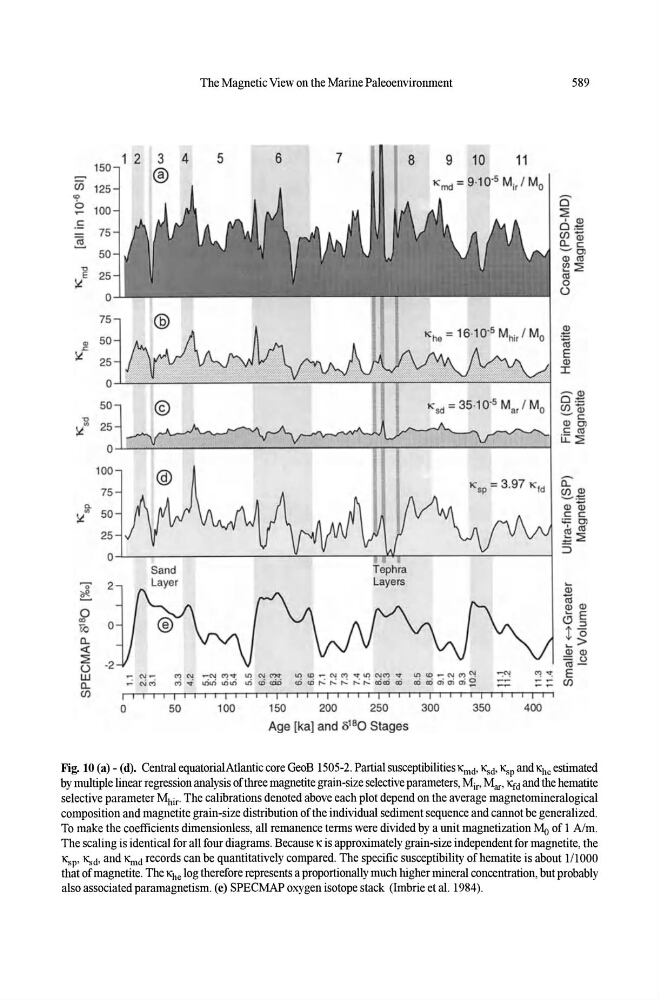
Fig. 10 (a) - (d). Central equatorial Atlantic core GeoB 1505-2. Partial susceptibilities Kmd, Ksd, Ks p and Khe estimated
by multiple linear regression analysis of three magnetite grain-size selective parameters, Mir M",., Kfd and the hematite
selective parameter M hir . The calibrations denoted above each plot depend on the average magnetomineralogical
composition and magnetite grain-size distribution of the individual sediment sequence and cannot be generalized.
To make the coefficients dimensionless, all remanence terms were divided by a unit magnetization 110 of 1 AIm.
The scaling is identical for all four diagrams. Because K is approximately grain-size independent for magnetite, the
Ksp, Ksd, and Kmd records can be quantitatively compared. The specific susceptibility of hematite is about 111000
that of magnetite. The Khe log therefore represents a proportionally much higher mineral concentration, but probably
also associated paramagnetism. (e) SPECMAP oxygen isotope stack (Imbrie et al. 1984).