

576
Frederichs et aI.
Origin
Source
Products
Pathways
cosmic - - extraterrestrial
meteorites _ _ _ _ -It-""-stratosphere
,
-imicrotektites
cosmic spherules ~
-t
glObal volcanic ash
- {
continental
pyroclastic ejecta
soil
bedrock - - -----1
lithogenic
industrial particulates
eolian---I
fluvial - - - I
glacial-----t
surface currents
~
deep water currents
t
hYdroth~rmal produ~ts
turbidites
submarinesubmanne pyroclasllcs
nepheloid la ers
weathered ocean basalts
y
biogenic - - authigenic _ _ _ -f[magnetosomes ---"'--~
extracellular magnetite
. - - - - - - - - - - - - - - - - - - -- - - ----t+deposition-----,r-----'
resuspension
diagenetic -
authigenic - - - - iron sulfides - - - --.....J... bioturbation
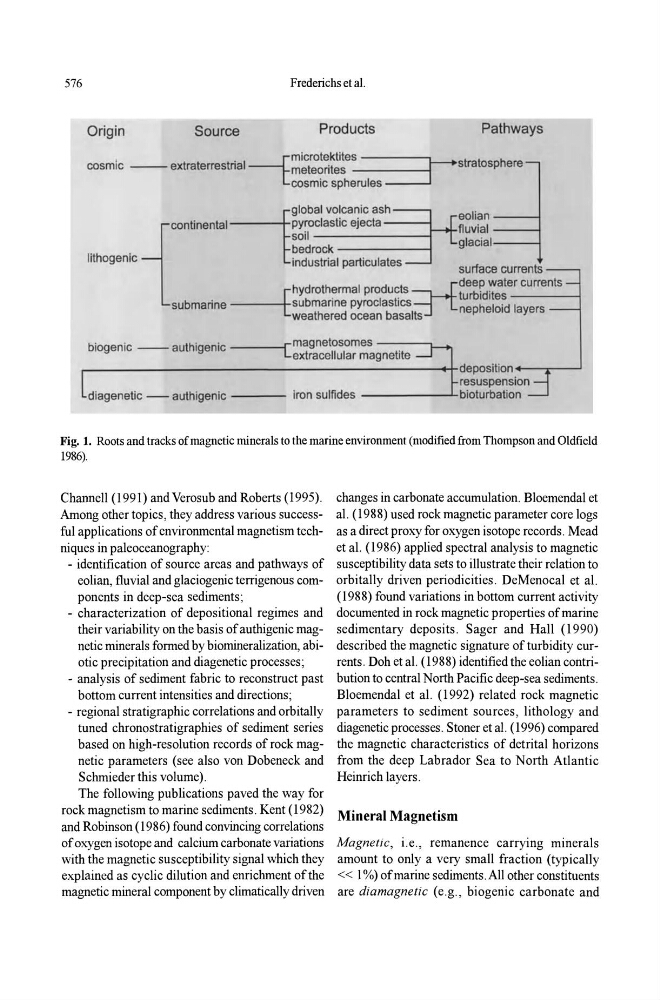
Fig. 1. Roots and tracks of magnetic minerals to the marine environment (modified from Thompson and Oldfield
1986).
Channell (1991) and Verosub and Roberts (1995).
Among other topics, they address various successful applications of environmental magnetism techniques in paleoceanography:
- identification of source areas and pathways of
eolian, fluvial and glaciogenic terrigenous components in deep-sea sediments;
- characterization of depositional regimes and
their variability on the basis of authigenic magnetic minerals formed by biomineralization, abiotic precipitation and diagenetic processes;
- analysis of sediment fabric to reconstruct past
bottom current intensities and directions;
- regional stratigraphic correlations and orbitally
tuned chronostratigraphies of sediment series
based on high-resolution records of rock magnetic parameters (see also von Dobeneck and
Schmieder this volume).
The following publications paved the way for
rock magnetism to marine sediments. Kent (1982)
and Robinson (1986) found convincing correlations
of oxygen isotope and calcium carbonate variations
with the magnetic susceptibility signal which they
explained as cyclic dilution and enrichment ofthe
magnetic mineral component by climatically driven
changes in carbonate accumulation. Bloemendal et
al. (1988) used rock magnetic parameter core logs
as a direct proxy for oxygen isotope records. Mead
et al. (1986) applied spectral analysis to magnetic
susceptibility data sets to illustrate their relation to
orbitally driven periodicities. DeMenocal et al.
(1988) found variations in bottom current activity
documented in rock magnetic properties of marine
sedimentary deposits. Sager and Hall (1990)
described the magnetic signature of turbidity currents. Doh et al. (1988) identified the eolian contribution to central North Pacific deep-sea sediments.
Bloemendal et al. (1992) related rock magnetic
parameters to sediment sources , lithology and
diagenetic processes. Stoner et al. (1996) compared
the magnetic characteristics of detrital horizons
from the deep Labrador Sea to North Atlantic
Heinrich layers.
Mineral Magnetism
Magnetic, i.e., remanence carrying minerals
amount to only a very small fraction (typically
« 1 %) of marine sediments. All other constituents
are diamagnetic (e.g., biogenic carbonate and